The Cubs have had a bevy of famous double play combinations throughout their long and sometimes storied history. Of course, there's the poetic trio of Hall of Famers, Tinker to Evers to Chance - "a trio of bear Cubs fleeter than birds" and all that jazz. Then, several decades later, the 1960's brought us the all All-Star infield powered by Kessinger to Beckert to Banks, who got oh-so-close to breaking the Cubs streak of futility. Further still, the teams of the 80's and 90's had people passing through the turnstiles to see Dunston to Sandberg to Grace; you'd think they'd have done better than one playoff appearance with that slick-fielding bunch. All in all, the franchise has managed to put together some decent infields over the years.
As notable as those combos were, there's yet another that earned a fair bit of attention during the time they were together. In the 1950's, advanced scouting reports chattered all about Smalley to Terwilliger to... the right field stands!
The Cubs teams of the 1950's were always stuffed to the gills with young potentials that could never put it all together at the same time, only once reaching the .500 mark in '52 (77-77). Like many Cubs prospects at this time, both Roy Smalley and Wayne Terwilliger eventually went on to have long and productive careers as role players. However, when the two first came up, the young firebrands could hardly control their throwing arms, earning their infamous DP branding. For instance, in 1950, Smalley was charged with 51 errors at shortstop while Terwilliger added 24 more from second base. First baseman, Dee Fondy, was probably the most well stretched out man in professional sports!
While Smalley stayed in Chicago for most of his playing days, Wayne Terwilliger ventured out to far greener pastures. In a professional baseball career that extended through eight decades and began when Harry Truman occupied the White House, "Twig" backed up Jackie Robinson in Brooklyn, won a pair of World Series rings as a coach in Minnesota, and stayed active as a manager and/or coach in the minor and independent leagues until well into the Barack Obama administration. Talk about longevity!
In fact, at the time the old second baseman was hired to manage the Fort Worth Cats in 2003, he became the oldest manager in minor-league history at age 77. After three years at the helm of the United Baseball League club, he would wrap up his 62-year baseball career at the Cats' first base coach in 2010.
To really hammer home the point, take a look at his rookie and sunset cards, side by side. I don't have either of these (though I really wouldn't mind tracking them down), so thanks to the Trading Card Database for the scans!
It should also be noted that prior to making it with the Cubs, Terwilliger
joined the United States Marine Corps and fought in the Pacific Theater
during World War II. A couple of the more famous conflicts in which
Terwilliger fought include the Battle of Saipan (as a tank operator) and
the immortalized Battle of Iwo Jima. While he may have had an
interesting career on the diamond, he was a certified hero off of it.
With that, it grieves me to say that, yesterday, the 95-year old
baseball lifer left this mortal coil. At the time of his death, the
near-centenarian was the oldest living former Chicago Cub, a title which
he now passes onto short-term reliever, Bobby Shantz, who is a scant three months younger than "Twig."
Shantz's brief tenure in Chicago was measured in months, so no Cubs card exists of the man. This Fleer Greats of the Game single has repped the now eldest statesman of the franchise in my Cubs All-Time Roster Collection binder since I pulled from a pack at CVS in 2005.
Speaking of cardboard representation, as of now, Wayne Terwilliger is represented in my CATRC by the Card Collector's Company (CCC) reprint you saw earlier in this post. Yea, unfortunately it's not a true 1951 Bowman and rather a reprint from the late 1980's. While the reprint is fairly high-quality, a man of his intrigue deserves to be repped by the real deal. Here's hoping that I can track down a more deserving card of Twiggy in the near future.
Terwilliger may have been part of perhaps the most infamous double play combination in Cubs' history, thanks to his live-arm, but he ended up contributing so much more to the game and to the world at large.
While Wrigley Roster Jenga was on extended holiday, I was grieved to discover that Mr. Carl Aldana had passed away. Apparently, he had ventured on into the next realm early in 2019; however, I did not hear about his death until a year and a half later, in the middle of my blogging hiatus. Thus, quite unfortunately, I have never had the chance to post a proper tribute to the artist, being that I am both slow on the uptake and prone to long disappearances. Now, almost two years later, please allow me to rectify this grave injustice.
For those who are not familiar with the name Carl Aldana, he was born in Guatemala in 1938 and, as a child, immigrated to the United States his family shortly thereafter. Carl eventually picked up a watercolor brush as a freelance designer in the mid-60's and went on to become renowned throughout his adoptive home state of California for his portrait, landscape and cityscape painting. Furthermore, his artistic endeavors were not limited to still frames, as he also worked in the art department for over thirty big-budget Hollywood films, including serving as the art director for Air Force One. Some other movies that you might have seen his work in include Ferris Bueller's Day Off, The Best Little Whorehouse in Texas, and Pleasantville, among several others choice moving pictures. All in all, I'd say that's not a bad resume for a working artist.
But what does any of this have to do with Wrigley Roster Jenga's topic of interest, baseball cards? Well, you see, when Carl wasn't cleaning his brushes or going Hollywood, the avid creator was also designing his own baseball cards.
In fact, it's rather likely that you have read about his vintage, broder-adjacent sets in your Standard Catalog of Vintage Baseball Cards or seen them at a vender booth at a card show. In 1970, he made his pasteboard debut by producing a 12-card checklist paying tribute to the Baltimore Orioles and he followed that up with a 16-card offering featuring a smattering of players from across baseball. Both of these products are listed in the aforementioned Standard Catalog; that said, those guys neglect to mention his 1972 love-letter to the Pacific Coast League's San Francisco Seals of the early 50's, an 18-card set that cast the spotlight on a league and team that he saw plenty of as a Cali kid of the time.
Some examples of Carl's vintage output, culled from Ebay listings as I possess none of these oddballs.
I'm not quite sure how this baseball artiste distributed his handiwork. Perhaps he made use of mail order in early trade publications, a la Renato Galasso? Maybe he sold them at some of the hobby's first card shows? Heck, it could be possible that these were just a passion project that ended up on the second hand market. Does anyone out there know anything information that could help fill in this gap?
Questions about distribution aside, no matter what, we know that Mr. Aldana was a fan of the game and of the PCL, as both showed up in his work on canvas and cardboard. However, after the three outsider art card offerings that we detailed above, Mr. Aldana disappeared from the trading card scene for the next 40+ years, no doubt focused on his much more lucrative film and artwork projects throughout the ensuing decades.
Apparently, the itch never completely went away though, as a few years ago, Mr. Aldana burst back onto the hobby scene. He went back to the well again and came back with a series of sets paying tribute to his beloved Pacific Coast League. These art cards mimicked the style of the old Mother's Cookies sets of the mid-20th century, but featured a wider swath of players and made use of new colorizations performed by the artist in question. It's hard to get a full, documented scope of these releases, as they are quite prodigious in number and were released rather haphazardly (via single listings on the Ebay, I'm pretty sure) throughout the years - just search "Aldana PCL" on the 'Bay and you'll find a couple hundred different listings. Obviously, Carl was back with a vengeance and making up for a lot of lost time!
Back in 2017, I first came across these Aldana revival cards while perusing my saved Ebay searches. With such a diverse checklist of obscure and fringe minor league baseball players, this discovery got my blood pumping. As I had expected, digging into these oddities uncovered a new, fertile source for War Era randos that I still needed for my Cubs All-Time Roster Collection - the most cherished collation of my baseball card collection. So, of course, I added a selection of these beauties to my cart and crossed a few names off of my "needs" list that I was beginning to think would never be acquired.
In posting about the Jim Adair (briefly with the Cubs in 1931) single you see above, I received quite the unexpected thrill when Carl Aldana himself commented on my humble little blog, reaching out to talk turkey about baseball cards. Granted, he was no Cy Berger, but this accomplished artist, film maker, and baseball card creator was putting his digital signature on my web space and wanted to talk to me about his work? As if that wasn't enough of a thrill, after our conversation, he also sent me the Steve Bilko beauty that you see above as a "thanks for your great blog on my cards."
Three years later, this connection still ranks as one of the coolest moments of my time as a blogger.
Unfortunately, we lost touch after that dialogue and I was grieved when I discovered that Carl had passed away not-so-long after we spoke. At 81, he lived a creative life full of excitement, flashy colors, film sets, and glitz behind the lens and behind the canvas that I can only dream about. At least he didn't have to see what the world has become just a couple years later.
The man was important enough to receive a tribute from the Oscars and he still took the time to talk to this amateurish writer.
At this point, we're several paragraphs deep and I have yet to explain how I came to find out about Carl's death or describe the significance of the card which leads off this post. As you can tell from the central concept of this post, I have a recurring problem with tardiness. Let me clarify.
I was on Ebay on day back in the throes of the early days of the pandemic, scrolling through listings in order to kill some time while isolating to "flatten the curve." Despite my boredom, my attitude perked up when I came across a cache of Aldana PCL cards that I had not seen before - a whole set of cards patterned around the Los Angeles Angels of 1947. This was especially exhilarating to me because the original LA Angels were the top affiliate of my beloved Chicago Cubs at that time, meaning that the checklist contained a healthy sampling of fringe guys who became well acquainted with the travel schedules between the City of Angels and the City of Wind, guys who did not have much of a cardboard footprint because of their decidedly non-star status in the pre-Topps era.
To put it succinctly, pay dirt for my CATRC binder! This is evidenced by the set ledger found on the card backs:
Besides Marv Felderman, Bill Fleming, Cecil Garriott, Russ Bauers, Bukk Schuster, and Johnny Ostrowski would also make welcome new additions to my CATRC tome. Like I said, this soil is fertile.
In the grand scheme of the game, Marv Felderman is not a significant figure. Of course, that doesn't mean he wasn't notable in his own way. "Coonie" was a catcher who suffered from chronic injuries, but still managed to work his way up the ladder, thanks to his skills behind the dish. In 1942, he broke into the Bigs with the Cubs, but was only able to get into three games and take seven measly plate appearances. This was mostly due to the fact that, upon breaking camp with the club, he flubbed a play in extra innings that choked away a potential win and was immediately sent down. Back in the bushes, Felderman injured his finger and struggled, only earning his way back to Chicago late that season through the team's dismal performance and lack of other backstop options.
After the '42 season, Felderman joined a different kind of campaign and enlisted in the Navy, as there was a little skirmish going on at the time that you might have heard about. Marv was stationed in Hawaii, at Kaneohe Bay Naval Air Station, and regularly plied his talents on the diamond for their baseball team, eventually playing in the 1945 Navy World Series in Hawaii.
Felderman with the Cubs in 1942 (left) and with the US Navy's Kaneohe Klippers in 1944.
Not so long after that World Series, Felderman was discharged from the service and was able to watch a different World Series. The Cubs were taking on the Tigers in that year's fall classic and the club invited their former catcher to take in the festivities from their box seats. Upon the Series' conclusion (and you know how that went for Chicago), the players even voted Felderman a partial share of their pennant purse.
Come 1946, Marv was one of hundreds of pro ball players attempting to make a comeback upon the conclusion of World War II and found himself back in the PCL. By 1947, he was back with the Cubs organization, laboring for a second trial in the National League with the Angels, as the Aldana card illustrates. I've seen it reported that he was called up near the end of the season once again, but he did not appear in a boxscore and I cannot find any contemporary sources to confirm. Either way, Felderman continued to chase his dream in the minor league and semi-pro ranks through at least 1951, without ever getting a second chance.
It was in conducting this research on Marv Felderman's baseball career that I discovered Carl Aldana's passing. Ever the prodigious artist, thebaseballhobbyist (with whom Carl used to work directly) continues to list pieces of Carl's art card portfolio for sale to this day. I'm definitely tempted to grab myself a few more and encourage you to do the same - these colorful oddballs would look great in anyone's baseball card collection!
At any rate, it's time to wrap this up. Carl, sorry it took me so long to pay proper tribute, but thank you for your wonderful art and film work, for creating some of the most fun outsider baseball cards ever produced, and for being so generous and communicative with this random, blathering blogger. Your creative output is something to behold and I am ever thankful to have some pieces of it nestled safely in my binders.
R.I.P. Carl Aldana. To close, here's a short video showcasing some of his watercolor work, specifically impressions of a visit made to the home of the Cubs, Chicago:
One week ago today, the sports world was rocked by the death of Kobe Bryant and understandably so. The Black Mamba was certainly one of the true greats of his profession, was equally beloved by fans, and was cut down at an age far too young, with a daughter who barely had time to live. All in all, it was a devastating situation that truly makes one take a step back and think.
Now, I've never been a huge basketball fan - my interest in the sport died when Michael Jordan retired (the second time) and, even before then, it was casual at best. Thus, tragic though Bryant's sudden death was, it didn't affect me the same way it did a lot of my peers. When news dropped about the accident, my wife and I were at a baby shower and the festivities ground to a halt. I was sad to hear about the loss of life, but I didn't feel as personally attached to Bryant as did many of those party guests and other sports fans across the world. That's not to say that I wasn't grieved by the loss of life - I'm not a monster - but I've just never paid all that much attention to Kobe's sport of choice.
However, just a few days later, there was another loss in the world of athletics that I felt on a much more personal level.
I maintain a small collection of NASCAR cards and I am passively working on obtaining one for each driver who has one. This card of John came paired with a 1:64 die-cast model of his #43 Cheerios Dodge that was released by Hot Wheels in (I believe 2002). That toy car has long since disappeared, but this card remains in my binders. Once a relic of my childhood, it now holds a more poignant significance.
On the following Thursday, it was announced that veteran racer, John Andretti, had lost his battle with colon cancer and passed away at the age of 56. Andretti, of course, hails from the most famous racing clan in the history of motorsport and, like his uncle Mario, he was one of the most versatile competitors of his generation. During the halcyon days of my NASCAR fandom, John was a fixture on the circuit as the pilot of one of the most famous cars in the game, driving the famous blue #43 for Richard Petty. Two family dynasties working together under one roof, it was almost poetic.
Seeing as Petty was and is my favorite driver in the history of stock car racing, I naturally rooted for John every weekend. While he was never a front runner, he was able to get a couple of wins under his belt before the NASCAR phase of his career ended in the mid-aughts. However, that did not mark the end of his time behind the wheel.
Like I said, Andretti was a versatile driver. Once he was done in stocks, he simply pivoted.
John Andretti returned to the circuit which provided him his first break into the big leagues of auto racing - Indy Car. In fact, he even brought the legendary blue #43 over with him for a couple of years, in a partnership between Richard Petty Motorsports and Andretti Autosport, as exemplified by this picture I snapped during Indy 500 time trials in 2009. If you'll permit me a humble brag, I'm impressed I was able to capture such a crisp, clear image of an Indy Car, at speed, with a simple Canon Powershot.
Of course, the Andretti name is synonymous with open wheel racing, so it was a natural move. Not to mention, John's biggest claim to fame is when, in 1994, he became the first man to attempt "The Double" - competing in the Indianapolis 500 and NASCAR's Coke 600 in the same day. That's 1,100 miles in just one day, split between Indy and Charlotte, NC - only a handful of brave souls have even entertained the thought. Even before that, John had been a regular on the Indy Car (then sanctioned by CART) circuit throughout the late 80's/early 90's, even notching a win in '91 at Queensland.
His return to the open wheel ranks was not earth shattering, but I was irrationally excited to see him show up at the Brickyard from 2007-11. After I began to grow tired of NASCAR, like John, I too pivoted to Indy Car and have been present for Indy 500 time trials nearly every year since 2003. seeing a name from the early days of my auto racing fandom show up in my new preferred discipline was a nostalgic thrill.
This is John during Indy time trials in 2006, driving for Marty Roth and a year before partnering back up with Petty.
Beyond NASCAR and Indy Car, John also competed in NHRA drag racers, USAC midgets, and sports cars. Also, besides his famed double, he's also the only person to have ever competed in a NHRA, Indy Car, and NASCAR event during the same season. Plus, he's had the opportunity to compete in three of the crown jewels of the entire the racing scene - the Indianapolis 500, the Daytona 500, and the 24 Hours of Le Mans - as well. Needless to say, John Andretti's racing career was full of intrigue.
Off the track, Andretti was well-liked and well-respected in the garage area of whatever track he happened to be competing at in a given weekend. Furthermore, he spent a great deal of time volunteering with charities, both with the Petty Victory Junction Gang camp and for Riley Children's Hospital through his own initiative, Race 4 Riley.
In short, the sudden loss of John Andretti hit me pretty hard, as I had followed his career with great interest since the earliest days of my auto racing fandom. it's never easy to see one of your childhood heroes pass on, whether they make larger than life dunks on the hardwood or guide sleek machines 200 miles per hour through a curve. In the end, it's important that we appreciate our brief time on this earth, as you never know when it's going to end, no matter if you're a random sports card blogger or among the greatest athletes of all time.
Yesterday, word began to leak to the press that longtime former manager and coach, Frank Lucchesi, had passed away. On Saturday, the 92-year old baseball lifer died from unspecified causes in the Dallas area.
Mr. Lucchesi began his career in professional baseball way back in 1945 when he first suited up for the Portland Beavers of the Pacific Coast League at a spy 18 years old. He would spend the next 13 seasons plying his trade in the bushes, but he would never reach the ultimate peak as a player. After he officially hung up his cleats in 1957, Frank grabbed a clipboard and took to coaching. For thirty-one years, the wry veteran would pass on his knowledge and lead baseball clubs up and down the professional baseball ladder.
On the Major League side, Frank Lucchesi is best remembered for his stint as skipper for the Philadelphia Phillies and his tumultuous time at the helm for the Texas Rangers. For the former, he is most notable for leading the team in their last contest at old Connie Mack Stadium and their first at Veterans Stadium. Otherwise, this team in transition didn't provide many highlights for his resume.
On the other hand, for the latter, Frank succeeded the embattled and controversial Billy Martin only to get punched out by his own second baseman, Lenny Randle, in a dispute about playing time in 1977. Randle was upset with losing time at the keystone to rookie, Bump Wills, and his anger eventually boiled over. The strike wasn't a glancing blow either, as the punch caused a fractured cheekbone, a concussion, and a busted lip. Afterwards, Frank would soon find himself demoted back to a coaching role and embroiled in a lawsuit against his former middle infielder, who was immediately suspended and then sent packing.
All in all, Frank Lucchesi managed for seven years in the Majors, with a career record of 316-399 for three different clubs.
Both Lenny and Bump would eventually end up with the Cubs, though - thankfully - not at the same time.
That's right, three. It's easy to forget (and maybe you never even knew), but Frank once again donned an MLB uniform in 1987, a full decade after his last managerial job. After the future Yankees General Manager and dynasty architect, Gene Michael, voluntarily stepped aside as manager in the waning days of the 1987 season, the Cubs found themselves needing an experienced fill-in on short notice. You see, there were several candidates on the coaching staff who were raring to go, but GM Dallas Green did not want to throw any of them into the fire. After all, the Cubs had already entered a death spiral after looking competitive in the early summer - no one was going to look good at the front of that train wreck. It was best to put off the search until the off-season.
Green turned to his friend Lucchesi, who Dallas had know since working in the Phillie front office in the early 70's. Frank had been serving the Cubs as a scout, but Dallas needed someone he could trust to steer his team through a rough transition. The expectations were nil - basically just get through the end of the calendar and evaluate the state of the roster. In this interim role, Frank led the club to a 8-17 record before going on his merry way (without fisticuffs) at the end of the campaign. As for the future, Lucchesi himself told the press that he would not seek and was not a candidate for the regular job.
For 1988, out of a pool of hopefuls which included Billy Williams, John Vukovich, and Johnny Oates, Don Zimmer was promoted from third base coach to take over the young roster, planting the seeds for the "Boys of Zimmer." Perhaps Lucchesi's evaluations at the tail end of the '87 season helped shaped the club that would surprise everyone by winning the National League East crown in 1989?
Despite the acknowledged temporary nature of his role, which lasted for just 25 games at the end of a lost season, Frank Lucchesi managed to sneak into the checklist of 1988 Topps in a Cubs uniform. The announcement of Popeye's succession into the manager's chair must have been made too late to include him in the set and Topps needed a face for the front of the Lovable Losers' checklist. At any rate, I'm thrilled about that development, seeing as it's a minor miracle that Frank Lucchesi has a true, Cubbie Blue card for my Cubs All-Time Roster Collection with his brief and unremarkable Chicago tenure.
Brevity aside, a Cub is a Cub no mater how long they called Wrigley Field home. With that in mind, on behalf of Cubs fans everywhere, I say thank you, Mr. Lucchesi, for stepping up when the North Siders needed you in 1987 and thank you for dedicating your life to America's pastime.
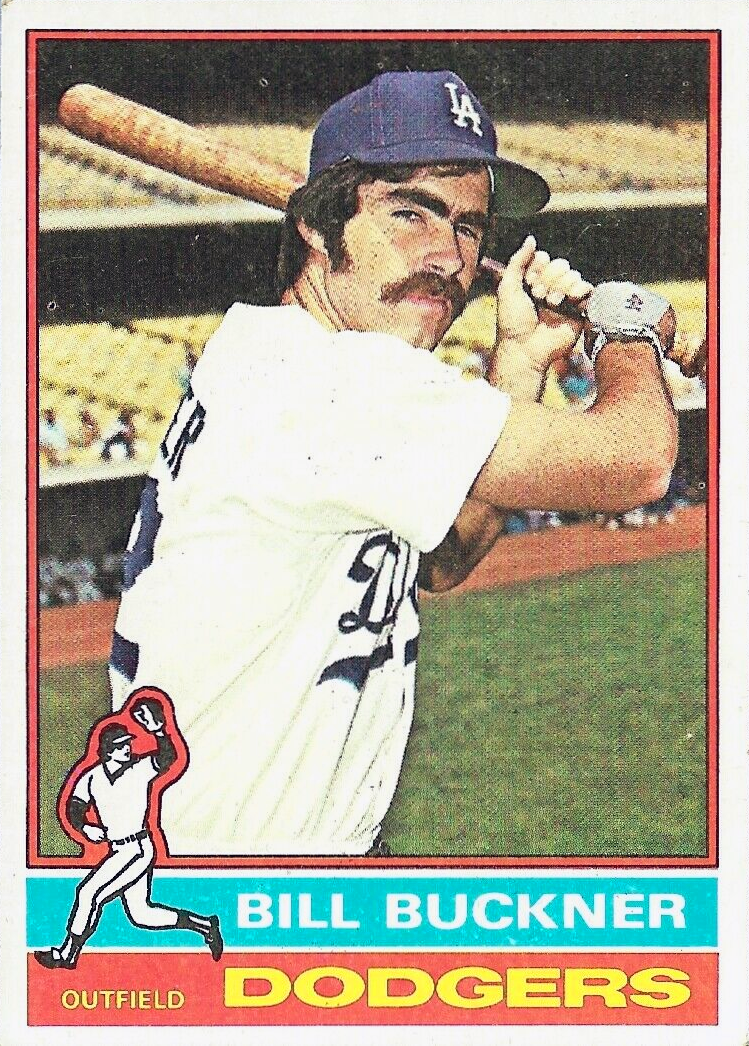
Yesterday, just before the start of the Cubs' marquee series with the juggernaut Houston Astros, word began to trickle throughout social media that former All-Star first baseman, Bill Buckner, had suddenly passed away at the age of 69. Apparently, the 22-year Major League veteran had been undergoing a previously unannounced battle with Lewy Body Dementia, a debilitating disease which attacks both the mind and the body at the same time. It would have been nice for the Cubbies to go out and win one for one of their all-time great first-sackers; however, that was not meant to be.
Buckner's career was one of just a handful to span from the 1960's through the 1990's and thus made an impact on multiple generations of baseball fans. To some, including our vaunted Night Owl, Buck will forever be the slow-footed, corner outfielder on some powerhouse Dodger teams, making a World Series appearance in 1974 and a futile attempt to climb the fence and catch Hank Aaron's 715th homer. To other people, he'll be the poor, unfortunate soul who had a momentary lapse in concentration, which lead to perhaps the most famous misplay in the game's history, as a Red Sox. To still others, he'll be remembered for his legendary plate discipline - the guy NEVER struck out three times in a single game. How unfathomable is that, especially looking back today? But, regardless, due to his ability and longevity, Bill left a mark on our favorite pastime's legacy that will never be forgotten.
To me, while I wasn't to enter into this realm of existence until half a decade after his being traded away, Mr. Buckner will always be a Cub. After all, during his eight years in the Windy City, the man won himself the 1980 National League batting title (.324), made his only All-Star appearance (1981), hit an even .300 in blue pinstripes, and made a cameo appearance on the franchise's first playoff-bound club, as Steve Goodman once penned, "since we dropped the bomb on Japan." Billy Buck was so tied to the team that during the press conference to announce his trade to Boston, the usually stoic ballplayer shed a few tears while speaking into the microphone. As part of a franchise with a strong lineage of first baseman, from Cap Anson to Anthony Rizzo, Buckner was one of the all-time standouts at the position.
As part of this tribute, I originally planned to include a countdown of my favorite Bucky cards. Unfortunately, except for those appearing in this post, I was unable to find any of them... which is quite odd because I know I have ton of his singles, owing to the fact that he was a semi-star who played throughout the "junk wax era." That being said, at least the exception happens to be an exceptional car:
This 2012 Topps Archives Fan Favorites autograph admirably serves as Bill's representation in my Cubs All-Time Roster Collection. The clean and powerful follow through on what was likely a well-swatted double, the blue ink signature, the powder blue, "pajama" uniform kit, Buck's glorious mustache and the personal favorite 1982 Topps design are all factors that add up to an A+ grade in my eyes. This is certainly a special card that I will now treasure all the more.
This piece of cardboard gold was a generous gift from Matthew, of the now sadly dormant Bob Walk The Plank blog, that blew me out of the water when I first found it in my mailbox in the summer of 2016 and continues to do so as we enter into the summer of 2019. Thank you once again, Matthew, for what will now serve as a wonderful connection to the excellent Chicago Cubs first baseman.
Rest in peace, Bill Buckner. Thank you for bringing joy to baseball fans for so many decades and for always being a classy professional, even when the waters were unjustly rough.
In the days before the Theo Epstein-lead Cubs revival, playoff appearances were a rare treat on the North Side of Chicago. Much was made of the 108-year World Series win drought, but in that same time there was a 39-year long streak of not even making the postseason, from 1945-84. Even after that, October baseball in Wrigley Field only happened about twice every decade, more or less. As such, we Chicagoans held our Divisional winning and Wild Card earning squads on high esteem, much like most, more successful franchises do for their World Champions. After all, we had to take what we could get.
When I was a kid, I used to take the cards out of my binders which featured players from these notable rosters and stack them accordingly - 1984, 1989, 1998, 2003, 2007, 2008 - and marvel at their glory. With fall cameos occurring so infrequently, there was rarely much crossover between these piles of postseason Cubs. In fact, until the Theo Era, Kerry Wood was the only player in the history of the franchise to see action in four different playoff years. With that in mind, anyone who was lucky enough to appear for more than one was a truly special Cub, in my eyes.
Scott Sanderson was one of those special guys. Sadly, last night we learned that the workhorse starter had passed away, suddenly and of undisclosed causes, at the far too young age of 62.
The wear on these cards from my childhood collection suggests they might have been involved in this stacking.
Sanderson played a key role for two of the most well-loved Cubs teams in the sprawling history of the Chicago National League Ballclub - the 1984 Cubbies, that broke the long postseason drought and came within one game of the World Series, and the 1989 "Boys of Zimmer," who came out of nowhere to thrill fans with a roster full of young guys who played way above their head but didn't know any better. For both teams, Scott was an unsung hero and took to the mound every fifth day as the fourth starter in the Cubs pitching rotation. He was particularly effective during the '84 season, as he twirled to the tune of an 8-5 record with a 3.14 ERA in 24 starts.
All told, Mr. Sanderson spent six total years on the North Side of Chicago - bookended by those playoff appearances - posting a compiled record of 42-42 with a 3.81 ERA. Mediocre, maybe, but serviceable and reliable. The "Lovable Losers" could certainly count on Scott to put them in a position to win whenever he got the ball.
However, it wasn't just those years in Cubbie Blue which endeared him to the Windy City sporting faithful. While Scott was born in Michigan, he came of age in Chicago and starred in the prep ranks for Glenbrook North High School in suburban Northbrook. In fact, he first made himself known to the city as a key member of the 1974 Glenbrook North state-champion baseball team. After being drafted in the third round of the 1977 draft, it took Sanderson only 28 minor league appearances before making his Big League debut with the Montreal Expos. A few years later, the local product made his grand return to the Second City after a three-team trade with the Padres.
We sports fans sure do love when the prodigal sons return.
And if that wasn't enough Chi-Town for you, Scott also made a one-year cameo appearance with the White Sox and should've made the playoffs with the South Siders too. Unfortunately, the single season he played with the Palehose, just so happened to be the strike-shortened 1994 campaign. When the lockout officially began, Sanderson's Sox were sitting pretty with 67-46 record with an AL Central crown in their future. Of course, sadly, that would never come to pass.
In the end, Sanderson also spent some time with the Yankees (where he made the All-Star team in 1990), Athletics, Giants, and wrapped up his 19-year career with the Angels. It was during this time with the Halos that he encountered an young, aspiring coach by the name of Joe Maddon, who upon learning of Scott's passing, commented that he was “thoughtful, kind. Just a wonderful man.”
After he finally hung up his cleats upon the conclusion of the 1996 season, Sanderson returned to the Chicagoland are, settling down in nearby Lake Forest. From there, he stayed involved in the game he so loved, operating as a player agent. Such notable names as Josh Beckett, Todd Helton, Josh Hamilton, and Lance Berkman employed his services, as did former Sox teammate, Frank Thomas. As you can see, the connections between Scott and Chicago are plentiful.
We're going to miss Scott Sanderson here in the "town that Billy Sunday could not shut down." At this point, all I can say is R.I.P. to a Chicago sporting legend, a Cubs and Sox fan-favorite, and a truly special player in the early years of my fandom. You'll always have a place in my special stacks.
We are saddened by the passing of former #Cubs pitcher Scott Sanderson and share our deepest condolences with his family and friends. pic.twitter.com/OcOFdMJijx
Much like the annual Grammy Awards take a few minutes before the end of the show to pay tribute to those in the music industry who passed away in the preceding year, it's now time to take a few minutes to remember those who've passed on from in the realm of Windy City sports.
In this blog post, I want to take some time and write a quick blurb about those who appear in my cardboard collections and who played for my favorite teams but did not survive the year 2018. While I may have already honored a few of these Chicago athletes who spent time with the Cubs, Bears, Blackhawks, or Bulls at the time of their deaths, I know that I missed several during my blogging hiatuses. Thus, before the year is out, I want to properly shine the spotlight on these men who took to the diamond, gridiron, ice rink or hardwood throughout the years.
I've made these sorts of entries before, for both 2016 and 2015 - although, I did not complete one for 2017. I must admit, it was The Angels, in Order and Billy from Cardboard History who inspired me to get back to it and to expand my horizons from just Cubs players to all of those in my collections. Hopefully, I do them justice.
Without any further ado, please allow me to honor those who have recently gone on to play in that great stadium in the sky:
Billy Connors
11/2/41 - 6/17/18
Chicago Cubs
A member of the 1954 Little League World Series winning squad, Billy Connors had an 11-game cameo with the Cubs in 1966 and pitched briefly for the Mets over the next two seasons. That said, it was as a pitching coach that Connors built a legacy in the 80's and 90's. Billy held that position with the Cubs from 1982-86, including the beloved '84 squad, as well as the Royals, Mariners, and Yankees into the new millennium.
Lee Smith once credited Connors and former manager Lee Elia as “the two guys who turned my career around,” while Connors also got credit for helping Mariano Rivera develop the cut fastball that made him the all-time saves leader. All told, those are some pretty good credits to have on the old resume!
Ray Emery
9/28/82 - 7/15/18
Chicago Blackhawks
Ray had a lengthy 11-year career as a backup goalie across the NHL. Both of the 2011-12 and the 2012-13 seasons were spent between the pipes with the Chicago Blackhawks, Valued for his steady leadership, veteran presence, and ability to step in without missing a beat should Corey Crawford be unable to go, Emery quickly became a fan favorite in Chicago.
In his second (and final) season with the club, Emery and Crow split the William M. Jennings trophy - given to the goalkeeper(s) having played a minimum of 25 games for the team with the fewest goals scored against them. Furthermore Ray earned himself a chance to hoist the Stanley Cup, as the Blackhawks went on to win their second of three NHL titles during their dynastic period.
Tragically, Ray drowned after going for a swim in Lake Ontario this summer. He was only 35.
Frank Ernaga
8/22/30 - 4/30/18
Chicago Cubs
Ernaga was one in a long line of Cubs wunderkinds who ultimately fizzled out during the doldrum between World War II and the near miracle of 1969.
In May of 1957, Ernaga made an immediate impact by smacking a home run in very first at-bat, off Warren Spahn, no less. As if that wasn't enough, he followed that memorable introduction with a triple off the Hall of Famer in his next trip to the plate. Over the course of the next week, Frankie continued to scorch the ball, going 6-for-10 before his batting average plummeted back to earth. Relegated back to the AAA-MLB shuttle, the young rookie's Major League tenure was over by the end of 1958.
Despite the abrupt end to his playing career, Ernaga had no regrets. During an interview with the Lassen County Times, he said, “Everything just fell into place for me. I always loved sports. I got to do everything in my life that was great.” by all accounts, his bright and sunny disposition brought joy to all who had the fortune of encountering him.
Oscar Gamble
12/20/49 - 1/31/18
Chicago Cubs
I actually remember exactly where I was when I heard that Gamble had passed away, a victim of ameloblastic carcinoma at just 68 . I was on an airstrip in Dallas, TX, on my way to a business conference and it felt like my heart had sunk faster than the just-landed aircraft. Mr. Gamble was the embodiment of all that was fun in baseball, from his witty and humorous personality to his barely-contained, iconic Afro. The card you see above might be one of the most iconic pasteboards of all-time!
I wrote a more in-depth piece shortly after Oscar's untimely passing; so feel free to check that out. I just want to take this opportunity to remind everyone reading that the fan-favorite got his MLB start with the Cubbies during the ill-fated 1969 campaign. He might have made his name elsewhere, but he'll always be a Cub to me.
Chris Gedney
8/9/70 - 3/9/18
Chicago Bears
As a Syracuse senior, Gedney was a consensus first-team All-American in 1992, leading to his third-round selection by the Bears in the following year's NFL draft. The tight end would go on to play three seasons for the Monsters of the Midway, though he was plagued by injury. A broken collarbone, heel problems, a broken leg, and a stress fracture in his foot limited his time on the turf at Soldier Field before he took his talents to the Arizona Cardinals for three more campaigns.
After hanging up his cleats, Gedney switched to the other side of the microphone, working color commentary for his beloved alma mater. Tragically, Gedney committed suicide this spring, after battling depression and other behavior issues. It seems as though Gedney suffered complications from CTE, like many a former football player.
Is there a way to make this sport safe?
Bill Johnson
10/6/60 - 1/20/18
Chicago Cubs
Bill Johnson might not be well-remembered today, but he played a bit part on one of the most beloved Cubs teams in the history of Chicago baseball. Johnson pitched in four games for the eventual NL East Division Champions, breaking a 39 postseason drought in the process. During his 5.1 innings of bullpen duty, Johnson posted a sterling 1.69 ERA as a September call-up. Additionally, Bill made ten appearances in the year previous; although, that was the extent of his Major League career.
Once his career came to a close, the noted leader and family man turned to coaching American Legion Baseball, high school and college programs from his home in Wilmington, DE, the same hometown as my lovely wife. Records show that he died early this year at only 57 years of age; but, those same records make no indication of the cause.
Dick LeMay
8/28/38 - 3/19/18
Chicago Cubs
Dick LeMay came up through the Giants chain, and pitched for the San Franciscans from 1961-62, before blowing into the Windy City, via trade, for 1963. The lefty only made it into nine games for the lackluster club, going 0-1 with a 5.28 ERA in 15.1 innings pitched, mostly out of the bullpen (one start). Once that season had concluded, LeMay would never be rostered on an MLB roll call again, though he would return to the minors and became a consistent winner for the AAA affiliates of the St. Louis Cardinals, through 1970.
Upon the completion of his playing career, Dick took up coaching... though not in the sport you might expect. In the mid-1980s, he was the head boys basketball coach at Cascia Hall High School - apparently, Mr. LeMay was quite the versatile athlete! At that same time, the multi-tasker was getting his American pastime fix as scout for les Expos.
Stan Mikita
5/20/40 - 8/7/18
Chicago Blackhawks
In the land of Chicago, Stan Mikita is a man who needs no introduction. On the Mount Rushmore of Second City sports, Stan the Man might just represent the Chicago Blackhawks, the team with which he spent the entirety of his lengthy, Hall of Fame hockey career (1958-80). Without a doubt, Mikita is regarded as one of the best, if not the absolute best centres of the 1960's. After all, he earned four scoring titles during that decade and was eight times an All-Star! Honestly, I don't know what else can be said for the superlative superstar.
Besides his propensity for finding the back of the net, Mikita is also known for his innovative usage of stick curvature to find a competitive advantage and for being one of the first NHL skaters to wear a helmet. And that's not even to mention his "famous donuts."
Bo Rather
10/7/50 - 4/2/18
Chicago Bears
Bookended by stints with the Miami Dolphins, David Elmer Rather- better known as "Bo" - played for the Bears as a wide receiver from 1974 to 1978. During this time, Rather appeared in 55 games and caught 91 passes for 1,428 yards and seven touchdowns in blue and orange. Before making his way to Chicago via trade, Rather earned himself a big, shiny ring as a member of the Super Bowl VIII Champion Dolphins. He played his college ball at the University of Michigan, where he set the Wolverine all-time record with 3,977 net rushing yards.
As a wide receiver, we know he was good with his hands. What you might not know is that, after retirement, he developed a passion for gardening and writing poetry. In fact, his flower gardens were recognized by the Battle Creek Garden Tour. Additionally, Rather also specialized in audio recordings for various ministry programs. What a well-rounded and artsy fellow!
Daryl Robertson
1/5/36 - 7/31/18
Chicago Cubs
Signed by the Giants out of Bingham Canyon HS (where he was part of multiple Utah state championship teams) in 1954, Daryl Robertson only spent one year in the Majors and it came with the Cubbies in 1962. In nine games for the club, "Sonny" went 2-for-19 at the plate and spent time in the field at both shortstop and third base. Unfortunately, this was not enough to impress the Cubs' brass and Robertson was sent back to the minors. He would retire from professional baseball at the conclusion of the AAA season.
However, he hadn't completely left the diamond behind - Daryl was inducted into the Utah Fast Pitch Softball Hall of Fame in July of 1997. I wish I could find more information about his softball exploits, but Google isn't turning up much. Although, away from the field, Robertson worked for the Salt Lake County Sheriff's Department and retired as a Lieutenant after 30 years of service. How very admirable!
Luis Valbuena
11/30/85 - 12/6/18
Chicago Cubs
This truly tragic story is still fresh on our minds as I type. Earlier this month, the slugging infielder was killed in an automobile crash, along with teammate and fellow former MLB'er Jose Castillo, on his way to a Venezuelan Winter League contest. It was revealed that the wreck was no accident, as it had been set up by roadside robbers, who were later caught with items from the car in their possession. All in all, it was a harrowing and sobering occurrence and highlights just how fleeting life can be.
In the wake of the event, I dedicated a full post to Luis, who was one of the few bright spots on some dismal, rebuilding Cubs teams in the first half of this decade. He will forever be remembered for his enthusiasm on the field, his unapologetic sense of self, and the legendarily prodigious bat flips he would unleash for home runs and walks alike.
In addition to those you see above, there were also several Chicago athletes who passed away in 2018, but do not yet appear in any of my roster collection tomes. Sans cards, I would like to take a minute to list their names below: