Showing posts with label Super Vintage. Show all posts

Friday, January 8, 2021

What a Long, Strange Trip It's Been


Early last summer, I came to the blog to vent about a case of mistaken identity.  In short, I thought that I had tracked down a great deal on a super vintage card of a random, long forgotten player for my Cubs All-Time Roster Collection binder.  As it turned out, both the Ebay vendor and I were confused as to the true identity of the player depicted on this rare beauty, as it only featured the man's surname on the front and back sides of the pasteboard.  Unfortunately for me, the player on the card in question played around the same time as the guy that I was actually looking for and he shared the same last name (without relation).  As you can see, it was a pretty easy mistake for the pair of us to each make and I didn't blame the vendor at all for the mix-up; however, that didn't make plopping down some of my hard earned money in a splurge not often made by my cheap ass any less frustrating at the time. Granted, I only lost about $20 on the deal; but, like I said, major cheap ass.
 

Now, it wasn't the Pete Kilduff card that you see above... at least, it wasn't at the time.  Confused?  Why is this card leading off the post?  Please, allow me to explain.  There is a method behind my madness.


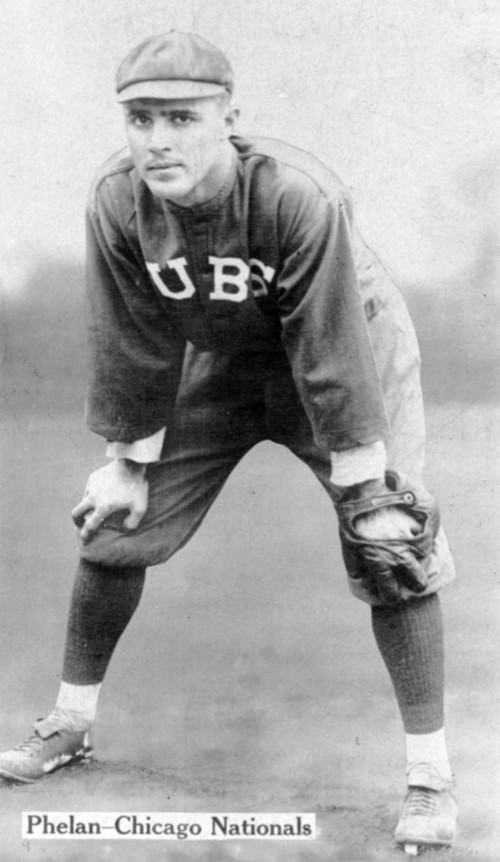
You see the card that I actually whiffed on was a 1912 Imperial Tobacco (C46) single and the player that it depicted was James, aka "Not Arthur," Pehlan:


John "Jimmy" Phelan was an outfielder who never made the ultimate ascent, but had a long playing career in the bush leagues, from 1905-14, with several different clubs.  Unfortunately, none of them were the Cubs.  Meanwhile, Art Phelan was an infielder with a five-year Big League tenure, playing at first for the Reds in 1910 and 1912, then with the Cubbies from 1913-15 in the near aftermath of their dynastic period.


At any rate, these guys were not the same person.  What a shame too, as I've always liked the look of the Imperials and was truly excited about finding one that fit into my budget and my most treasured collection.  That's the way the cookie crumbles I guess... or the cigarette rolls, perhaps?


However, I didn't let this confusion keep me down for long.  I took solace in the fact that such a card would definitely have some trade value, which I was truly counting on when I took to Wrigley Roster Jenga to discuss my switcheroo.  Additionally, I also shared my post on Twitter to maximize the exposure I could get in hopes of a trade offer.  Luckily, my hunch was correct and the immensely knowledgeable and respectful Mark Hoyle was more than happy to given Jimmy a good home.  In exchange, the SABR heavyweight offered me card that was a much better fit in my collection:


That's right, you're eyes do not deceive you - that's an authentic 1935 Goudey 4-in-1 and it's the first one I have ever held in person.  Plus, if you're keeping score at home, that's four Cubs in exchange (three of which reside in Cooperstown) for one non-Cub.  Hot damn, that's one helluva deal!  


You should totally give Mr. Hoyle a follow too - the Red Sox oddballs that he shares @Markhoyle4 are fascinating to baseball fans of any team.  I've learned about so many off-the-beaten path products from his Tweets that I've lost count.


Despite the card getting lost in the mail for about a month (hey, thanks orange goblin for ruining the post office on top of the laundry list of crap you've caused), the only thing on my mind was which player should this card be used to represent in my CATRC?  Which, if I'm being honest, is a pretty strong reason why I tend to avoid acquiring multiplayer cards for said binder unless absolutely necessary.  But, no matter what, a Pre-War Cubs card is something that I am absolutely never going to turn down, especially in exchange for something I didn't even really want!


But Tony, you might be saying to yourself, "what the heck does any of this trade have to do with the Kilduff card that you showed at the beginning of this blog entry?"  "You're rambling!"  To that I say, patience, young padawan, everything will make sense in the end and, yea, I have a strong tendency to be long-winded.


Anyway, like I said, I loved my new Goudey; but, the more I thought about it, the more I realized it was while it did fit into my collection, it was an imperfect fit.  That being said, I was still perfectly happy to have it in my possession.  But, a few weeks later, another excellent Twitter account - @Grandcards - was doing the same thing I did with my impostor Phelan.  Here's the deal, this guy is always tweeting out great deals on pre-war stock and I had noticed a lot of caramel cards that was of particular interest.  Rather, I should say that the lot contained a single card that was of particular interest to me.  Can you guess what it was?


You guessed it, we've finally reached the branch of the trade tree that includes our ol' buddy Pete here, a 1921-23 E220 National Caramel treat.  While it's definitely trimmed, has a crease and some paper loss, this is not a card or a set that pops up very often in my price range.  In fact, I had never seen Kilduff's entry on the checklist.  Dig that awesome (albeit staged) fielding photograph!


Luckily for me, the Grand Man was interested in trades as well as sales, especially for other pre-war cards in return.  Generally, the Motor City fan generally prefers Tigers when it comes to exchanges; nevertheless, he was still interested in adding my newly acquired Goudey 4-in-1 to his stash, as he only had one other example from the set.


I realize that trading a card of my favorite team that featured three vintage Hall of Famers for this nobody seems like a terrible, Darvish for Davies level deal.  But, rest assured that it was absolutely worth it to me.  You see, Pete Kilduff doesn't have much of a cardboard footprint; in fact, it's so faint that it's barely there.  According to the Trading Card Database, the only cards he does have come from the 1921-23 time period and they are ALL rare, regional, food issues.  I guess that's what happens when your not a star or even a regular starter in an era post-tobacco cards and pre-Topps.  At any rate, this situation is not exactly conducive to my low budget collecting ways.  When such an opportunity knocks, I feel obliged to answer the door.


No matter what, I get more enjoyment out of my Kilduff card than I do the pasteboard that came before it, though I'm no less grateful for Mark Hoyle's initial rescue!


Kilduff during his tenure with the Cubs (Sporting News Collection Hologram/MEARS Photo LOA)


Anyway, we've done a lot of leading to and talking about the card itself, but said very little about the player which it pictures.  Pete Kilduff played in the Major Leagues from 1917 through 1921 for the Giants, Cubs, and Robins (aka the Dodgers), though he continued on in the minors until 1928.  The infielder usually came off of the bench, only twice topping 100 games during his time in the Bigs and was a fairly usable piece when he did, with a .270/.338/.364 career slash.  Of course he lacked power, but so did everyone back then.

Unfortunately, the two things this serviceable ballplayer are best remembered are not exactly great things.  First, while Pete did get to play in a World Series during his time with Brooklyn, he was one of the three men caught up in Bill Wambsganss' famed unassisted triple play.  Secondly, shortly after he permanently hung up his spikes as player, Pete was announced to manage one of his former clubs - the Shreveport Sports of the A-level Texas League - going into the 1930 season.  Tragically, the transition wasn't to be, as Kilduff died suddenly, before he even had the chance to hand in a lineup card.  He was only 36 years old when he passed.

In a bizarre bit of symmetry, the manager whom Kilduff was succeeding in Shreveport was none other than Art Phelan, the man who started this whole cardboard journey.  Huh....


What a tangled web we weave, eh?


Before I start thinking too hard about that odd coincidence, I want to ask you all, have you ever completed such a long, drawn out trade such as this one?  Was it worth the whole process in the end?  Furthermore, have you ever made a deal that - on it's surface - seemed like it was not beneficial towards your goals, like three vintage HOF Cubs for a scrub?  This hobby isn't truly about value after all, despite what all these new cardboard stock traders might make it seem, it's about enjoyment and finding things that bring you joy.  I'd love to hear your thoughts in the comment section below!


Once again, my eternal thanks go out to Mark Hoyle and Grand Cards for making these trades with me - I truly do appreciate your generosity and I hope that you enjoyed your ends of the deals as much as I did mine.  


Welcome to the CATRC, Pete Kilduff.  What a long, strange trip it's been.


Tuesday, January 5, 2021

You Know What They Say When You Assume...

Just before I disappeared from the blogosphere, I made a couple of purchases that might have - subconsciously - helped push me out of full-bore collecting and writing. You know that feeling? Where you mess up so frustratingly that you just have to step back and stay from whatever situation you're involved with for a period of time? Well, that's at least partially what happened with these card-related transactions. Now, there's a litany of other contributing factors that played a much larger role in my absence; but, these mess ups were non-zero de-motivators.


Now, you might be asking yourself, what monumental screw ups could this guy have made that were so heinous that he had to temporarily put one of his favorite hobbies on the backburner.  Well, I ignored one of life's most important guidelines - "if it seems too good to be true, then it probably is."  To make things even worse, I did it twice in a row, meaning I snookered myself and then, knowing what I'd done, willingly dove right back into a shallow pool.  What a dunce, right?


Anyway, on with the show.  Here's a couple of things that I bought that weren't at all what I was expecting.  First up:


What's this?  A stretched and pixelated picture of an old school pitcher that was clearly downloaded from the internet, blown up well-beyond the limits of the original file, and spat out on a ink-jet printer on some cheap photo paper?  


Bingo! You nailed it!


When I saw this image attached to a listing on Ebay, for some reason, I assumed that it was just a poorly scanned image of a vintage postcard.  You know, like one of those Brace and Burke photo postcards that I've often showcased on Wrigley Roster Jenga, several of which populate my Cubs All-Time Roster Collection because they are the best, most budget friendly source for cards ballplayers from the WWII era and earlier.  The seller wasn't being deceptive - I just made an assumption about what I saw based on absolutely zero evidence.  Well, you know what they say when you assume - you make an ASS out of U and Me.  Going back and looking at the listing, the vendor never made this claim, so I had no right or reason to make this leap and, yet, I jumped right in with both feet and no life preserver.  


Thankfully though, this transaction wasn't a total loss.  While I did think I that was getting a Brace/Burke postcard out of the deal, the photograph wasn't the main focus of the Ebay listing - I'd zeroed in on the wrong part of the advertised package.  In fact, in all honesty, the Kodak print was just used as a throw-in to spice up the package for the true center of attention:


Any purchase that comes with the autograph of a bonafide Major League Baseball player can't be a total wash, right?  Especially when the total purchase price is less than a measly five bucks, correct?  It's kinda hard to stay upset when looking at that silver lining.


At any rate, the photograph depicts and the autographed index card comes from former Cubs hurler, Ed Hanyzewski. Of course, with his sterling penmanship, you probably didn't need me to spell that out for you - worlds apart from today's certified autos of today.  Beyond practicing his cursive, Eddie pitched on the North Side of Chicago from 1942-46, taking the mound in 58 games (about half of which were starts) while posting an ERA 3.30 and a record of 11-12.  Overall, the highpoint of his career was definitely the 1943 campaign, when he appeared in 33 games (16 as a starter) and won eight of 15 decisions. This year, he contributed a 2.56 ERA in 130 frames to go along with three complete games.  That's one helluva swingman!


Unfortunately for Ed, he hurt his arm along the way in '43 and was never really the same afterwards.  Such a sad and common tale in the time before Tommy John.


Here's a clearer image of Ed, courtesy of SABR


Overall, getting an autograph from such a vintage player is always a victory, so I really shouldn't be too sad about this acquisition.  However, I am left with a minor quandary - should this count towards my CATRC binder?  After all, it's an index CARD, right?  Even though it's not a traditional baseball card, it would hardly be the first off-the-wall addition to said binder.  The only thing that gives me pause is the lack of an image to go along with his John Hancock.  Perhaps I should create my own cut-auto card to jazz it up, though that's a risky proposition with the signature of a guy who's been dead for thirty years now.


What do you think I should do about this dilemma?  How would you handle this sort of situation?  Please share your thoughts in the comment section below; I would love to hear what you have to say!  As of now, I have this index card included in the tome, displayed in a postcard page along with the bum photo print.  I mean, I lay down my hard earned money for that picture after all, I might as well put it to good use, for the time being.


So, that's the story on frustrating purchase number one of two.  The Hanyzewski index card is definitely the less annoying of the two; although, to be upfront, both transactions do involve an autograph.  "What a complainer," you must be thinking.  How could getting two autographs of Cubs players for your favorite collection be such an annoying thing?  Well, please allow me to make my case.


This is an item, like with Ed, that I was under the falsely assumed presumption was an antique Brace or Rowe postcard that came with a proper autograph.  Unlike with Ed, this item came with the signature on the item itself, rather than on a separate index card.  All seems well here - a vintage postcard feature a non-mangled image and autograph of a rare, forgotten Cubs player that I still needed to fill an empty slot in my Cubs All-Time Roster Collection.  This should be an absolutely perfect and celebrated acquisition, eh?


Sadly, all is not as it seems - there's a couple of black marks that go against this buy that are not readily obvious from the picture above nor from the original listing.  First of all, once again, rather than being an actual Brace or Rowe postcard, this is an image that someone printed on their own.  This time, it's not even on photo paper; rather, it's been printed on thin, though slightly matted, traditional paper.  While this is a negative, it's not a deal breaker on it's own.  While slightly disappointing, were these the only defects, I would still be perfectly happy in nestling this bit of ephemera into my CATRC binder.  After all, this is another case where I made an unjustified assumption about the item in question and it's still an autograph on a piece which properly features the actual player in question.


Or is it?


Here's the thing.  Roy "Pop" Joiner, besides being another athlete with excellent penmanship, had a couple of brief trials with the Cubbies in 1934 and 35, as well as a cameo with the Giants five years later.  As someone who played so long ago, you would be correct to assume that he also passed away some time ago - December of 1989 (the same year I was born).  If you're keeping score at home, we're now 31 years on.  The photograph in question is printed on some pristinely white paper that is in immaculately good condition... are you thinking what I'm thinking?


I feel like there should be at least some signs of aging on three-decade old, basic paper  Furthermore, there isn't a wrinkle or corner ding to be found on what is, once again, three-decade aged, regular ol' paper.  Maybe I'm overly skeptical and am looking for problems, but this seems rather suspicious to me.  What do you think about these red flags?  Once again, I'd really and truly appreciate it if you weighed-in in the comment section below.


On the plus side, the Ebay seller has overwhelming positive feedback and the few down votes they have are completely unrelated to forged autographs.  Plus, who would go to the trouble of faking the signature of such an obscure and uncollected athlete from a time before plastic had even been invented?  That would be like counterfeiting pennies.  Plus, I only spent six bucks on the piece, so even if it was a forgery, it's not like it really hurt my wallet all that much.  With that in mind, for now, I've also included this imperfect acquisition in my CATRC binder, as it very well could be the real McCoy.  However, if I come across a good deal on Joiner's 1940 Playball pasteboard, you darn well better believe that I'll be making a swap.


Have you seen this man?


Overall, I'm mostly just being a baby.  Maybe I got scammed, maybe I didn't.  Either way, in both cases, I made some stupid assumptions that I shouldn't have and, in neither case, did I spend much money.  I'd say these are premium examples of low risk, high reward purchases.  With that in mind, maybe they could pitch a few innings in the bullpen next year?  However, with all of the other malaise surrounding baseball at the time of these transactions, the annoyance caused was just another nail hammered into my hibernation coffin.


Now I ask you, have you ever made such presumptive purchases or am I alone in making such delusional deals?  Feel free to tell me what a dunce I am.


In the end, at least I was (maybe) able to check a couple of obscure names off of my want-list.  In 2021, my News Years resolution is going to be doing a better job of looking on the bright side - there's already far too much negativity in the world right now.


Friday, June 26, 2020

Topsy Turvey

A few weeks back, I wrote and ranted about a case of mistaken identity.  The switcheroo was entirely on me, but nevertheless frustrating.  I mean, I thought I was getting an intriguing card which featured a Dead Ball player I needed for my marquee collection - the Cubs All-Time Roster Collection - and instead I sunk most of my monthly hobby budget on an expensive and superfluous minor leaguer who shared a surname.  I mean, no one died, but I think we all know that annoying feeling of self defeat pretty well.  It tends to get stuck in your gaw, so to speak.

Luckily for me, just a few days later I was able to consummate a trade that swapped the accidental acquisition for a super vintage card that was more my speed.  However, that trade is still pending, so it'll be a little while yet before I get to showcase that swap.  In the meantime, I continued to monitor the market for antique baseball cards and I managed to come across another needed card from the same era which fit snugly in what was left of my budget.  Although it wasn't Art Phelan, like I had been originally tracking, it was certifiably, undoubtedly, and undeniably a player who I actually needed for my CATRC binder and not some bush league impostor.  

Enter Frederick "Topsy" Hartsel:


As you can see, this 1911 T205 Piedmont tobacco card has seen better days; of course, it's those very creases, rough corners, and lost paper which put this super vintage beauty into a price range I can afford.  When trying to collect one card of every player for a franchise that's history stretches back to the Grant Administration, one has to try and limit the damage done to the wallet.  All in all, I'd say this piece still ain't too hard on the eyes.  It doesn't hurt that the AL portion of the T205 set is the most ornate and creative looking card design of the era either.

Speaking of standouts, you don't hear much about him now, but Topsy might have been the greatest leadoff hitter of his generation.  The diminutive (5'5") lefty led the American League in walks five times, on base percentage twice, and runs scored once while topping the order for Connie Mack's Athletics throughout the first decade of the 20th century.  The outfielder was also quick, stealing over 240 bases during his 14-year career, including a league-leading 47 in 1902.  All in all, Topsy was everything a manager could possibly want out of their table-setter.  

Of course, the Cubs are gonna Cub - Hartsel accomplished all of that after he left the Windy City for the City of Brotherly Love.


Boy they sure don't write 'em up like they used to... that bio truly does pack a "wallop."  That paragraph also alludes to the fact that Topsy first emerged onto the baseball scene by posting an excellent .339 batting average with the Cubs (or the Orphans, as they were known then) in 1901.  Now, Hartsel had made Big League cameos with the old Louisville club and Cincinnati from 1898 to 1900, but it wasn't until the Chicagoans acquired his contract that he received an extended audition.

In fact, Hartsel's contract was a matter of fiery debate at the time, as both Cincy and Chi-Town had claimed to sign Hartsel from the bushes going into 1900.  Though originally awarded to the Reds, the Cubs eventually won out after team president and soon-to-be owner, James Hart, campaigned to force his rival to forfeit all 18 games in which Topsy appeared that year.  Eventually the NL gave in and awarded his services to the squeaky wheel.


Topsy with his 1901 Orphans teammates.


In the end, it quickly became apparent why the two teams were fighting so hard for the then unproven outfielder's services.  To go along with his stout batting average (actually 335 according to BRef), Topsy also swiped 41 bases, smashed 25 doubles and walked 74 times in 1901.  Overall, an excellent season by any measure - truly, the Orphans/Cubs had found themselves a diamond in the rough.

Of course, after his excellent debut campaign, Topsy thanked the organization that gave him his big break by jumping ship and joining the upstart American League for the 1902 season.  Hartsel jumped from the Orphans to Mack's Athletics and the rest was history.  Topsy lead off for four A's pennant winners, including a World Series victory over his former organization in 1910. 

Perhaps President Hart should have fought for Topsy when he jumped to the AL as hard as he fought to pry the player back from Cincy?  It's been over 110 years and the Cubs still find themselves in need of a solid leadoff man.  Outside of a few standouts like Dexter Fowler and Bob Dernier, the first spot in the lineup continues to be a blackhole for the organization.  Are we sleeping on the curse of Topsy Hartsel?


That said, the Cubbies didn't end up missing Mr. Hartsel too badly, as the franchise's golden years just so happened to coincide with their former prized prospect's peak years.  I guess this situation worked out for everyone, much like the turn of events that landed me this Hartsel card.  While the initial purchase was a complete dud, I was still able use my mistake in a productive and mutually beneficial trade (again, more on that in a later post) and still uncover a super vintage, tobacco card that I could afford.  Again, everyone wins!

Welcome to the CATRC binder, Topsy Hartsel. Now if I could just track down Art Phelan...

Thursday, June 4, 2020

Anybody Want to Trade?

I made an oopsy.

As you know, my collecting goal is to obtain one card of every man to ever suit up in Cubbie Blue.  Seeing as the franchise history extends back into the Ulysses S. Grant administration, that leads to a large swathe of my Cubs All-Time Roster needs being much more obscure than your average Topps or Panini pasteboard.  More importantly, at least to my wallet, this means that many of my wants are expensive antiques that I can't justify dropping beaucoup bucks on without some careful financial planning.

In the midst of a total household remodel, I've been selling a lot of old furniture and knick-knacks on Facebook Marketplace.  This stuff would have been simply dropped off at Goodwill, under normal circumstances; however, with the local thrift shops not accepting donations (or even being open) during this pandemic, I figured I'd try to get the junk piling up by our front door out of the way via capitalism.  Thanks to a Covid-captive audience, that mass of lamps, desks, end tables, etc. was quickly transformed into some rainy day cash.

The wife and I treated ourselves to some date nights through the drive-thru, birthday celebrations, and some new, more aesthetically pleasing wall decorations.  Although, at the end of our clearance sale, there was still some leftover fun money for splurge of a card purchase.  As I usually do when I find myself with bonus bucks burning a hole in my pocket, I opted to cross a pre-war need off of my cardboard shopping list:


Of course, pretty much anyone who knows anything about cards is familiar with the most popular tobacco releases from the first decade-plus of the 20th century - the T206 Honus Wagner has made sure of that.  One "Flying Dutchman" contemporary set that doesn't get nearly as much attention as those brightly colored portraits is the 1912 Imperial Tobacco (C46) release, as seen above.  Not only do they lack color, but the brown, wood grain border of these Canadian cards combined with the dark black & white photography create a rather dreary and bleak-looking product.  Plus, the checklist is absolutely chock full of minor leaguers, focusing on players active in the International League at that time.  Thus, they don't seem to generate nearly the same level of interest as the much more celebrated T206's, T205's, Hassan Triple Folders, etc.

One thing that they do have going for them, compared to their brethren of the era, is a backside dedicated to player bios, rather than advertising space:


This is especially helpful considering the large amount of obscure bush-leaguers which populate the checklist.  The bio truly shines a light on some people that time has forgotten.

Speaking of forgetting, I probably shouldn't have forgotten to double-check my research before pulling the trigger on this purchase.

When I saw this "Phelan" card pop up in my saved Ebay searches, I got a bit excited.  First of all, it was only fifteen bucks, a price point I rarely see tobacco cards offered at unless they are literally missing chunks of cardboard or held together with century-old tape.  Furthermore, it showed up under my saved search for "Art Phelan," a third baseman who played with the Cubs from 1913-15 and who I knew appeared on some tobacco issues back in his day.  When I read that notification, I got caught up in the thrill and quickly jumped, purchasing the pasteboard with nary a second thought.  This listing popping up, in my price range, just as I found myself with some extra funds seemed more kismet than coincidence.

This is where I made my oopsy.


Art Phelan, appearing on one of those contemporary cards, as a Cub


Not even ten minutes later, a creeping doubt began to seep into the back of my brain.  You might notice that both the nameplate on the front of the card and the write up on the reverse only mention the ballplayer's last name, "Phelan."  There's no mention of the first name anywhere on the card.  Although the listing clearly stated "Art Phelan" in it's title and description, the dark thoughts reminded me how easy it would be to misidentify a minor leaguer from before "the Great War" had even taken place.  Although I hoped that I was just being a pessimist, or maybe even feeling a twinge of buyer's remorse since I rarely splurge with double digits on a single card, dread quickly overwhelmed my initial euphoria.


Sadly, a Google search proved Luke Skywalker correct. 

While Art Phelan was a former Cub with a five-year Major League career John Phelan - better known as Jimmy - shared no such qualifications.  Though he was a ten-year professional, this Phelan never played in the Majors, let alone with the Chicago National League Ballclub.  His career .241 batting average probably had a lot to do with his lack of ascension, especially considering the era in which he played.

Anyway, cue the sad trombone - I was tricked by a Phelan *womp, womp*


 Art - not Jimmy - Phelan on his T207 (left) and Fatima (right) cards.


The fault is completely mine, I should have been more careful about my purchase.  After all, even though the listing was incorrect, I highly doubt the seller was being spurious - there's not exactly a demanding market for the other Phelan, so why intentionally misrepresent.  As a result, I've been quite bummed about my impulsive mix-up, especially considering how rarely I treat myself to one of these comparatively high-dollar acquisitions for my CATRC binder.

On the bright side, tobacco cards always seem to generate interest, even on the low end.  With that in mind, is there anyone out there on the blogosphere who wants to trade for this antique oddity?  Maybe you just so happen to have the correct Phelan on his T207 or Fatima release (off condition, of course).  In the likely event that you do not and are still interested in obtaining this woodgrain, Imperial beauty, I'm interested in any pre-war era Cubs card that features a player still needed for my CATRC.  Please see the "Cubs" tab found at the top of this page for my collection record and who has yet to be obtained for my most hallowed tome.  If I don't have someone from that era, I'll take them in whatever uniform you have to offer - beggars can't be choosers, after all.

Have you ever allowed your excitement to get the better of you when it comes to a hobby purchase?  Did you ever pull the trigger on a card of the wrong player?  Perhaps, in the heat of the moment, you got tricked with a reprint versus the real deal?  Still, you might have accidentally clicked "purchase' before reading the full description of an item and gotten something completely different than you thought you were.  Personally, I've done all three and have screwed up in countless other ways.  Please feel free to vent with me in the comment section below.

In the meantime, I've learned a lesson and next time I decide to treat myself, I won't let my exuberance overwhelm my sense of reason.  Oopsies happen, but this one was particularly frustrating.

Darn tricky Phelans...


Thursday, July 18, 2019

Old Edition


Did you know that Johnny Gill played baseball?

The former member of 80's/90's R&B mainstays, New Edition, and accomplished singer, songwriter, and actor also suited up for the Cleveland Indians, Washington Senators, and - most importantly - the Chicago Cubs.  He looks incredibly good for his age too, as his stint in the Major Leagues took place many decades ago, from 1927 through 1936.  Who knew that the vocalist traded in his baseball bat for a microphone and apparently discovered the fountain of youth along the way?  More like Old Edition, am I right?

*Muffled sounds coming from the Wrigley Roster Jenga research intern* What's that? *more muted voices coming from off-screen*  That's not the same Johnny Gill?  Hmmm... well, I suppose that makes sense.  I was having an awfully hard time trying to figure out why Wikipedia made no mention of Johnny's exploits on the diamond.  It's all starting to come together.


In all seriousness, Johnny Gill is an obscure baseball player from the golden years who may or may not have had a lovely singing voice, but definitely has not maid much of a footprint on the internet.  In the process of drafting this post, my Google searches turned up almost nothing but biographical information, discographies, and new articles about the New Edition performer of the same name.  There's no relation or any sort of connection between the two; so, this name sharing is not particularly helpful when it comes to learning about newest addition to my Cubs All-Time Roster Collection:


Can you find the typo?


This super-vintage antique hails from the 1936 S and S Game baseball card set, one of the most readily available collations from that pre-war time period.  As the name implies, these pasteboards were used to play a card game based on America's pastime that simulated actual gameplay.  Along with the slips of cardboard, there were several pegs and a board that would keep track player movements based on the card drawn.  For example, the card in my possession is marked "sacrifice bunt," moving the runner - or, rather, peg - along while also making an out.

Seeing as these cards were seen more as game tokens than collectibles, little attention was paid to the bare bones design, with the game information printed on either side of a black and white picture that is simply slapped on the cream background.  You also get the briefest of the subject's vitals underneath the photo, which really only serves to make an already small snapshot smaller.  Furthermore, while the fronts are not particularly flashy, the backsides are completely plain and feature green or cream fills.  Finally, these game pieces are just slightly off from the standard trading card size, measuring in at 2.25 x 3.5 inches, and make use of rounded corners and thin cardstock to simulate an actual deck of playing cards. 

All in all, this set is just another in a long line of baseball card games - think of it as an ancestor to MLB Showdown.  They sure aren't exciting slips of cardboard, but they aren't meant to be either; they're simply a means to an end.


S&S' The National Game, as packaged.  Image courtesy Robert Edward Auctions.


The checklist is packed with Hall of Famers from the time, i.e. Jimmie Foxx, Carl Hubbell, the Waner brothers, etc. - and these are often the most affordable "playing day" singles available for these legends.  The reason for this relative ease is that a dealer found a large stash of near mint, complete 52-card decks in the 1960's; so many, in fact, that the guy was able to sell these old oddballs for more than a decade after his discovery.  However, I paid no mind to this information while trying to track down my desired S&S game card, as it was the forgotten outfielder - who definitely did not appear on the Billboard charts - that I was after.


Image courtesy of the Conlon Collection.

From what I can find, Johnny Gill served as a journeyman, extra outfielder throughout the late 20's and mid 30's.  Originally debuting with Cleveland in 1927, he never appeared in more than 71 games in one campaign, with his high-water mark coming in his swan song season (1936).  Most significantly, at least to this blue-blooded Cubs fanatic, Gill was a member of the 1935 pennant winners from the North Side of Chicago.  That said, his tenure was only a mere three games, though he did smack a double and drive in a run during that cuppacoffee; thus he did contribute to that World Series appearance, ever so slightly.

As far as relevant trivia about Mr. Gill, all I can find is that he was nicknamed "Patcheye," for reasons that are currently unclear.  Additionally, while playing for the Minneapolis Millers in 1935 lead the American Association with 43 home runs and 154 RBI, all while batting a potent .361. Meanwhile, his career slash line in the Majors (.245/.306/.398) wasn't nearly as impressive.  I guess he was your prototypical, quad-A type of player.

So then, why did S and S decide to include the role player on his way out of the circuit in their star-studded, 52-card playset?  After all, the 1936 Cubs didn't win anything, but they sure did have some recognizable names, like HOF'ers Gabby Hartnett and Billy Herman and All Star Stan Hack.  S and S would know that too, as they were actually based in the Windy City.  Although, I guess you wouldn't want to insult those guys by putting their pictures on a "sac bunt" card, would you?


 Surely these legends are worth more than a sacrifice bunt.


At any rate, I'm glad that S and S went in the direction they did, as this card is by far the easiest specimen of Johnny's to obtain.  After all, I don't think I've ever seen a 1933 Worch Cigar or 1945 Centennial Flour baseball card in my entire life.  Meanwhile, I only had to drop a few bucks on this eighty-year old artifact (in surprisingly good condition) that was available only a few clicks of the mouse away on Ebay. Thank goodness that, back in the day, some vendor found all those decks in a warehouse or whatever.


So there ya have it, Johnny Gill, the baseball player - by way of an S and S "The National Game" playing card.  Not Johnny Gill, the twice Grammy Award nominated singer and the sixth member of New Edition.  They are not, in fact, the same person.  Although, with Gill, pitchers Phil Collins and Rick James, outfielder Davy Jones, and infielder Ron Dunn, it sure seems like the Cubs All-Time Roster Collection could form itself quite the prolific super group.  There's a blog post concept in there somewhere...

Anyway, does anyone else on the blogosphere have an S and S card in their collection?  What do you think of these super vintage oddballs?  Did you find that they are more readily available than a lot of their fellow pre-war counterparts, especially when it comes to the Hall of Famers included?  Does your franchise have a player that amusingly shares their name with a prolific singer or celebrity from another arena?  Are you a big fan of Johnny Gill and the rest of New Edition?  Please feel free to weigh in down in the comment section below.

In the meantime, I've got to log out and officially add Mr. Gill to my CATRC binder... and flesh out that blog idea about a harmonizing vocal group!


Monday, January 28, 2019

An Arctic Blast of Cardboard


BRRRRRRRR!! 

The snow is falling and, already a few inches in, it probably won't be stopping any time soon.  Then, as if trying to drive a two-wheel drive PT Cruiser through unplowed roads wasn't bad enough, the temperatures will also be decreasing steadily throughout the week.  By Wednesday, the daytime high is predicted to be... get this... negative 11 degrees.  Wind chill will bring that astonishingly bitter number all the way down to the negative 50's... Holy snowballs, Batman - it's getting so cold that Mr. Freeze might have to put on a sweater!

This arctic blast is going to be torturous for all of the upper Midwest, not just Chicago.  Minneapolis, Indianapolis, Detroit, Milwaukee... Jack Frost is coming for us and he's pissed.  There's simply nothing we can do except bunker down and ride out the storm.  With that in mind, I have some time to blog and I just so happen to have recently received a card in the mail that I've been meaning to show.  Coincidentally, the player depicted is also suited up for one of us frigid, Midwestern municipalities, back in the day.


Newt Randall was a long-time star for the Cream City in the minors, but he was also a one-year wonder in the Major Leagues.  While his top-tier cameo was split between Chicago and Boston, Randall eventually became a fan-favorite and consistent contributor for Milwaukee's entry in the American Association.  All told, the outfielder spent eight years with the early Brew Crew, winning the AA pennant in 1913 and '14 with the club, while also knocking a league record 23-game hitting streak in 1911.

In short, during the years before Big League baseball in the cheese state, Randall was a marquee name. 

That said, while his greatest success came in "the good land" and his professional career spanned from 1902-23, the reason that Newt is on my collecting radar is due to that brief call-up with the Chicago National League Ballclub in 1907 - a mere sliver of his baseball life.  What can I say?  I'm a Cubs fanatic, after all.


Seeing as his time in the Bigs was so brief, it should come as no surprise that Newt has no Big League baseball cards on his ledger.  Luckily for me, his star burned brightly enough that he was included as a Brewer in the iconic T206 card set.  Even more fortunate, I was able to track down a copy of this rare slip, with a Piedmont back, in my relatively minuscule price range.  Sure, the top border is hacked off and there's what appears to be a nibble mark on the upper right corner; although, the surfaces look remarkably clear for a 110 year old slip of paper.  Sure, it cost me fifteen bucks, but it's easily the best conditioned tobacco card in my collection.

Now, since this is a Cubs-themed blog and I didn't track down this artifact based on his exploits in Milwaukee, let's take a deeper dive into his time spent 100 miles to the south.

In August of 1906, Cubs manager, Frank Selee, discovered Newt while the latter was playing in the Western League with Denver.  His contract was soon purchased from the club and, while he was not promoted in time for Chicago's run to the National League pennant, his services were secured for the next season.  While I'm sure the delay was frustrating to Randall, it's fortunate that Selee didn't venture out west sooner in the season; otherwise, he might never have reached the Majors at all.

As it turns out, the outfielder was a bit of a hot head.  Earlier in '06, after a dispute over a call, Newt grabbed and held an umpire while a teammate punched the ump in the face. That night, both Randall and his partner in crime were arrested and fined in police court and subsequently suspended for three days. The attacked umpire didn't pursue further disciplinary action for the assault because Randall threatened that if he were to do so, he would send him to the hospital.  Sure, baseball was much more rough and tumble in those days; that said, had the Cubs skipper stopped by the ballpark on that day, would he have been so willing to buy that contract?


The only pic I could find of Newt in Cubs duds.


Regardless, the promising minor leaguer was brought to Spring Training the following March, which was then held in New Orleans.  He impressed the brass enough to make the club as a starter in the outfield - impressively, he was the only rookie to break camp with the team that year.  However, the shine soon wore off, as even in the offensively-challenged Dead Ball Era a .205/.279/.308 slash line was not going to get the job done.  After 22 games of action, the World Series bound Cubbies decided to cut bait and quickly consumated what became known as “The Fastest Trade on Record.”

On June 20, the Cubs were scheduled to play the Boston Doves.  Right up until game time, Randall’s was slated to be the starting left fielder for the Cubs, while Boston listed Del Howard as their right fielder. However, just before the umpire could declare "play ball,"  the two managers began a dialogue.  Minutes later, Randall and a teammate, Bill Sweeney, were swapped to Boston for Howard.  In fact, the deal went down so quickly that Randall and Howard literally exchanged the uniforms off of their backs before taking their new places on the diamond.

Can you imagine that sort of trade happening today?  Talk about an impulse buy!


No word on where Sweeney got his Boston uniform from that day.


While Del and his new mates would go on to win their second pennant of three in a row and their first World Series of two consecutive, Randall was relegated to that would finish 47 games out of first place. Batting an anemic .213 along the way, Newt was stunted by injuries to his knee and head that kept him out of action for large chunks of the summer. Unimpressed, Boston sold Randall to Milwaukee that winter and, just like that, his time in the MLB spotlight came to an unceremonious end. Of course, that almost was not the case.

We know that Randall went on to star for nearly a decade with his team in "the good land." Although, he very nearly vacated Milwaukee for a return to the Windy City. In 1914, our hero missed jumping to the newly-formed Federal League by the slimmest of margins. Just one day after signing a contract extension with the Brew Crew, Newt was approached by former Cub, King Cole, with an offer to join the Chicago entry in the third Major League. However, tempting though the offer might have been, Randall stuck to his morals and refused the offer, even after a personal plea to jump from the club's manager, his former teammate, Joe Tinker.

He may of been a hothead, but Newt was certainly good for his word!


Randall could have made a "Whale" of a return to the Majors, like these former Cubs.


Ultimately, Randall kept on keeping on in the bushes and semipro ranks through 1923.  Once he finally stepped away from baseball, Newt returned to his hometown of Duluth, MN with his wife and worked as a watchman and driver with the Minnesota Steel Company until his death at the age of 75 in 1955. 

And that is the story on former Cub and Brewer, Newt Randall - hair temper, quick trader, near Whale, Steelman and true midwesterner, through and through.  I wonder if, with his Minnesotan roots and time spent in Chicago and Milwaukee, he would have been able to handle the Arctic-like temperatures we'll be experiencing this week?  We're used to some rough winters out here, especially in the "Land of 10,000 (frozen) Lakes;" but, fifty degrees below zero is an entirely different animal.

That animal, is a Wampa.  Heck, Hoth might actually be a comparatively warmer climate.

Anyway, welcome to the Cubs All-Time Roster Collection, Newt Randall.  Hopefully the binder doesn't freeze over before I get the chance to add you to it's pages!


Saturday, December 29, 2018

A Case of Mistaken Identity

Over the long course of Major League Baseball's existence, many players who have taken to the diamond have shared the surnames on the backs of their jerseys.  To make things even more confusing, many of those same players were also bestowed with the same given name on the front of their birth certificate.  Think of all the common names (i.e., Greg A. Harris and Greg W. Harris), the family legacies (like Ken Griffey, both Sr. and Jr.), and even these two prospects who have gained notoriety by having the same name tag AND face.   As you can see, there's plenty of opportunity for overlap in history's roll call.

Although, this name-sharing should certainly not come as a surprise; after all, the pages of the all-time MLB roster book are filled with the names of thousands upon thousands of young men from all across the globe and all throughout the past two centuries.  In short, there's bound to be a few people who share the same monikers - it would be impossible for this not to occur.

In the terms of my Cubs All-Time Roster Collecting, this commonality has sometimes caused a fair bit of confusion, as one might expect when a collection revolves entirely around the individual players from throughout nearly a century and a half of Windy City baseball.  This bewilderment is further exacerbated by same-named players who plied their trade during the same eras, as I was rudely reminded this Christmas season.


Roy Johnson had a cuppacoffee in the Majors way back in 1918 and spent a few more years twirling minor league innings across various small town locales.  More importantly (to me, anyway), he also had a cup of joe as a Major League manager for the Chicago Cubs in 1944.  In between those stints, "Hardrock" transformed from an intimidating moundsman to a tough as nails minor league skipper and eventually parlayed that reputation into a spot on the Cubbies' coaching staff in 1935.  This was the beginning of a lengthy relationship.

From 1935 through 1954 (excepting a few seasons in the middle due to WWII service), the rest of "Hardrock's" time in organized baseball was spent with the North Side club, either as a coach, farm system manager, and scout.  Oh - and, as previously mentioned, this Swiss Army Knife employee also spent one glorious day in the sun as a Big League manager.


Here's a cool vintage video featuring the Cubs during their last spring at Catalina Island, including Roy Johnson (#42)


In May of 1944, the Cubs were hitting the skids.  After having lost nine of their first ten games, bench jockey Jimmie Wilson was given the boot and Coach Johnson was first in line to inherit the reigns.  Things did not get better under Roy's interim command, as Chicago promptly lost their tenth in a row in an embarrassing 10-4  blowout at the hands of the Reds.  By the time they took the field again, their "on again, off again skip," Charlie Grimm, had taken over the home dugout for the rest of the season and Johnson returned to the coaches' box.

All told, Roy Johnson managed the Cubs for just a single game, but an official Cubs manager he will always be; thus, his representation in my CATRC binder is a requirement.

Sometime around the year 2006, the authentic Goudey card that you see above came into my possession as part of a larger Christmas gift from my father.  My dear ol' dad likes to surprise me with a stack of cardboard from my want-lists from time to time and, boy oh boy, was that acquisition a surprise!  At the time, it was the oldest card in my collection and, even today, it remains one of this cheapskate's few "super vintage" pieces.  I was thrilled to have Roy Johnson represented with a card from such an iconic baseball card set.  Unfortunately, there was a problem and it took more than a decade to come to light.


In a bizarre bit of symmetry, this year, my father again gifted me with a large stash of baseball cards from my want-list for my CATRC.  Seeing as how he knows that I prefer to have my Cubs represented as such in my collection, he tracked down the cyan-tinted, TCMA "The 1930's" single that you see above to serve as a "Cubgrade" for Mr. Johnson.  Though they're no Goudey, these oddballs from 1972 do not surface often and I was thrilled to have a true and literally blue Cubs card for such a short-term skipper.  After all, managers of any stature rarely get love from the baseball card manufacturers.

Released in a continuing series of 24 cards each set during the early days of TCMA, there's plenty of variation as one progresses through the checklist.  The majority of the cards are black and white and 2" x 2-3/4," but cards 337-384 measure in the standard dimensions. Furthermore, cards 409-456 were printed with blue ink and were, again, under-sized. Based on these specifications, you might have already guessed where in the checklist my Xmas gift falls.

As I usually do when tracking down new cards for my most hallowed tome, I didn't just research the trading card, I also took to the internet to learn about the player depicted.  It was then that I discovered an interesting factoid about the Cubs' Roy Johnson - he never took the field in Boston Red Sox uniform, the team he's depicted with on my Goudey goody.  His lone slice of MLB action came in the colors of the Philadelphia Athletics.  As I sat in a haze of befuddlement, it slowly hit me that not everything was as it seemed.


The Goudey Roy Johnson was an outfielder... not a pitcher.  This Roy Johnson had himself a nice a ten-season career (1929-38), batting .296 with 58 homers and 555 RBI in 1155 games for the Tigers, Yankees, Red Sox, and the Bees (nee Braves).  This Roy Johnson won a World Series with the Yanks in 1936.  This Roy Johnson never ventured into coaching, let alone management, once he hung up his spikes for good.  Simply put, this was the wrong Roy Johnson - this guy had absolutely no association with the Chicago franchise in any way, shape, or form.

Apparently, when I originally put this card on my want-list all those years ago, I'd just assumed it likely that a Roy Johnson who played professionally in 1933, when Goudey first hit store shelves, could have easily made the transition into coaching and management by the time 1944 had rolled around.  Well, you know what they say when you assume... For some reason, I never thought to verify whether or not there was more than one Roy Johnson.  Hell, now that I'm actually researching, there's actually three, as another Roy Johnson patrolled the outfield of Olympic Stadium for a few seasons in the mid-80's.

Oopsy doodles.


On the bright side, I was able to immediately correct my egregious error upon first noticing it by replacing the Goudey with my TCMA "Cubgrade."  Also, I now have an intriguing piece of trade bait newly available to the market.  So, in the immortal words of Carl Spackler, I have that going for me.

Like I said at the outset of this post, common names make for a common cause of confusion when it comes to MLB history.  In fact, this Roy Johnson swap isn't even the first time the name game has tripped me up - the whitewashing story of the two Ray Webster's will forever hold that honor - and I'll bet that I will probably fall victim to this sort of snafu yet again in the future.  Have any of you readers ever fallen victim to such a trap, thinking you were getting a card of a particular player only to have the rug pulled out from underneath you by some guy with the same designation?  I sure would like for you to share your experience in the comment section below so I don't feel like such a dunderhead.

In the meantime, welcome to the CATRC, Roy Johnson.  Sorry I didn't take the proper time to vet your previous, fraudulent placeholder!