Showing posts with label Reprint. Show all posts

Thursday, February 4, 2021

Smalley to Terwilliger to the Right Field Stands

The Cubs have had a bevy of famous double play combinations throughout their long and sometimes storied history.  Of course, there's the poetic trio of Hall of Famers, Tinker to Evers to Chance - "a trio of bear Cubs fleeter than birds" and all that jazz.  Then, several decades later, the 1960's brought us the all All-Star infield powered by Kessinger to Beckert to Banks, who got oh-so-close to breaking the Cubs streak of futility.  Further still, the teams of the 80's and 90's had people passing through the turnstiles to see Dunston to Sandberg to Grace; you'd think they'd have done better than one playoff appearance with that slick-fielding bunch.  All in all, the franchise has managed to put together some decent infields over the years.


As notable as those combos were, there's yet another that earned a fair bit of attention during the time they were together.  In the 1950's, advanced scouting reports chattered all about Smalley to Terwilliger to... the right field stands!


The Cubs teams of the 1950's were always stuffed to the gills with young potentials that could never put it all together at the same time, only once reaching the .500 mark in '52 (77-77).  Like many Cubs prospects at this time, both Roy Smalley and Wayne Terwilliger eventually went on to have long and productive careers as role players.  However, when the two first came up, the young firebrands could hardly control their throwing arms, earning their infamous DP branding.  For instance, in 1950, Smalley was charged with 51 errors at shortstop while Terwilliger added 24 more from second base.  First baseman, Dee Fondy, was probably the most well stretched out man in professional sports!


While Smalley stayed in Chicago for most of his playing days, Wayne Terwilliger ventured out to far greener pastures.  In a professional baseball career that extended through eight decades and began when Harry Truman occupied the White House, "Twig" backed up Jackie Robinson in Brooklyn, won a pair of World Series rings as a coach in Minnesota, and stayed active as a manager and/or coach in the minor and independent leagues until well into the Barack Obama administration.  Talk about longevity! 


In fact, at the time the old second baseman was hired to manage the Fort Worth Cats in 2003, he became the oldest manager in minor-league history at age 77.  After three years at the helm of the United Baseball League club, he would wrap up his 62-year baseball career at the Cats' first base coach in 2010.


To really hammer home the point, take a look at his rookie and sunset cards, side by side. I don't have either of these (though I really wouldn't mind tracking them down), so thanks to the Trading Card Database for the scans!


It should also be noted that prior to making it with the Cubs, Terwilliger joined the United States Marine Corps and fought in the Pacific Theater during World War II.  A couple of the more famous conflicts in which Terwilliger fought include the Battle of Saipan (as a tank operator) and the immortalized Battle of Iwo Jima.   While he may have had an interesting career on the diamond, he was a certified hero off of it.


With that, it grieves me to say that, yesterday, the 95-year old baseball lifer left this mortal coil.  At the time of his death, the near-centenarian was the oldest living former Chicago Cub, a title which he now passes onto short-term reliever, Bobby Shantz, who is a scant three months younger than "Twig."  


Shantz's brief tenure in Chicago was measured in months, so no Cubs card exists of the man.  This Fleer Greats of the Game single has repped the now eldest statesman of the franchise in my Cubs All-Time Roster Collection binder since I pulled from a pack at CVS in 2005.


Speaking of cardboard representation, as of now, Wayne Terwilliger is represented in my CATRC by the Card Collector's Company (CCC) reprint you saw earlier in this post.  Yea, unfortunately it's not a true 1951 Bowman and rather a reprint from the late 1980's.  While the reprint is fairly high-quality, a man of his intrigue deserves to be repped by the real deal.  Here's hoping that I can track down a more deserving card of Twiggy in the near future. 


Terwilliger may have been part of perhaps the most infamous double play combination in Cubs' history, thanks to his live-arm, but he ended up contributing so much more to the game and to the world at large.


R.I.P., Wayne Terwilliger.


Monday, August 5, 2019

Asgardian Cardboard

While most of the money in our hobby goes to the card companies, grading resources, supply manufacturers, and secondhand vendors, another large source of collective collecting budgets go towards shipping services.  The United States Postal Service, UPS, DHL, FedEx, etc. get a lot of the blogosphere's money in exchange for delivering our PWE's, RAK's, trade packages, Ebay winnings and sellings, redemptions, etc.  Sure, baseball cards are not the most lucrative part of their business model, but there's no doubt that our hobby and community would not be what it is today without these mailing services.

Now,one of these titans of shipping is getting directly involved in the hobby.


What you see above is a sheet of classic card reprints, produced and printed by Asgard Press and sold in limited FedEx Office centers across the United States.  These perforated cards come in panels - of which there are four - featuring eight cards each from the early tobacco card era.  According to Asgard, the cards chosen originally hail from the Benjamin K. Edwards Collection, which was donated to the Library of Congress by Carl Sandburg in 1954.

While I do not use the services of FedEx for my mailing needs - I stick to the good, old fashioned USPS -  I was made aware of this new oddball reprint set by Twitter, as the following was retweeted into my timeline:


Right after I saw this tweet, you darn well better believe that I took to the official Asgard Press website to try and decipher which cards were selected for their tribute to vintage baseball.  I expected the checklist to be made up of the big names from the Deadball time period - Cy Young, Ty Cobb, Chief Bender, etc.  However, I was pleasantly surprised to see that many of the cards chosen for reprint turned out to be much more obscure ballplayers.  In fact, I was ecstatic to find out that there might even be a card that I need in this collation.  More on that later in the post.

By Odin's beard, was I ever excited about this Asgardian discovery!

Without haste, I was soon Googling where the closest FedEx was stationed.  Turns out the nearest location was only a stone's throw away from my home, in the neighboring suburb of Oak Lawn:


As it happened, I had some time after work on Thursday to swing by and see if my store was one of the lucky locations to have these baseball cards bestowed upon their customers.  I wandered in that afternoon - the only customer without an armful of packages to ship or documents to copy - in hopes of buying baseball cards rather than mailing them.  Thankfully, I was elated to discover that my quest for "vintage" cardboard turned out to be quite successful:


There they were - all four available sheets - right near the front of the retail space, on a rotating rack with several other Asgard Press paper products.  I was so excited that I think I might have peed a little...  I hadn't actually expected Oak Lawn, IL to be one of the chosen few!

Admittedly, I was initially distracted by the lovely, retro comic book cover notecards, vintage travel poster prints, and college football stationary put out by Asgard.  Now, this isn't the same Asgard that brought us Thor, Loki, and Valkyrie.  That is, not unless Thor traded in his hammer, Mjölnir, for an enchanted printing press.  From what I can gather, based on their official website, Twitter account, and the products I saw in store, Asgard Press specializes in capturing nostalgia on paper goods.  The company started out with fancy calendars in 1999 and have since expanded with healthy selections of note cards, posters, journals, postcards, and other ephemera.  Their tagline is "vintage paper goods" and their slogan is "old school is now in session;" so, I guess it wasn't much of a mystery as to what they're all about.

In all honesty, introducing some baseball cards into their product portfolio is positively perfect for their desired aesthetic.


Only briefly abstracted, I was able to quickly refocus and locate the specific sheet for which I came looking:


Like I mentioned earlier, there was a specific card in this set that had caught my fancy and it came as part of "plate no. 2."  After quickly browsing through the rest of Asgard's displays - they must do a lot of business with FedEx - I plopped down my $4.95 and went about my merry way.

Any guesses as to which one of these singles I was chasing?  I'll give you a hint - it has something to do with my Cubs All-Time Roster Collection.

Once I got home and freed my sheet from it's plastic, cardboard-backed prison, I discovered that these cards are printed on little more than ink-jet printer compatible cardstock.  Thin, flexible, and fragile, they feel about as thick as your average index card.

Speaking of cards, the cards themselves are high-resolution and slightly enlarged scans of tobacco cards from the aforementioned Library of Congress donation.  Maintaining the original aspect ratio, the cards have been blown up to standard height (3.5 inches) but still remain short of standard width.   Also, seeing as they are simply scans of already existing, century old antiques, all of the flaws and damage from the originals carried over to the reprints, as best exemplified by the two instances below.


Personally, I like this "flawed" characteristic, as I feel as though it adds some charm to the Asgards and makes them feel a touch more "authentic" than your normal C.C.C. re-do.  How do you feel about the paper loss and stain carryover?  Would you find it distracting, perhaps?

Also, as you can tell from the above scans, all of the cards feature full backs, filled with copy and advertising, just as the originals did.  Furthermore, we have a varied selection of cards from the early 20th century.  Although Asgards erroneously lists the cards as all being from the famous T206 set, which was released through 16 different brands owned by the American Tobacco Company from 1909-11 and is the source of the iconic Honus Wagner card, none of the cards on sheet number two actually are from that seemingly infinite checklist.  In fact, all of the cards included are part of the 1911 T205 release.


The baseball diamond was turned into a picture frame for the American League portion of the T205 release and it truly is one of the most clever and beautiful layouts in baseball card history.


The National League portion of the T205 checklist is a tad more bare bones, featuring a bust shot portrait on a plain, colored background, and maintaining the unifying gold/brown borders which define the set.  Again, this Ed Barger Dodger card is a fine example of the damage and staining which were transferred from the original artifacts to the reprints.

While the American League cards are far more detailed, the National League examples are a fine study in the KISS principle.  This has nothing to do with costumed rock stars, platform boots, or fake blood though - KISS stands for Keep It Simple, Stupid.  The more you cram into a design, oftentimes, the more crowded and confusing a piece will get.  Although, the creators of these cards once again flipped back to the polar opposite for the sampling of minor leaguers included with the premiums:


There are 12 minor league cards in the original set which made use of an ornate, plaque-like frame.  Two of these bush leaguers were reproduced by Asgard - a Charles Hanford with "paper loss" was displayed previously and George Merritt you can see directly above.

While all three templates used in the T205 set, I find that they are all quite pleasing to the eyes.  Overall though, I think my favorite is the relatively bare bones design of the NL cards.  Of course, that might just be because my college graphic design professor personally chiseled the KISS principle into my skull; however, the bright, bold colors and wonderful drawn portraits get to speak for themselves during the Senior Circuit section, whereas they are more a secondary feature to the crowded designs of the other two.  That said, that is merely the opinion of one insignificant card blogger - what do you think about the three layouts, which is your preferred design?

Now, if you've been counting along at home, you might have noticed that I've showcased seven of the eight total cards included on the Asgardian panel.  With the overview of the company, cards, and quality out of the way, it's time to spotlight my "chase" card, the pasteboard which caused me to drop everything I was doing to run out and purchase this product.  Without any further ado, lease allow me to drop the curtain on the card of the hour:


That's right, I could care less about inner circle Hall of Famer Ty Cobb's inclusion; I'm here for that sweet, sweet Wilbur Goode (or Good, depending on the source) of the Boston Rustlers.  More like, Wilbur Great, am I right?

Okay, so here's the deal, I haven't abandoned my Cubs fandom to become a super collector of the Atlanta Braves and their previous franchise iterations.  The reason that this random, Deadball Era ballplayer who has long faded into obscurity has captured my attention is the fact that Wilbur was traded from Boston - just a year after this card originally hit the market - to the Cubbies, where he would spend the next five years patrolling the outfield of the West Side Grounds and, later, Wrigley Field.  Thus, I needed a card of Wilbur for my Cubs All-Time Roster Collection as part of my quest to collect at least one card of every man to EVER suit up for my favorite franchise, no matter how brief or how long ago.

For his career, the journeyman fly-chaser post a career .258/.322/.342 batting line, mostly as a reserve piece for the Yankees, Naps, Rustlers, Cubs, Phillies, and White Sox for eleven total seasons in the Majors.  Far from being a star, the ballplayer appears on very few cards (two that I can identify) and all of them date from his ancient playing days - therefore, they are tough to track down and tougher on this cheapskate's wallet.  Therefore, I have no problem whatsoever with using a reprint card to fill an otherwise nigh-unfillable gap in my favorite binder.  To say it was a pleasant surprise that could cross another one of these tricky names off of my "needs" list with a trip to FedEx (of all paces) and an Abraham Lincoln flash card would be an immense understatement. 

Before I go, I have to ask, what do you think about these Asgard cards?  Do they seem like something you might be inclined to spend some money on, maybe as an impulse buy as you wait in line to ship a box of cards to a fellow blogger?  Do you see them as cheap and irrelevant in a see of endless sea of reprints and forgeries?  Perhaps you don't even see products such as these as "true" baseball cards at all and I am cheating by using such items to fill needs in my collection?  Please feel free to weigh-in in the comment section below.  Personally, I am of the opinion that any card that fills a need within my CATRC is good enough for me!

In the end, I am still reeling from filling such an obscure need in my niche collection with a trip to FedEx... and I didn't even ship or receive any mail.  That's one of the best parts about collecting this way - you just never know where the cards are going to come from.

Thank you very much, Asgard.  Sorry you got destroyed by Hela and Surtur at the end of Thor Ragnarok - tough luck there.  Your paper products are quite fascinating though!


Monday, April 16, 2018

The Great Garage Sale Discovery


For the first time in weeks - perhaps since the beginning of 2018 - the wife and I had ourselves a free weekend.  No family get-togethers, no friendly shindigs, no extra work commitments, no surprise apartment fumigation (yes, that's happened this year)... nothing, glorious nothing.  With such a wide open itinerary, naturally, we took advantage of this unfamiliar situation and enjoyed doing absolutely nothing.  I must say, it was quite nice not trying to hurriedly pack up our Kia or frantically shop for a last minute birthday gift, for once.

During this downtime, I was able to sit down at the coffee table, grab a cool beverage, and flip through my Cubs All-Time Roster Collection binder for the first time in months.  It's my favorite cardboard endeavor, the linchpin of this entire blog; however, the behemoth requires a significant amount of free time to page through.  Thus, I was kind of excited to dust off the cover of my marquee, six-inch three-ring.

While idly flipping through these Ultra-Pro pages, I noticed something about this collection that hadn't registered with me in a long time and had gone pretty much entirely undiscussed here on Wrigley Roster Jenga.  This story involves one of my greatest garage sale finds of all-time, an oddball set of trading cards, and flashback to more than a decade ago:


Sometime in the middle part of the previous decade, I was a broke teenager, sans job, who was just launching his CATRC project - the 2003 "Why Not Us?" Cubs had recently re-ignited my passion for our nation's pastime and it's trading cards.  While I did pop into my LCS on occasion, it was during these cash-strapped days that I began mining thrift shops, flea markets, and garage sales for good deals on previously discarded cardboard.

Unsurprisingly, with my previous collecting period having occurred during the tail end of the overproduction era, my pasteboard holdings focused heavily on the 80's and 90's, while new acquisitions began to fill in gaps with the current club.  Vintage cards from the 60's and 70's were well out of my minuscule price range and were never seen outside of the sliding-glass display cabinets of the card shop and players from before that might as well have been ancient relics from Mesopotamia.  In short, nearly three-quarters of the history of my favorite franchise was almost non-existent in my then much smaller binder.

That is, until one glorious Saturday morning.


As I've mentioned on this blog before, my favorite local tradition is our village's annual Garage Sale Day, where residents are invited to lay their wares out for sale in their driveway or lawn without need of a permit.  Since the days of my chasing Beanie Babies in the 90's, I've never missed this Saturday morning festivity and, honestly, it's one of my favorite days of the entire year.  You just never know what you're going to find... maybe there'll be a giant Red Bull cooler, or a super cheap Keith Magnuson autograph,  or a long sought after LP... it's a community-wide treasure hunt!  During one such quest, circa 2005, I happened upon the box you see above.

I might not remember the exact year, but it was at a house on Lawndale Avenue that, hidden among the strewn about junk, I happened upon a complete, reprinted box set of the 1951 Bowman checklist.  I couldn't grab that sucker off of the folding table fast enough.

Back in the late-80's, a company known as Card Collectors Company jumped into the burgeoning baseball card market by reproducing iconic sets of decades previous.  Colloquially referred to as CCC for short, the group recreated highly-priced and treasured tobacco/bubblegum cards for collectors on a budget, including '51 Bowman in 1988.  Fast forward a little bit to 2005-ish and I was a collector on an extremely tight budget, whose blossoming collection of all-time Cubs contained a massive vintage blackhole.  In short, this set was basically meant for me!


If I recall correctly, this bad boy only set me back about five dollars, as well; the seller appeared to have once been a big investor in the trading card boom and was looking to rid himself of the clutter.  Although created as a cheap alternative to real, super vintage, these reprint sets still often change hands for upwards of thirty bucks and are rarely broken up into affordable singles.  Thus, this was an absolute steal of a deal on product already designed for those with light wallets.

Thankfully, this discovery came near the end of the garage sale tour because I recall fighting the urge to immediately dig into the contents of the box.  Surely it was going to be a significant boon to my burgeoning Cubs All-Time Roster Collection.


Not only were my lofty expectations met, they were far exceeded!  From just one transaction that cost me nothing more than a meager Abraham Lincoln banknote, I added what had to be nearly fifty new names to my All-Time Roster tome.  In just one purchase, the decade of Elvis Presley and Sputnik went from nearly completely absent to more than halfway complete.  I don't have any recorded statistics to back this claim up; but, this has to have been the greatest one-time addition to my CATRC throughout it's existence.

This massive boost was aided by not only the Cubs team set - as showcased by Bill Serena, Wayne Terwilliger, and all those shown previously - but also by Cubs of a different color.  By that, I mean future/former Cubs shown in other uniforms.


After all, since day one of this project, I've accepted such cards as placeholders until a properly-attired card can be acquired.  Furthermore, in many cases, several such players never received a genuine Cubs card or only super duper rare regional issues; so, in the interest of completion, I welcome the colors of other clubs to this very day.

During the ensuing decade and a half, many of these cards have since been upgraded in my collection by actual vintage or by cards printed in the more traditional, standard size.  I must admit, though I would never have turned down this find, I do have an inherent bias against mini cards, be it modern Allen & Ginter or authentic Bowman dimensions.  Even still, a hefty amount of these CCC reprints still rest comfortably in my CATRC accumulation, including all of the cards featured in this post.


All of these years later, a total of 18 Card Collectors Company recreations are still included in my marquee collection.  Even if that total represented my initial acquisition, that would still divide out to just over 25-cents per card, an investment which I would easily pull the trigger on right now.

Sadly, this isn't an entirely happy story.  While I have no qualms about breaking up the set, I no longer have the fancy-pantsy box that originally stored the brick of cardboard (I lifted that image from Ebay, in all honesty).  As a matter of fact, I no longer have ANY of the cards which lacked a connection to the North Side franchise.  After initially sorting through my Garage Sale Day bounty, in a short-sighted move  I re-packaged all of the non-Cubs into that box and immediately tossed them in the trash.  Hell, I didn't even use the damn recycling bin.  All of that glorious cardboard, wasted to the great landfill of time.

What a nitwit!  At the very least, they would have been fun to include in various trade packages; of course, this was well before I had any communication whatsoever with other collectors. 


Oh well, how typical of your average American teenager.  At least I was able to hang onto to all of the rest of these oddballs!

All in all, I think I can say, unequivocally, that this box of 1988 CCC '51 Bowman reprints was my greatest Garage Sale Day find of all-time.  This five-dollar purchase from 2005 (or thereabouts) continues to provide a significant contribution to my Cubs All-Time Roster Collection here in 2018.  With that in mind, I know I can't be the only cardboard collector on the blogosphere who has an unbridled love for garage sales.  So, I have to ask, what is the best secondhand discovery that you've ever come across at such an event?  Please feel free to share in the comment section below.

In the meantime, my lazy weekend has officially run out - it's now Monday morning and it's time for work.  And if that wasn't joyous enough, we have a coating of snow to go with the beginning of the work week dread.  Thank goodness I was able to unwind with my big ol' binder this weekend!


Sunday, November 5, 2017

The Orphans

Today, Sunday, November 5th, is Orphan Sunday.  This national day of recognition comes every year on the first Sunday of the eleventh month and it first made it's way to the United States in 2003, courtesy of the Christian Alliance for Orphans.  According to their official website, "Orphan Sunday is a time to stand up for the orphans of the world. In truth, there are likely no more vulnerable human beings in the entire world than those thousands upon thousands of children in this world who have no mother or father, due to all sorts of tragedies that have occurred in their lives, ranging from accidents, to sicknesses, to war."

With that in mind, you might remember that the Chicago Cubs didn't always have such a cuddly nickname.  If you wind back the clock 120 years ago, the Chicago National League franchise lost their proverbial father when "Pop"Anson retired from our national pastime in 1897, after two decades of stewardship, as both a player and the manager of the team.  By the time the 1898 seasons began, the newspapers in town adapted a new nickname for their beloved ballclub - the Orphans - a moniker which stuck around officially through 1902.

During my quest to complete my Cubs All-Time Roster Collection, I've acquired many cards of players from this tumultuous era in team history.  In fact, most of them have already appeared on this blog, in one way or another.  To mark Orphan Sunday, allow me to present to you the only such player who has yet to be properly spotlighted on Wrigley Roster Jenga:


Carl Lundgren earned a try-out with the Orphans on the strength of his stardom with the nearby University of Illinois, from which he graduated with a degree in civil engineering in 1902.  His stardom on both the mound and the gridiron made him one of the premier amateur athletes in the state, at the time.  Shortly after his graduation, Carl made his debut with the club on June 19th and he ended up twirling 17 complete games (18 appearances) and with a sterling ERA of 1.97. 

Not bad, eh?


 Lundgren was an early multi-sport star for the Fighting Illini.


The rookie would stick around with the franchise as part of a larger youth movement that lead to the Orphans moniker being dropped in favor of the Cubs.  This "rebuild' somewhat mirrored the one in recent years and lead to three straight NL pennants and back-to-back World Series victories.  Lundgren was a contributing member along the way, though he never made a postseason appearance, as an unheralded, but steady presence in a pitching rotation where "Three Finger" Brown, Jack Pfeister, Orval Overall, and Co. stole the spotlight.  He was such an unappreciated member of that dynasty, that he had to file a grievance against the club to claim his $10,000 World Series bonus for 1908.

With a reputation for wilting in the summer heat, Lundgren earned a reputation as "the best cold-weather pitcher in the profession" by the Reach Baseball Guide.  Come the warmer months, Carl's control problems would manifest in full and he often ranked near the top of the league in walks and hits per nine innings.  By 1909, the Cubs had gotten all they could from Lundgren and he was let go on waivers, never to play in the Big Leagues again.  That said, Lundgren did hang around the minors for a few years, before successfully transitioning to a second life as a collegiate coach in both baseball and football.

To this day, Lundgren is rightfully revered in his hometown of Marengo, IL, despite being a mostly forgotten man in Cubs/Orphans history.


The card which represents Lundgren in my collection hails from the 1906 National League Fan Craze set; of course, my copy is actually a reprint, but whatever.  Fan Craze was an early baseball card game (an ancestor of MLB Showdown, if you will) that was originally released for the American League in 1904.  The game was such a success that an NL version was printed up two years later.

According to PSA, the set is reminiscent of a deck of playing cards measuring 2-1/2” by 3-1/2” with rounded edges like a deck of cards. Each card features the player’s black-and-white portrait (some sources indicate the photography was the work of Charles Conlon) presented in an oval vignette and includes the player’s name beneath as well as his team."  The backs for the AL version are blue, while they are red on the NL edition.  Meanwhile, I can't determine for certain who exactly is responsible for my reprint version, but I believe it was printed up in 1990.

This CATRC addition was an Ebay purchase, an auction-win from long before the days of the blog.  Perhaps I can chase down the real McCoy after a lottery win.


The portrait chosen for Lundgren on his Fan Craze single just screams "turn of the century" baseball.  It's impossible to know for certain when this photograph was taken, but the ridiculously high collar on his wool jersey hints that the baby-faced Lundgren and his impeccable middle-part was in the early years of his Major League career.  Perhaps this snapshot is actually from his rookie campaign, when the recent college graduate was a young Orphan, rather than a Cub?  

Again, punctuating his lack of respect, Lundgren was saddled with being the "balk" card of the deck.  Underappreciated starter on a World Series champ who often faded in the later months of the season and was left off the postseason roster?  He was like that generation's Jason Hammel!

And that is the story behind Carl Lundgren and his 1906 Fan Craze baseball card (reprint) which resides in my Cubs All-Time Roster Collection binder.  The man was a multi-sport maven at the University of Illinois, went on to engrave his name in history as one of the 1908 Chicago Cubs, and got his start in professional baseball as an Orphan.


---------------------------------------------------------------------------------------------------


Footnote - I don't mean to denigrate the importance of Orphan Sunday by using it as an excuse to look back at a favorite baseball card.  In honor of the occasion, you can donate to help the cause at CAFO's official website or find a way to volunteer your time to help these children in need.  


Wednesday, August 2, 2017

The NSCC - Holy Sheet!

Here we are, day three of my humble bragging about what I was lucky enough to come across at the. National Sports Collectors Conference.  So far, in part one, I gave you the general overview of what I uncovered while wandering, mouth agape, about the Donald E. Stephens Convention Center in nearby Rosemont, IL; plus, you got to check out the hottest rookie card to hit the market (forget Judge and Bellinger).   Then, in part two, I went completely "postal," in that I spent our time together showing off the postcards of long-forgotten Cubs players of yore which just so happened to fill some gaps in my CATRC binder that I wasn't sure would ever be filled.  For once, "mailing it in" wasn't a bad way to approach a blog post!

With that, I know you must be on the edge of your seat, desperate to find out what we'll be gazing at with awe today.  So, let's get right down to business.

As I've mentioned countless times throughout this blog's history, at this point in my CATRC, most of the players I'm chasing hail from the 1940s and earlier and, thus, lack the cardboard footprint of more modern ball players.  This means that, oftentimes, my selections are limited to super vintage and ultra rare curiosities - not friendly to this penny-pinching collector.  When I come across them, I'm content to let reprints hold down the fort until I win the lottery enough times to buy the stacks of strip and tobacco cards I'll need to complete my task.  That's why, when I saw this stash of oddballs at one vendors table, all I could think was "holy sheet - these are going to fill in a bunch of gaps:"


Entire, un-separated sheets of Renata Galasso T206 reprints!  Now we're cooking with gas.

There are upwards of a dozen subjects in what might be the most famous baseball card issue of all-time who have thus far eluded my grasp.  If I were to sit around and wait until I scrounged up enough funds to purchase all of those singles, I might be paying for them with my first retirement check.  Thanks to the revered Renata Galasso, the queen of oddball baseball cards, and her reprints of the early 1980's, I can now cross some of these names off of my "need" list without taking food out of my own mouth.

You know what that means, I definitely perforated these bad boys - sorry, not sorry.


At this particular table, the seller had four different, full sheets available for purchase. However, sadly, my limited, cash only budget only had enough wiggle room for me to land two of them.  Moral of the story - always make sure you have your debit card BEFORE you peel out from an ATM.  Oh well, I think Meatloaf would still agree that two out of four ain't bad - heck, you're batting .500!

Renata released this set of T206 reprints in both perforated sheets and as a boxed set, circa 1983.  As I am writing this, I see no confirmation that her re-do's contain all of the original cards from "the Monster" (as the large set is affectionately known); however, that is certainly doubtful.
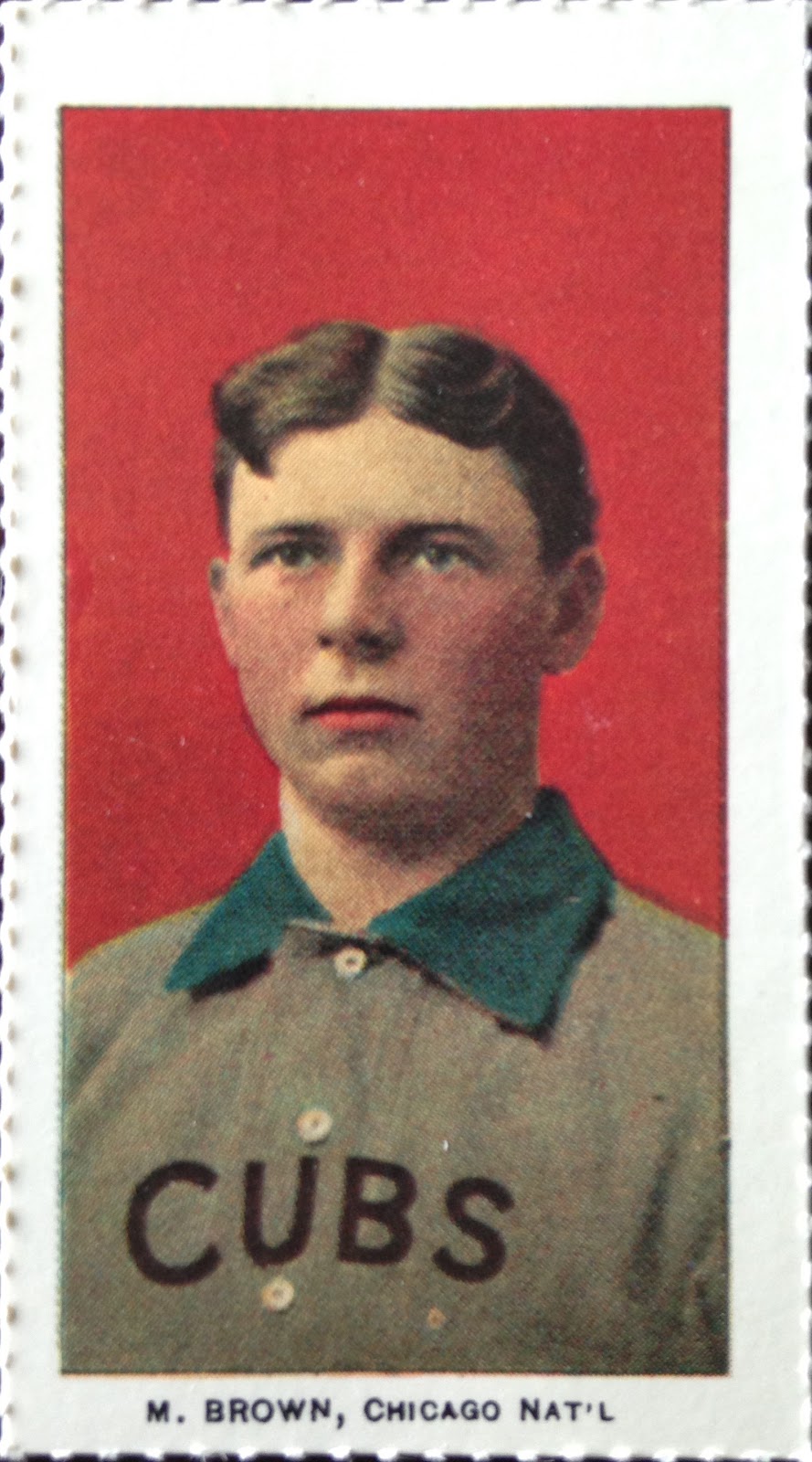
A lot of the big names of the era are included on the sheets that I did end up pulling the trigger on - Mordecai Brown and his three fingers, Joe Tinker (sans his poetic teammates), plus some non-Cubs notables like that Cy Young fellow and Tris Speaker.  Of course, being the roster obsessed collector I am, the only names that concerned me were the obscure ones.


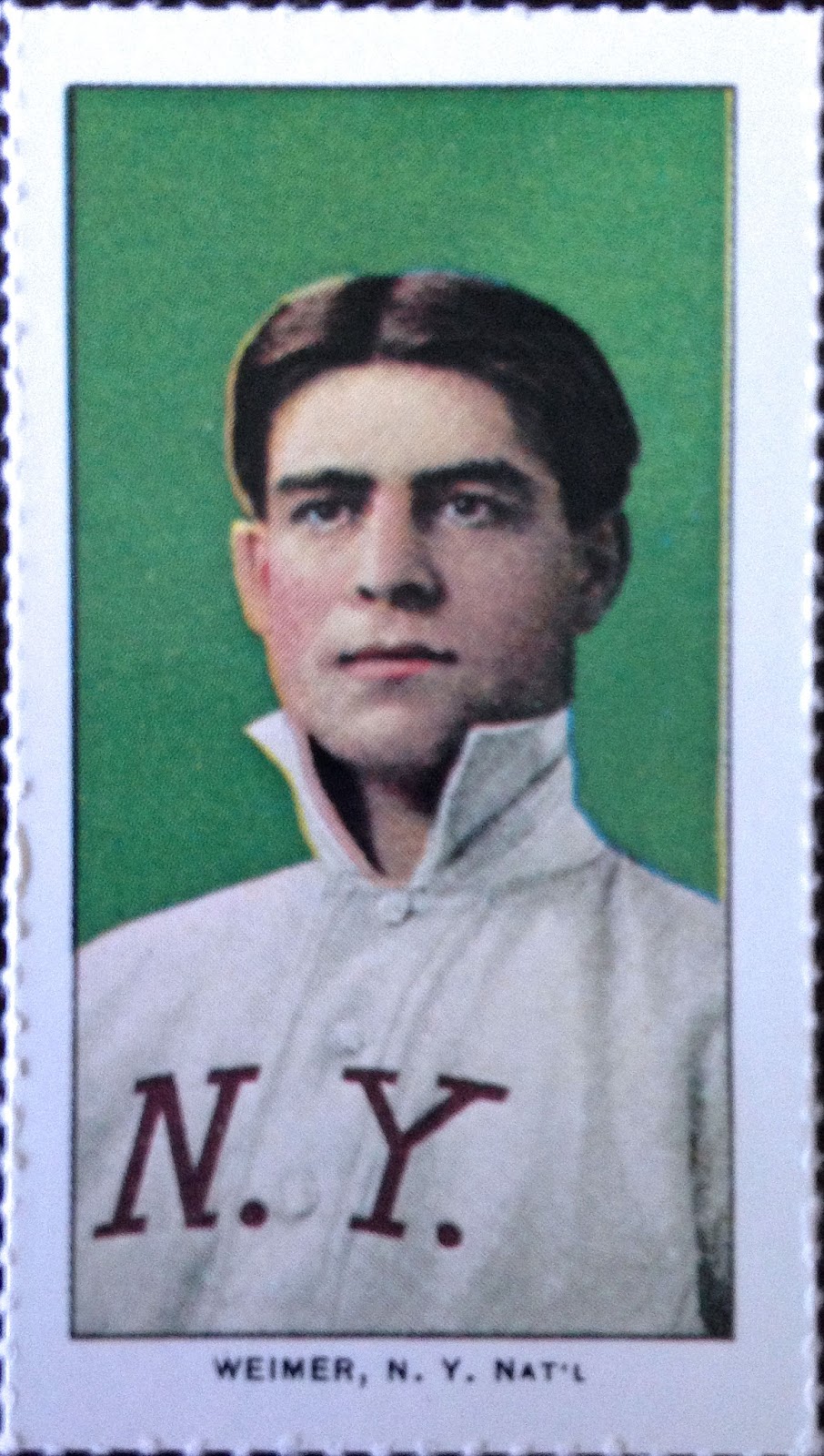
I'm talking about guys like Johnny Bates and Jake Weimer, Deadball Era players whose fame did not translate through the decades.  The former, Bates, was a regular in the outfield for the Boston (as pictured), Philly, and Cincy clubs from 1906-13, before being released mid-season in '14.  Nearing the end of his rope, Johnny inked a deal with the Cubbies, with whom he finished out the year with nine more games with one hit in eight at-bats.  After one more year with the rebel Federal League in Baltimore, Bates racked his Major League bat for the last time.

Meanwhile, Jake Weimer broke in immediately as regular in the Cubs' starting rotation in 1903, posting a 20-8 record and never winning less than 18 contests in his three total seasons in the Windy City.  With a strong starting staff and an opening at third base, Chicago decided to swap Weimer to the Reds for Jimmy Sebring and the answer to everyone's favorite trivia question, Harry Steinfeldt.  Of course, that trivia question is, "who played third base during the Tinker-to-Evers-to-Chance era?"


Just a couple o' Bills here.

Bill Bradley was a longtime Cleveland Blue/Nap/Indian; but, he broke into the Bigs with the Chicago National League franchise, before the turn of the century, in 1899.  After playing a year and a half as the starting third baseman for the then-Orphans, Bradley "jumped" on over to Cleveland in pursuit of a more lucrative offer to play in the newly-formed American League.

Billy Maloney did some jumping himself, from team-to-team, throughout the first decade of the twentieth century.  During his sole season with the Second City, Maloney managed to lead the NL in stolen bases, with 59 swipes.  Of course, he also lead the league in strikeouts, with all of 59 - 'twas simply a different time.  Also, gotta love the old-timey field (that almost looks more like a carnival than a ballpark) in the background of Billy' lithograph.


Finally, here's the card I was most happy to see included on these Galasso sheets:  John Ganzel.

Ganzel was a teammate of Billy Maloney's at Rochester when this set was originally released in cigarette packages.  By then, he was nine-years removed from his one year stint with the Chicago club.  Of course, playing as a first baseman there was a fool's assignment, seeing as HOF'er Frank "The Peerless Leader" was firmly entrenched and not going anywhere.  As such, Ganzel was traded away after just 78 contests in 1900.  Not to be deterred, John stuck around in the pro ranks all the way through the 1918 season.

That said, none of that has anything to do with the fact that THIS seemingly innocent trading card was my favorite find of the bunch.  In fact, the reason truly has nothing to do with the card or John himself at all - this is the reason why:


That's right - Ebay notifications are the true reason... they've been driving me bonkers.  Granted, that is a rather short drive.

I, like many a collector, have a ton of saved searches on my Ebay account, lest a card that I desire show up and run right under my nose.  Additionally, I have notifications turned on for that very same reason - simply put, like Aerosmith, I just don't want to miss a thing.  For whatever reason, I'd been getting pop up notes for "new items" in relation to Mr. Ganzel, at the rate of at least once a day, for several weeks.  A rational person might have just turned off notifications or deleted that search; but, I just knew that if I did that, someone would list an off-condition, Ganzel T206 for a bargain basement price and I would miss it.

Like I said, short drive.  Regardless, my long, national nightmare is now over - I have a Ganzel and I can stop following that search, with it's kooky, rogue pop ups.


Btdubs, that photograph on my lock screen comes from a charity promotion put on by the local commuter railroad earlier this summer.  They brought in the "Joliet Rocket" (NKP 765) to roll down our line, pulling a special excursion train.  Seeing as another one of my longstanding passions is railroading and it's history, watching this galloping 2-8-4 steam locomotive roar through town made my hair stand on end.  It's incredible to think that when guys like Ganzel, Maloney, Bradley, Weimer and Bates were entertaining fans on the diamond, this was simply a normal, everyday scene.

Anyway, all told, courtesy of the Renata Galasso discovery, I was able to add five new names to my Cubs All-Time Roster Collection binder that otherwise might have taken me years to track down elsewhere.  Thank you for your oddballs and reprints, Mrs. Galasso - this collection would look drastically different without your efforts!

This concludes part three of the series about my finds at the National.  Stay tuned, for tomorrow we will wrap everything up, with a tidy bow on top, with a potpourri.  Oddballs?  Check ✅.  Ultra vintage? Check ✅.  Refractors?  Check ✅.  We're going to go out with a grand finale-like bang.

All you'll be able to say is, "holy sheet!"