In the time that I was away from Wrigley Roster Jenga, I was still passively collecting baseball cards. Honestly, the almighty Cubs All-Time Roster Collection has never been fully ignored in the nearly two decades that I've been assembling it. However, with baseball being absent all spring due to the pandemic and then testing my nerves when it finally came back mid-summer, my true focus shifted to my other prime hoarding hobby - record collecting.
Ever since I was a wannabe radio DJ in college, I've been slowly putting together a record collection that I am quite proud to own. Of course, it's not exactly a museum-worthy collation of albums because I don't give a damn about resale value and I purchase them for use, not display. Furthermore, I do most of my shopping at resale shops and garage sales because there's no greater thrill than finding a sought after LP in the bargain bin. Every now and then, I'll pull the trigger on a "mint in package" repress from a big box retailer or something off of the top shelf at the local record shop; but, my focus is definitely on treasure hunting.
All things considered, I think I've put together a pretty good library over the last decade plus. My tastes skew towards punk, cheesy 80's pop, Motown, emo music from the early aughts, and a whole lotta classic rock, so those genres take up most of the space on my shelves. Just in case you were curious.
With that in mind, the spring and summer of 2020 were spent obsessively sifting through OfferUp and Facebook Marketplace. After all, being stuck in quarantine, I had nothing better to do than listen to records all day and my need to collect wasn't being satiated by baseball card hunting on Ebay. One of the black platters than I acquired during this period of obsessive hunting was a marquee release from one of the biggest names in 70's rock:
Alice Cooper - both his solo career and the original Alice Cooper band - is one of those artists that still commands a premium. Thus, the shock rocker's only representation in my collection heretofore was a copy of his 1989 LP, Trash, that I pilfered from the archives of my college's radio station. However, as much as I enjoy Poison, that hair metal offering from near the end of Alice's relevance doesn't hold a candle to Billion Dollar Babies, the green goodie that you see above.
The sixth offering from Cooper was unleashed on the public in 1973 and features several now classic rock radio standards. Elected, No More Mr. Nice Guy, the title track and a slew of other rockers came to define shock rock and early heavy metal and further pushed the Alice Cooper name into the mainstream. All in all, I don't think it's much of hot take to say that this album is one of the most significant rock and roll LP's from the decade and I was super pumped to come across a copy in a good condition and price range for my collection.
Lo and behold, imagine my surprise when I opened the gatefold and realized that Billion Dollar Babies has something to offer for both my record AND trading card collections:
Remember, I was a born in 1989 and am a child of the 90's - squarely in the CD era of music distribution. In high school and college, the iPod emerged and physical media was suddenly an endangered species. Thus, while I am quite familiar with the discographies of my favorite artists and the trivia and stats of their releases, the album packaging is something I am constantly learning more and more about as I acquire each artifact.
Therefore, I had no way of knowing that the wallet-like design of Billion Dollar Babies was more than just a layout on the outer cover. One I opened the gatefold, I noticed the raised money clip and I've come to find out that the album originally came with a large "billion dollar bill" to nestle underneath. That funny money wasn't the only premium that came with the wallet. Those pictures of the band that you see on the left panel aren't just there to let you know what the group looks like; they're actually a perforated sheet of genuine Alice Cooper band trading cards!
I guess you can say that these were the original "wallet cards!"
I apologize for the fuzzy picture - this is what happens when you rely on a camera phone and are too cheap to buy a scanner. Perhaps I should crack open my own wallet...
Anyway, these oddballs feature head-shots of all the classic AC band members (complete with facsimile signatures), an array of "in action" stage snapshots, and a promo picture for the Billion Dollar Babies tour/album. Of the bunch, I'd have to say that pasteboard of Alice and his slithery friend on the bottom left is by far the most interesting. Shades of 1984 Donruss Glenn Hubbard! Anyway, the cards themselves are slightly smaller than standard, measuring approximately, 2" x 3" and feature completely blank backs. Additionally, they're all centered around a logo card for the album itself, which - unlike the rest - is perfectly square.
You sure don't get that from a CD jacket or a .jpg on iTunes or Spotify!
Uncovering these oddballs made for a welcome surprise, one that came completely out of left field. For now, rather than punch them out and mangle my album, I'll leave them in there so that I can enjoy them every time I spin Billion Dollar Babies. I might not seek out mint condition records for my collection, but I sure don't intend to actively mangle them either. You might say that would be my "nightmare!"
Okay, so that's a terrible pun based on the wrong album, but it's my blog and I'll ruin the internet in whatever way I so choose.
At any rate, how would you handle this oddball situation? Would you punch out these cards and page them up in a binder? Perhaps you'd tack them to your wall like a teenager from the 70's? Would you stuff them in your own, actual wallet like pictures of your children? Or, maybe you'd do as I did and leave them be - they've been there close to fifty years now, why disturb them? Please feel free to let me know in the comment section below!
Now, while we're on the topic of records, I'm also going to take this opportunity to show off some of my other recent hauls of stacks of wax:
That's just SOME of the albums that I've added to my library in the last year. Like I said, I'd been a busy boy in collecting while WRJ was on hiatus, just not so much with baseball cards. And, believe it or not, none of those LP's cost me more than a buck each.
Thank you for entertaining my humble brag.
Does anyone else out there on the blogosphere also
dabble in record collecting? Personally, I've actually thought about
starting up another blog to babble on and on about my other favorite
hobby, but I have a hard enough time keeping the cobwebs off of the
webspace that I'm managing already. For now, I'll settle for the
occasional tie-ins which meld the world of cards and vinyl into one neat
and blog-able package, such as this "shocking" discovery.
Who's this shadowy-faced fella? This crow-marked, wily veteran is clearly a San Diego Padre, but that's all you can tell from the front side of this oddball baseball card. So, since this card is lacking in information, please allow me to pick up the slack.
Bud Hardin had a lengthy 13-year career in minor league baseball, including a long run as a starting infielder in the old, open classification Pacific Coast League in the early 50's. This circuit almost rivaled the Majors in terms of popularity on the west coast and William Edgar Hardin starred for the Los Angeles Angels throughout the early 50's. Beyond that, he also appeared up and down the baseball chain for the Giants, Cardinals, Cubs, and Indians organizations in various remote locales from 1942-57. Of course, there was a nice, lengthy absence from the professional ranks from 1943-45 due to serving his country during a skirmish most of the world was involved with. From what I understand, a few ballplayers careers were put on pause at this time.
To close out his time in organized baseball, Bud started the 1957 season with the original San Diego Padres, returning to the PCL in a stint which is commemorated by the pasteboard which kicks off this post. However, old glory was not recaptured, as he only got into 17 games before his contract was transferred to the Mobile Bears of the Southern Association. Both clubs were affiliated with the Indians franchise at the time. After 21 more contests, Hardin hung up his cleats for good, closing the books on a long and prosperous MiLB career.
Hardin during his brief trial with the '52 Cubs. Image courtesy of Baseball Birthdays.
In contrast to his time in the bushes, Mr. Hardin had a rather brief career in the Majors, appearing in just three games with the 1952 Chicago Cubs, after he was selected in the Rule 5 Draft out of the Cardinals organization. In those three contests, Hardin made seven plate appearances - rapping out a single hit (appropriately, a single) - and played a combined, error-less fourteen innings at shortstop and second base. Shortly after the calendar turned to May, he was sent back down to the minors (the Cubs-affiliated Angels) and that was all she wrote for his MLB career.
While Bud Hardin's Major League career was brief and his stat-line revealed nothing particularly notable, his inclusion is still required for my Cubs All-Time Roster Collection. Like many cameo Cubs of this era and earlier, this was problematic due to a lack of cardboard representation. After all, the bulk of his playing career dated before the emergence of Topps and, as we've already established, his MLB stats would not have made him a likely subject anyway. Thankfully, in this department, obscure oddball and regional minor league issues often rescue my most treasured collection and it was no different in this situation. Although, it should be noted that this particular oddity comes with a bit of notoriety and significance within our hobby.
The 2"x 3", black and white oddity is printed on super thin cardstock, barely a notch above index card quality. Also, it's not hard to tell in this scan that it was printed as part of a sheet, seeing as remnants of the cards on either side were left behind when Bud was sliced out. Overall, the simplistic card is extremely basic, letting the picture do all of the heavy lifting. The backside continues this minimalist theme:
No stats, no write-up, all we get is Bud's name, team affiliation, and the set information, all of which is type-written and surrounded in a vast white space. Based on the info presented, one can thus be forgiven for thinking that this oddball hails from 1957 and being distributed with bags of popcorn. After all, cards of this very size and "design" were handed out in that very manner by teams across the Pacific Coast League in the mid-50's. This is not one of those food premiums though, as it hails from a couple of decades later. Although, it clearly draws *ahem* inspiration from those popcorn pasteboards. However, this sit has it's own interesting lineage.
As it turns out, this card comes from a set produced by Ed Broder of the infamous Broder family. If you were alive and collecting during the junk wax boom, the name Broder should ring all sorts of alarm bells, as Rob Broder became famous for his - shall we say - semi-legitimate outsider baseball card projects. These off-brand curiosities were originally meant to pump up his sport photography business, but the cards ended up taking on a life of their own. They ended up spreading everywhere - you've definitely seen these cards kicking around the dime boxes and discount bins at card shows. Nowadays, with everyone and their mother having access to photo editing software and a printer, "customs" and ACEO's have carved out their own niche; but, in the 80's and 90's the Broder works were looked down upon as fakes and phonies.
Here's a pair of Broders from my collection that I am particularly fond of. Two of my favorite all-time players.
The notoriety rose to such heights during this time of cardboard investment that the family's last name became the catch-all term for counterfeit and collector-issued cards. While Rob was the guy who accelerated the Broder boom, Rob's father Ed is the one who got the family business off the ground with passion projects such as the 1974 PCL Popcorn set. Ed seemed to be particularly fond of the PCL, as he separated the wheat from the chaff with set of the league's All-Stars a year later, and Japanese baseball, the subject of several sets on his resume. All of these products were similar in that they were decidedly not fancy - all picture with small splashes of text. As evidenced by the cheap cardstock, the wishy-washy cutting, and the minimalistic design, these cards were probably produced with little more than some old programs/magazines, a typewriter, and a facsimile machine.
In the end, cards is cards to me. Broders, customs, ACEOs, art cards, and anything put out by the major, "legitimate" manufacturers are all equally qualified for a home in my baseball binders. I have Ars Longa cards displayed next to Topps pasteboards and Monarch Coronas pouched side by side with Upper Decks - a card is a card to me. After all, where is the line between "legit" and "fake" when it comes to simple cardboard rectangles with pictures meant for children to play with anyway? With that in mind, this is actually the third Border popcorn piece to find a spot in my CATRC.
Here we have Frank Ernaga and Ed Winceniak - another pair of ballplayers who, like Hardin, had brief runs with the Cubbies but much longer careers in the minor leagues. Obviously, they also played in the PCL at some point, or they wouldn't appear in a set dedicated to the fan-favorite circuit. For all three of these men, these ancestral Broders are pretty much the only baseball cards that I can find with their mugs on them. Without such enterprising baseball fanatics, I wouldn't have been able to add this trio of players to my Cubs All-Time Roster Collection - so, thanks a bunch, Ed!
How do you feel about Broders and other such collector-driven releases? Now, we aren't talking about actual, straight-up counterfeits meant to deceive the naïve, even though the term Broder eventually came to include such nefarious copycats. Eff that crap. I'm asking if you have any of Ed of Robs work in your collections? Perhaps, if we expand the parameters, you might have a Carl Aldana, Helmar, One Star, Gypsy Oak or any one of hundreds of expertly-crafted blogger customs in your binders or boxes? After all, this stuff is all either descended from or on the same family tree as the work of the Broder clan. Personally, I feel like these outsider cardboard options add color, variety, and a desperately needed alternative perspective in the baseball card hobby. These works often cover players, eras, and events that the boys at Topps, Panini, and the like would never bother with. But, that's just me - what do you think?
In the meantime, I suppose I'll make myself some popcorn and wait for the conversation to get poppin'!
While Wrigley Roster Jenga was on extended holiday, I was grieved to discover that Mr. Carl Aldana had passed away. Apparently, he had ventured on into the next realm early in 2019; however, I did not hear about his death until a year and a half later, in the middle of my blogging hiatus. Thus, quite unfortunately, I have never had the chance to post a proper tribute to the artist, being that I am both slow on the uptake and prone to long disappearances. Now, almost two years later, please allow me to rectify this grave injustice.
For those who are not familiar with the name Carl Aldana, he was born in Guatemala in 1938 and, as a child, immigrated to the United States his family shortly thereafter. Carl eventually picked up a watercolor brush as a freelance designer in the mid-60's and went on to become renowned throughout his adoptive home state of California for his portrait, landscape and cityscape painting. Furthermore, his artistic endeavors were not limited to still frames, as he also worked in the art department for over thirty big-budget Hollywood films, including serving as the art director for Air Force One. Some other movies that you might have seen his work in include Ferris Bueller's Day Off, The Best Little Whorehouse in Texas, and Pleasantville, among several others choice moving pictures. All in all, I'd say that's not a bad resume for a working artist.
But what does any of this have to do with Wrigley Roster Jenga's topic of interest, baseball cards? Well, you see, when Carl wasn't cleaning his brushes or going Hollywood, the avid creator was also designing his own baseball cards.
In fact, it's rather likely that you have read about his vintage, broder-adjacent sets in your Standard Catalog of Vintage Baseball Cards or seen them at a vender booth at a card show. In 1970, he made his pasteboard debut by producing a 12-card checklist paying tribute to the Baltimore Orioles and he followed that up with a 16-card offering featuring a smattering of players from across baseball. Both of these products are listed in the aforementioned Standard Catalog; that said, those guys neglect to mention his 1972 love-letter to the Pacific Coast League's San Francisco Seals of the early 50's, an 18-card set that cast the spotlight on a league and team that he saw plenty of as a Cali kid of the time.
Some examples of Carl's vintage output, culled from Ebay listings as I possess none of these oddballs.
I'm not quite sure how this baseball artiste distributed his handiwork. Perhaps he made use of mail order in early trade publications, a la Renato Galasso? Maybe he sold them at some of the hobby's first card shows? Heck, it could be possible that these were just a passion project that ended up on the second hand market. Does anyone out there know anything information that could help fill in this gap?
Questions about distribution aside, no matter what, we know that Mr. Aldana was a fan of the game and of the PCL, as both showed up in his work on canvas and cardboard. However, after the three outsider art card offerings that we detailed above, Mr. Aldana disappeared from the trading card scene for the next 40+ years, no doubt focused on his much more lucrative film and artwork projects throughout the ensuing decades.
Apparently, the itch never completely went away though, as a few years ago, Mr. Aldana burst back onto the hobby scene. He went back to the well again and came back with a series of sets paying tribute to his beloved Pacific Coast League. These art cards mimicked the style of the old Mother's Cookies sets of the mid-20th century, but featured a wider swath of players and made use of new colorizations performed by the artist in question. It's hard to get a full, documented scope of these releases, as they are quite prodigious in number and were released rather haphazardly (via single listings on the Ebay, I'm pretty sure) throughout the years - just search "Aldana PCL" on the 'Bay and you'll find a couple hundred different listings. Obviously, Carl was back with a vengeance and making up for a lot of lost time!
Back in 2017, I first came across these Aldana revival cards while perusing my saved Ebay searches. With such a diverse checklist of obscure and fringe minor league baseball players, this discovery got my blood pumping. As I had expected, digging into these oddities uncovered a new, fertile source for War Era randos that I still needed for my Cubs All-Time Roster Collection - the most cherished collation of my baseball card collection. So, of course, I added a selection of these beauties to my cart and crossed a few names off of my "needs" list that I was beginning to think would never be acquired.
In posting about the Jim Adair (briefly with the Cubs in 1931) single you see above, I received quite the unexpected thrill when Carl Aldana himself commented on my humble little blog, reaching out to talk turkey about baseball cards. Granted, he was no Cy Berger, but this accomplished artist, film maker, and baseball card creator was putting his digital signature on my web space and wanted to talk to me about his work? As if that wasn't enough of a thrill, after our conversation, he also sent me the Steve Bilko beauty that you see above as a "thanks for your great blog on my cards."
Three years later, this connection still ranks as one of the coolest moments of my time as a blogger.
Unfortunately, we lost touch after that dialogue and I was grieved when I discovered that Carl had passed away not-so-long after we spoke. At 81, he lived a creative life full of excitement, flashy colors, film sets, and glitz behind the lens and behind the canvas that I can only dream about. At least he didn't have to see what the world has become just a couple years later.
The man was important enough to receive a tribute from the Oscars and he still took the time to talk to this amateurish writer.
At this point, we're several paragraphs deep and I have yet to explain how I came to find out about Carl's death or describe the significance of the card which leads off this post. As you can tell from the central concept of this post, I have a recurring problem with tardiness. Let me clarify.
I was on Ebay on day back in the throes of the early days of the pandemic, scrolling through listings in order to kill some time while isolating to "flatten the curve." Despite my boredom, my attitude perked up when I came across a cache of Aldana PCL cards that I had not seen before - a whole set of cards patterned around the Los Angeles Angels of 1947. This was especially exhilarating to me because the original LA Angels were the top affiliate of my beloved Chicago Cubs at that time, meaning that the checklist contained a healthy sampling of fringe guys who became well acquainted with the travel schedules between the City of Angels and the City of Wind, guys who did not have much of a cardboard footprint because of their decidedly non-star status in the pre-Topps era.
To put it succinctly, pay dirt for my CATRC binder! This is evidenced by the set ledger found on the card backs:
Besides Marv Felderman, Bill Fleming, Cecil Garriott, Russ Bauers, Bukk Schuster, and Johnny Ostrowski would also make welcome new additions to my CATRC tome. Like I said, this soil is fertile.
In the grand scheme of the game, Marv Felderman is not a significant figure. Of course, that doesn't mean he wasn't notable in his own way. "Coonie" was a catcher who suffered from chronic injuries, but still managed to work his way up the ladder, thanks to his skills behind the dish. In 1942, he broke into the Bigs with the Cubs, but was only able to get into three games and take seven measly plate appearances. This was mostly due to the fact that, upon breaking camp with the club, he flubbed a play in extra innings that choked away a potential win and was immediately sent down. Back in the bushes, Felderman injured his finger and struggled, only earning his way back to Chicago late that season through the team's dismal performance and lack of other backstop options.
After the '42 season, Felderman joined a different kind of campaign and enlisted in the Navy, as there was a little skirmish going on at the time that you might have heard about. Marv was stationed in Hawaii, at Kaneohe Bay Naval Air Station, and regularly plied his talents on the diamond for their baseball team, eventually playing in the 1945 Navy World Series in Hawaii.
Felderman with the Cubs in 1942 (left) and with the US Navy's Kaneohe Klippers in 1944.
Not so long after that World Series, Felderman was discharged from the service and was able to watch a different World Series. The Cubs were taking on the Tigers in that year's fall classic and the club invited their former catcher to take in the festivities from their box seats. Upon the Series' conclusion (and you know how that went for Chicago), the players even voted Felderman a partial share of their pennant purse.
Come 1946, Marv was one of hundreds of pro ball players attempting to make a comeback upon the conclusion of World War II and found himself back in the PCL. By 1947, he was back with the Cubs organization, laboring for a second trial in the National League with the Angels, as the Aldana card illustrates. I've seen it reported that he was called up near the end of the season once again, but he did not appear in a boxscore and I cannot find any contemporary sources to confirm. Either way, Felderman continued to chase his dream in the minor league and semi-pro ranks through at least 1951, without ever getting a second chance.
It was in conducting this research on Marv Felderman's baseball career that I discovered Carl Aldana's passing. Ever the prodigious artist, thebaseballhobbyist (with whom Carl used to work directly) continues to list pieces of Carl's art card portfolio for sale to this day. I'm definitely tempted to grab myself a few more and encourage you to do the same - these colorful oddballs would look great in anyone's baseball card collection!
At any rate, it's time to wrap this up. Carl, sorry it took me so long to pay proper tribute, but thank you for your wonderful art and film work, for creating some of the most fun outsider baseball cards ever produced, and for being so generous and communicative with this random, blathering blogger. Your creative output is something to behold and I am ever thankful to have some pieces of it nestled safely in my binders.
R.I.P. Carl Aldana. To close, here's a short video showcasing some of his watercolor work, specifically impressions of a visit made to the home of the Cubs, Chicago:
Just before I disappeared from the blogosphere, I made a couple of purchases that might have - subconsciously - helped push me out of full-bore collecting and writing. You know that feeling? Where you mess up so frustratingly that you just have to step back and stay from whatever situation you're involved with for a period of time? Well, that's at least partially what happened with these card-related transactions. Now, there's a litany of other contributing factors that played a much larger role in my absence; but, these mess ups were non-zero de-motivators.
Now, you might be asking yourself, what monumental screw ups could this guy have made that were so heinous that he had to temporarily put one of his favorite hobbies on the backburner. Well, I ignored one of life's most important guidelines - "if it seems too good to be true, then it probably is." To make things even worse, I did it twice in a row, meaning I snookered myself and then, knowing what I'd done, willingly dove right back into a shallow pool. What a dunce, right?
Anyway, on with the show. Here's a couple of things that I bought that weren't at all what I was expecting. First up:
What's this? A stretched and pixelated picture of an old school pitcher that was clearly downloaded from the internet, blown up well-beyond the limits of the original file, and spat out on a ink-jet printer on some cheap photo paper?
Bingo! You nailed it!
When I saw this image attached to a listing on Ebay, for some reason, I assumed that it was just a poorly scanned image of a vintage postcard. You know, like one of those Brace and Burke photo postcards that I've often showcased on Wrigley Roster Jenga, several of which populate my Cubs All-Time Roster Collection because they are the best, most budget friendly source for cards ballplayers from the WWII era and earlier. The seller wasn't being deceptive - I just made an assumption about what I saw based on absolutely zero evidence. Well, you know what they say when you assume - you make an ASS out of U and Me. Going back and looking at the listing, the vendor never made this claim, so I had no right or reason to make this leap and, yet, I jumped right in with both feet and no life preserver.
Thankfully though, this transaction wasn't a total loss. While I did think I that was getting a Brace/Burke postcard out of the deal, the photograph wasn't the main focus of the Ebay listing - I'd zeroed in on the wrong part of the advertised package. In fact, in all honesty, the Kodak print was just used as a throw-in to spice up the package for the true center of attention:
Any purchase that comes with the autograph of a bonafide Major League Baseball player can't be a total wash, right? Especially when the total purchase price is less than a measly five bucks, correct? It's kinda hard to stay upset when looking at that silver lining.
At any rate, the photograph depicts and the autographed index card comes from former Cubs hurler, Ed Hanyzewski. Of course, with his sterling penmanship, you probably didn't need me to spell that out for you - worlds apart from today's certified autos of today. Beyond practicing his cursive, Eddie pitched on the North Side of Chicago from 1942-46, taking the mound in 58 games (about half of which were starts) while posting an ERA 3.30 and a record of 11-12. Overall, the highpoint of his career was definitely the 1943 campaign, when he appeared in 33 games (16 as a starter) and won eight of 15 decisions. This year, he contributed a 2.56 ERA in 130 frames to go along with three complete games. That's one helluva swingman!
Unfortunately for Ed, he hurt his arm along the way in '43 and was never really the same afterwards. Such a sad and common tale in the time before Tommy John.
Overall, getting an autograph from such a vintage player is always a victory, so I really shouldn't be too sad about this acquisition. However, I am left with a minor quandary - should this count towards my CATRC binder? After all, it's an index CARD, right? Even though it's not a traditional baseball card, it would hardly be the first off-the-wall addition to said binder. The only thing that gives me pause is the lack of an image to go along with his John Hancock. Perhaps I should create my own cut-auto card to jazz it up, though that's a risky proposition with the signature of a guy who's been dead for thirty years now.
What do you think I should do about this dilemma? How would you handle this sort of situation? Please share your thoughts in the comment section below; I would love to hear what you have to say! As of now, I have this index card included in the tome, displayed in a postcard page along with the bum photo print. I mean, I lay down my hard earned money for that picture after all, I might as well put it to good use, for the time being.
So, that's the story on frustrating purchase number one of two. The Hanyzewski index card is definitely the less annoying of the two; although, to be upfront, both transactions do involve an autograph. "What a complainer," you must be thinking. How could getting two autographs of Cubs players for your favorite collection be such an annoying thing? Well, please allow me to make my case.
This is an item, like with Ed, that I was under the falsely assumed presumption was an antique Brace or Rowe postcard that came with a proper autograph. Unlike with Ed, this item came with the signature on the item itself, rather than on a separate index card. All seems well here - a vintage postcard feature a non-mangled image and autograph of a rare, forgotten Cubs player that I still needed to fill an empty slot in my Cubs All-Time Roster Collection. This should be an absolutely perfect and celebrated acquisition, eh?
Sadly, all is not as it seems - there's a couple of black marks that go against this buy that are not readily obvious from the picture above nor from the original listing. First of all, once again, rather than being an actual Brace or Rowe postcard, this is an image that someone printed on their own. This time, it's not even on photo paper; rather, it's been printed on thin, though slightly matted, traditional paper. While this is a negative, it's not a deal breaker on it's own. While slightly disappointing, were these the only defects, I would still be perfectly happy in nestling this bit of ephemera into my CATRC binder. After all, this is another case where I made an unjustified assumption about the item in question and it's still an autograph on a piece which properly features the actual player in question.
Or is it?
Here's the thing. Roy "Pop" Joiner, besides being another athlete with excellent penmanship, had a couple of brief trials with the Cubbies in 1934 and 35, as well as a cameo with the Giants five years later. As someone who played so long ago, you would be correct to assume that he also passed away some time ago - December of 1989 (the same year I was born). If you're keeping score at home, we're now 31 years on. The photograph in question is printed on some pristinely white paper that is in immaculately good condition... are you thinking what I'm thinking?
I feel like there should be at least some signs of aging on three-decade old, basic paper Furthermore, there isn't a wrinkle or corner ding to be found on what is, once again, three-decade aged, regular ol' paper. Maybe I'm overly skeptical and am looking for problems, but this seems rather suspicious to me. What do you think about these red flags? Once again, I'd really and truly appreciate it if you weighed-in in the comment section below.
On the plus side, the Ebay seller has overwhelming positive feedback and the few down votes they have are completely unrelated to forged autographs. Plus, who would go to the trouble of faking the signature of such an obscure and uncollected athlete from a time before plastic had even been invented? That would be like counterfeiting pennies. Plus, I only spent six bucks on the piece, so even if it was a forgery, it's not like it really hurt my wallet all that much. With that in mind, for now, I've also included this imperfect acquisition in my CATRC binder, as it very well could be the real McCoy. However, if I come across a good deal on Joiner's 1940 Playball pasteboard, you darn well better believe that I'll be making a swap.
Have you seen this man?
Overall, I'm mostly just being a baby. Maybe I got scammed, maybe I didn't. Either way, in both cases, I made some stupid assumptions that I shouldn't have and, in neither case, did I spend much money. I'd say these are premium examples of low risk, high reward purchases. With that in mind, maybe they could pitch a few innings in the bullpen next year? However, with all of the other malaise surrounding baseball at the time of these transactions, the annoyance caused was just another nail hammered into my hibernation coffin.
Now I ask you, have you ever made such presumptive purchases or am I alone in making such delusional deals? Feel free to tell me what a dunce I am.
In the end, at least I was (maybe) able to check a couple of obscure names off of my want-list. In 2021, my News Years resolution is going to be doing a better job of looking on the bright side - there's already far too much negativity in the world right now.
I know I'm supposed to be playing catch-up with the Cubs' roster and, thus, Cubs All-Time Roster Collection additions that I missed while I was away from Wrigley Roster Jenga. But, that being stated, I feel inspired to blog about a different CATRC acquisition that I was lucky enough to make during my sabbatical. Muses are fleeting, so I am not about to question when the inspiration strikes. I highly doubt anyone's jonesing for me to talk about the random Cubs reliever who was added to the team in July anyway.
Back when both professional baseball and the blog were dark, I was randomly perusing the internet when I stumbled upon the website for Warren Ball Park in Bisbee Arizona - The Friends of Warren Ball Park. At this point, I cannot recall how I ended up at this web address; perhaps I happened to stumble in while planning our vacation to the Grand Canyon State that COVID-19 86'ed. Whatever the reason, I'm glad that I found them because, as a history nerd that happens to love baseball, Warren Ball Park is about as historic as a baseball diamond can get.
My beloved Wrigley Field may be one of the oldest ball parks in the Major Leagues, but Warren predates the Friendly Confines by nearly a decade. In fact, Warren's build date of 1908 makes it the oldest ball park standing in the United States and is still in it's original condition. Built to serve as recreation for the Calumet and Arizona Mining Company, it eventually came to host minor league baseball, starting in 1928 with the Bisebee Bees and then the Bisbee-Douglas Copper Kings calling the diamond home, starting in 1947. During this time, the team and and it's host were affiliated with the Yankees, Dodgers and Pirates. However, after 1958, the club folded and professional baseball would stay out of Warren except for two brief cameos with independent circuits in 2003 and 2016-17.
Beyond pro ball, Warren Ball Park has a rich history hosting amateur baseball. In the 1920's & 30's two outlaw leagues played through Warren's confines and, for almost 5 decades between professional stints, Warren was used for high school sporting events. Furthermore, a semi-pro version of the Bisbee Coppers Kings has called the field home since 2006 and Warren has played host to a vintage baseball tournament since 2013. To the latter point, I can't think of a better place to host vintage baseball, with it's period dress and 1860's rules, than the most vintage ball park in the country!
Warren Ball Park in it's earliest days, via a vintage postcard courtesy of Tour Cochise County
Warren Ball Park as it stands today - image courtesy of Wikipedia.
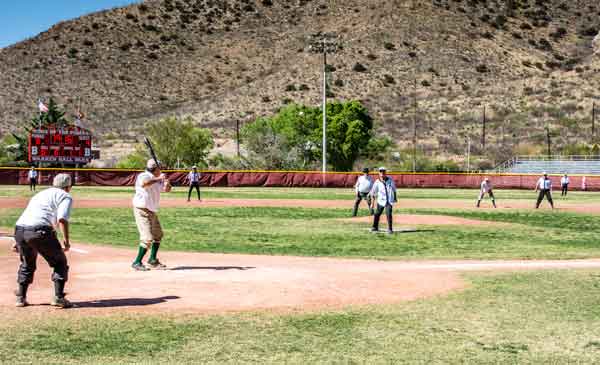
Copper Classic vintage baseball action
The history of Warren Ball Park is much longer and richer than I have time to go into here. Seriously, if you love baseball history, go spend some time at the Friends of Warren Ball Park website - you won't be disappointed.
Anyway, as you might be able to tell, I got lost and spent a few hours delving into this artifact of America's pastime. Then, I stopped into the online shop for the Friends of Warrenville and saw that they were selling baseball cards to raise some funds for the ballpark's upkeep. You're telling me that I can add some cool oddball pasteboards to my collection and help the Friends rebuild the outfield fence at Warren at the same time?
The organization printed up their own set of baseball cards which shine the spotlight on players who have sat in the home dugout of Warren Ball Park throughout it's 110+ year long existence or who originally hail from the Bisbee area. Sold in four sets of five cards, I figured that - with such a long and rich history of baseball to pull from the 20-card checklist must feature an eventual Cub or two. Luckily for me, after checking each listing, I was thrilled to discover that I was not only correct in my hypothesis, but that there was even one player featured that I still needed for my CATRC binder.
Seeing as most of the guys I still need for my marquee collection are super obscure and old players who don't have much of a cardboard footprint, you better believe that I was making a purchase.
As it turns out, the guy who I was after holds an important distinction, despite his obscurity:
This sepia-toned, 4"x 3" oddity is one of my favorite finds in a long time, even though they're printed on thin, almost photo paper-esque stock.
Signed by the Chicago Cubs prior to the 1938 season, Jesus "Jesse" Flores would eventually become the first Mexican-born pitcher to play in the Major Leagues four years later. However, before this pioneer blazed his trail, he started his journey with the Bisbee Bees. Though they didn't seem to have an official working agreement with the Cubs, they must have had some sort of deal, as there were a few Cubs prospects farmed out to the Bees down in Class D ball. At any rate, the knuckleballer made short work of his competition and quickly rose through the ranks.
Flores was quite good during his short time in the Majors too. Throughout his seven-year career, the hurler posted a 3.18 ERA across 176 appearances, 113 of them being starts. In fact, he even earned some down-ballot AL MVP votes in 1943, after the Cubs allowed his contract to be purchased by the A's. All in all, Flores had himself a pretty nice Major League career. Not to mention, when he wasn't in the Bigs, he was a star in the open classification Pacific Coast League through 1954, which was nearly as popular as the Majors in that time.
Here's what the back of these Warren cards looks like
After baseball, he continued to have a large impact on the game, eventually becoming a revered scout for the Minnesota Twins. He'd go on to sign quite a few significant names, including Lyman Bostock and Bert Blyleven, among dozens of others.
Despite his cultural significance and quality performance both on the mound and behind the clipboard, Flores remains nearly completely forgotten today. At least partially, this most likely has to do with the fact that he played for some truly terrible teams. Despite his low career ERA, he was saddled with a 44-59 record in a time when the pitching win meant everything - the Cubs and Athletics of the 1940's were not exactly powerhouses and were nearly always near the cellar. It should also be noted that, especially considering the era, a hefty dose of racism more than likely played a role as well.
Flores with the Cubs-affiliated Los Angeles Angels, second from left. Image courtesy of KCET.
As an added bonus, seeing as most of his career took place during the War Years and the seasons immediately following, Jesse's baseball card ledger is quite desolate. Best I can tell is that there were a few rare regional issues made during his active days and one Historic Autographs cut signature card made a couple years ago. So, until Friends of Warren swooped in and became friends of Wrigley Roster Jenga, my only choices for Flores' slot in my CATRC were super rare/expensive and ugly. That's the way it typically goes for players who came up in an era were paper was much more valuable in the war effort than bubblegum cards.
While the focus of this post is definitely on Flores, remember the set in which this card was sold in packs of five. So, perhaps we should take a look at the other four cards which the Friends of Warren Ball Park mailed my way? Especially since Jesse wasn't the only Cub in the bunch!
Roy Johnson was a longtime coach for the Cubs and even (ever-so-briefly) served as interim manager in 1944. Prior to that, Johnson began his dugout career as the very first manager for the Bisbee Bees. Furthermore, "Hardrock" spent some time playing in the outlaw Copper League and thus played through Warren as a visiting player. Thus, Johnson is yet another Cub who has strong ties to the Warren Ball Park. That being stated, Johnson is already represented in both the managers and coaches sections of my CATRC.
Next up, we have yet another Cubs card - this Cubs fan is getting a lot of bang for his buck with this set!
Hadley Hicks was born in Bisbee, AZ in 1933 and is best remembered for his time as the head football coach at Sterling College in Sterling, Kansas for two seasons, from 1988 to 1989, compiling a record of 3-16. However, prior to that, Hicks was a baseball star at Arizona State and was able to parlay that into a brief minor league baseball career. For one season, he played for the Pulaski Cubs in the rookie level Appalachian League. He was also a published author and served on the board of the Arizona Athletic Hall of Fame
On that note, here's a relevant sidebar. The Pulaski Cubs eventually became the Pulaski Yankees and were unceremoniously axed from organized baseball in the great minor league reorganization project that Rob Manfred has overseen. But, that's an angry rant for another time.
Finally, we have another local star and an area umpire, but this blog post is already running too long. These guys have no connections to the Cubs, so if you want to learn more about them, you should toss a few bucks to the Friends of Warren Ball Park and add some of their oddball cards to your collection. Beyond the five cards you've seen here, there are four other sets of five available in their store and the subjects of those collations are every bit as interesting as those seen here. There's even some AAGBL stars in there for some added flavor, a league which has been criminally ignored by trading card manufacturers!
So there you have it, the story behind Warren Ball Park, the Mexican-born trailblazer who called the park home and eventually made history with the Chicago Cubs, and some wonderfully obscure oddball trading cards for your viewing pleasure. My eternal gratitude to the Friends of Warren for printing up these pasteboards, allowing me to add Jesse Flores to my favorite collection, and for being so quick to ship and a pleasure to deal with. For those reading, now you understand why I was still excited to talk about these even though they were acquired several months ago.
Hopefully, when the world starts returning to some semblance of normalcy and I can reschedule our family trip to Arizona, I'll have the time and opportunity to visit the oldest ball park in the United States. Everyone always talks about Fenway and Wrigley, but I'd say that Warren Ball Park definitely deserves a little more attention from the baseball-loving populace.
As far as baseball cathedrals go, you can't get any older than Warren.