Saturday, March 22, 2014

Angels in the Outfield (and First Base)

I've been on a bit of a buying blitz lately.  I'm so close to completing my 1980-present Cubs collection and to 60% for my All-Time Roster Collection that I just can't help myself.  So, when I saw this card listed on eBay for 50 cents, it was pretty much inevitable that I'd pull the trigger; it satisfies both needs:


Angel Echevarria was only a Cub for a single season and boy was it a terrible season.  Not for him personally, but the 2002 Cubs were abysmal.

They went 67-95, second to last in the NL Central, cycled through 3 managers and were near the bottom of the league in every offensive category.  Sandwiched in between just missing the playoffs in 2001 and a division title in 2003, it looked even worse.

But, it offered Angel Echevarria a chance to prove that he still belonged in the majors.

Angel came up with the Rockies as a spray-hitting outfielder with a little pop (think Matt Murton) in 1996.  After three seasons of riding the shuttle from the majors to the minors, he got some regular playing time in 1999, where hit .293 with 11 homers in 102 games. 

But then 2000 happened.  A herniated disc kept him out of the lineup until June and he never seemed to recover even after he was activated from the DL.  He was placed on waivers, where he was claimed by Milwaukee, and demoted to the bench.  On the year, he batted .296 with 1 homer in 41 games.

He was kept on the bench by Milwaukee in 2001 and things got better.  His .256  avg seemed to indicate that he might find a home as a pinch hitter.  The Cubs thought so anyway, so they signed him going into the 2002 season.

 Angel drives in the winning run in a walk-off victory against Florida in the 16th inning

Although there were many, many weak spots on the Cubs in 2002, Angel was not one of them.  As a regular contributor off the bench, he batted .306 with 3 round trippers in 50 games pinch hitting and spelling Fred McGriff at first base and playing the corner outfield spots.  You'd take that coming off of your bench, right?

Well, the Cubs decided to go a different direction and let him walk.  Unfortunately, no other MLB teams took a flyer either and he ended up in Japan with the Nippon Ham Fighters.  As a regular, he ended 2003 with 31 home runs, 81 RBIs, with a .275 batting average.

Now the level of competition isn't exactly the same, but I think Angel sure would have looked better coming off the bench for the 2003 Cubs than Troy O'Leary... But, hindsight is 20/20, right?

Even after that solid season in Japan, he would never make it back to the big leagues.  Although, the Cubs did eventually offer another chance, signing him to a minor league deal with an invitation to spring training for 2005.

He fought valiantly, making it through to the very last round of cuts before getting sent to Iowa.  He stayed until May before being released, never again to play professional baseball.

.........................................................................................................................................

Crossing Angel off of my list, I now need only the following players to complete my Cubs from 1980-Present side-quest; it's crunch time!:

Gene Krug - 1981
Bill Johnson  - 1983-1984
Johnny Abrego - 1985
Mike Maksudian  - 1994
Joe Kmak - 1995
Roberto Rivera - 1995
Ramon Morel - 1997
Ramon Tatis - 1997
Steve Gajkowski - 1998-1999
Derrick White - 1998
Richard Barker - 1999-2000
Doug Creek - 1999
Brad Woodall - 1999
Raul Gonzalez - 2000
Mike Mahoney - 2000, 2002
Mike Fyhrie - 2001
Ron Mahay - 2001-2002
John Gaub - 2011
Jeff Beliveau - 2012
Lendy Castillo - 2012
Chang Yong-Lim - 2013
Zac Rosscup - 2013

Friday, March 21, 2014

Assaulting the 80's

As I mentioned in a recent post, The 80's Called, They Want Their Cliches Back, I mentioned that one of my side-quests in my All-Time Roster Collection is to obtain a card of every Cub who has played since 1980.  I'm getting very close to achieving this and today I can cross two more names off of that list thanks to super-cheap eBay auctions.

These two were career minor-leaguers who were served a few cups of coffee in the mid-80's, but never amounted to much:


In fact, Botelho was already pretty much a lost cause by the time he ended up with the Cubs.  The pitcher was a 2nd round pick by the Phillies in 1976.  He was traded to the Cubs just 2 years later in the Manny Trillo deal and appeared in 4 insignificant games with the Cubs AAA affiliate before being released.  Game over, right?

He took a year off before latching on with the Royals in A-ball.  He had a good run in the organization and by 1982 he made his Major League debut, getting into 8 games (2-1 4.13 ERA, 24 innings).  But the next year went poorly for him in AAA, posting an ERA well over 5, and the Royals traded him away, back to the Cubs, before the 1984 season began.

He was purely organizational filler by this point and he pitched in the Iowa rotation.  Then, 1985 happened.  It seemed like every pitcher in the Cubs organization pulled up lame, with the entire starting rotation eventually ending up on the DL.

Enter Derek Botelho.  He got into 11 games (7 starts) as the Cubs turned to desperation mode while trying to find live bodies to stand on the mound, with a line of 1-3, 5.32 ERA.  Once the Cubs got healthy in 1986, Botelho's MLB career was over.

Derek Botelho today, pitching coach extraordinaire, with another former Cub, Luis Salazar

After bouncing around in the minors for a few more years, he called it quits in 1988.  Starting in 1990, he then took up coaching, which this card notates.  He's still in the game today as a pitching coach for the Class A-Advanced Lynchburg Hillcats, his 24th year as a coach and 38th in professional baseball. 

But, if he'd hung around in the bigs for just 1 more year, he might have pitched to our next subject...


...Mike Martin, a catcher who had been toiling in the minor leagues for 8 years before finally getting a shot with the 1986 Cubs.  He was the Bobby Scales of his generation.

He was a 1st round draft pick out of college by the Padres in 1978, but never lived up to his promise.  The Padres cut ties with him in 1984 and he signed as a minor-league free agent with Milwaukee.  He was to be their starting catcher at AAA, a tenure which this card pictures, but only got into 77 games and batted just .230.  He was cut loose again at the end of the year and the Cubs took him on to be their AA catcher in 1986. 

1986 was an All-Star and Gold Glove season for Jody Davis, but there wasn't much talent behind him that year.  Steve Lake was unproductive, Steve Christmas was injured and Keith Moreland was an emergency option at best.

Thus, Mike Martin's chance in the majors finally came.  In August, he was called up as a backup backstop (say that 5 times fast!) and batted .077 in 8 games, obviously not enough to push himself ahead of the crowd, even with as weak as it had been.

Mike Martin catching, with Reggie Jackson at the plate, in spring training 1987

He stayed on through spring training of 1987 before finally being cut from the roster.  I guess one stint in the majors was good enough for him, as he never played professionally again.  He's now the president of a baseball academy in Las Vegas.

This 1985 release from Cramer Sports Productions' excellent Pacific Coast League set was the only card that I could locate for Mike.  There is a card that pictures him as a member of the Cubs' AA affiliate at the time, but it's a tough find.  I'll take this one though, as I love minor league cards and this set is amongst my favorites of such pieces.

..................................................................................................................................................

Two more obscure Cubs down.  I now have 1,158 Cubs out of 1,988 all-time (58.25%).  As for my quest to complete the Cubs roster from 1980 through today, I have just 23 to go:

Gene Krug - 1981
Bill Johnson  - 1983-1984
Johnny Abrego - 1985
Mike Maksudian  - 1994
Joe Kmak - 1995
Roberto Rivera - 1995
Ramon Morel - 1997
Ramon Tatis - 1997
Steve Gajkowski - 1998-1999
Derrick White - 1998
Richard Barker - 1999-2000
Doug Creek - 1999
Brad Woodall - 1999
Raul Gonzalez - 2000
Mike Mahoney - 2000, 2002
Mike Fyhrie - 2001
Angel Echevarria - 2001
Ron Mahay - 2001-2002
John Gaub - 2011
Jeff Beliveau - 2012
Lendy Castillo - 2012
Chang Yong-Lim - 2013
Zac Rosscup - 2013
 
Have you seen these men?

Thursday, March 20, 2014

Leave No Binder Unturned

Today's post will cover the second half of my surprisingly large haul from my LCS.  I know you've been sitting at the edge of your seat, waiting patiently since last night to find out what else I found, so I won't keep you waiting any longer.

The cards themselves are not particularly rare finds, but it seems vintage cards are always harder to come across when it comes to physical store.  Hidden under the binders and books of unwanted, junk wax basketball cards was a box filled with 1967 and 1975 Topps.  Hallelujah!

Perfect; the mid-70's and earlier is where collection starts to thin out a little bit.  This box did not leave me disappointed either:


Let's go in order and start out with my '67 finds.  Vic Roznovsky was a catching prospect with the Cubs who first came up in 1964.  In 2 years with the club, he hit an anemic .214 with no power and average defense.  They dumped him on the Orioles for Carl Warwick, who then traded him to Philadelphia in April of 1969, in what would be his last season.

It sure likes he could have used a tan when the picture for this card was taken.

Art Shamsky was a fine super-sub for the Red in the mid 60's before being traded to the Mets in 1968.  He excelled in a rightfield platoon with Rob Swoboda and helped to push the Cubs out of the pennant race in 1969 - jerk.  But, back injuries started to get the best of him by 1971 and he tried desperately to hang on.  His 15 games with Chicago in 1972 netted him a .125 BA and a ticket out of town.

Art was also the manager of the Modi'in Miracle in the first and only season of the Israel Baseball League in 2007, a league in which former Cub Ken Holtzman also managed.

I have one problem with this card of Mr. Shamsky and it is about the back of the card.  The 1967 set featured some fine cartoons in what has become a lost art.  However, Art's doodle in the upper left makes him look like a bit of a perv:


Is the runner trying to avoid a tag or is he trying not to be pinched on the butt?  We'll never know.


This beat up piece of cardboard from 1975 features one of the first in a long line of failed top draft picks in Cubs history.  Terry was drafted 2nd overall by the Cubs in 1967 and only appeared in 2 major league games, both in 1970.  He had fallen off of the prospect map by the time the Cardinals purchased him for 11 games in 1973   The Red Sox had a go at fixing him in 1974, but his career .209 BA wasn't going to improve.  Seeing as he never appeared in the majors after that, this is his official "sunset" card.

Although this card is bent, water damaged and nicked, I'll still gladly take the opportunity to cross a name off of my list.

Beyond the binders, I was still able to find yet another box, this one stuff with older Cubs issues.  It was mostly your big names (i.e. Santo, Banks, Williams, etc.) but there was also this high-number, 1965 Topps rookie card:


This set is one of my all-time favorites and it's no wonder they chose to base this year's Heritage set off of it's design.  They really should have picked a better picture of Beckert though.

Now, of course I added Beckert to my collection a long time ago, Roberto Pena is a name that has eluded me. The Cubs decided that he was a lost cause after batting .214 in 57 games from '65-'66 and like many players of that time (Lou Brock, Moe Drabowsky, Bill North, etc) he proved them wrong, having a a few nice seasons as a regular middle infielder for the Phillies, A's, Padres & Brewers.

This concludes my bragging about the purchases that I made yesterday.  I was able to add 12 more names to my All-Time Roster Collection and I'm getting pretty close to 60%!  It just goes to show, you never know what you'll find at the bottom of a pile of junk.

I have to say though, having this blog has definitely made a great outlet for such things.  Now I no longer have to hide my excitement or bore the crap out of my girlfriend or roommates about this and that card find.  So, now you all will suffer so that they won't have to!

Wednesday, March 19, 2014

Cut, Copy, (Re) Print!

With it being a gloomy Wednesday afternoon and a particularly boring day at work, I decided I needed a pick-me-up.  What's the best way to brighten a day? A trip to the local cardboard merchant of course!

The LCS by my workplace is pretty good. More Fun Sports Cards has all your typical relics, autographs, shiny things, etc. in cases up front. But, for a guy like me, the best part is the table in the middle of the room with casts amounts of unsorted cards, ripe for the picking.

While some find this sort of sorting daunting, I relish it. It honestly makes me feel like I've earned my reward, a feeling I don't get when I simply point and click my order.

By golly, my day became brighter than a 70's Padres jersey after this trip!  I found enough new additions for my All-Time Roster Collection that I'm going to have to divide it into 2 separate posts.  So, let us commence Episode I: The Phantom Men.... Aaaaand I've just been sued for copyright infringement.

The title for this post stems from my love of re-prints. At this stage in my collection, most players that I need are from the 60's and earlier.  Seeing as I'm not made of money, re-prints allow me to satiate my need to collect without having to shell out for Tobacco cards, like these 1910 Plowboys:


This sepia set was originally printed 104 years ago, but this edition only dates back to 1992; slightly newer.  The full group features Cubs and White Sox players of the day, but the dealer was kind enough to let me break the set and cherry pick; he finds my collection goal fascinating.


Johnny Kling is probably the biggest new name that I acquired.  He was the Cubs starting catcher for much of their early 20th century dominance, including their last two World Series titles, excepting 1909.  That year he decided to pull a Michael Jordan and jumped into a different pro sport: billiards. Was it worth it? Well he did win the World Championship, so...

Francis "Big Jeff" Pfeffer was a workhorse pitcher who had two tours of duty with the Cubs, 1905 and then again in 1910. He even pitched a no-hitter, but of course that came in a Boston uniform in 1907. His younger brother Jeff also pitched during the same era, mostly for the Dodgers and Cardinals, thus "Big Jeff."


Fred Luderus came up with the Cubs in 1909 and played sparingly for the club through 1910. As a first baseman on a club with Frank Chance, he was superfluous. Therefore, he was traded to the Phillies where he became their, mostly adequate, starting first baseman all the way through 1920. Fun fact: he was the very first Phillie to hit a home run in World Series play, coming in 1914.

Ginger Beaumont was not a silent movie star or 19th century southern belle, despite what imagery his name conjures.  The longtime Pirate won the batting title in 1902 with a .357 avg and
was the first player to ever come to bat in World Series play. But his 1910 season with the Cubs would be his last, as recurring leg problems finally got the best of him. I believe he was signed by Jim Hendry to a mega-deal going into that year (sarcasm alert).


Al Carson's entire MLB career lasted only 6.2 innings.  He made two relief appearances for the Cubs in May of 1910 and then rode off into the sunset, never to be seen again.  That's about all I can find on the guy. I legitimately thought that this guy would never make it into my collection, seeing as his career was so very short and so very long ago. I'm amazed he ever had a card; but, I love surprises!

Rube Kroh was brought in for the stretch drive of the 1908 season, where he started 2 games late. His lasting contribution in Cubs lore though, is that he is allegedly the player who got the ball to Johnny Evers in the famed "Merkle's Boner" game.  He hung around until 1910 and then finished up his career with the Boston NL club  in 1912.


Finally we have the Jason Marquis of his time, Harry McIntire, although this card incorrectly uses a "y" to spell his surname.  Harry was an innings eater and not much else.  The season which best exemplifies this is 1905, where for Brooklyn he led the National League in Hits Allowed (340), Earned Runs Allowed (127) and Hit Batsmen (20). He also led the league in Hits Batsmen in 1908 (20) and 1909 (21).  His career win/loss record is a horrid 77-117. Remember, this is the Deadball era, where pitching was king.

Even if those were the only cards I pulled today, it wouldn't be bad for a days work. In fact, I'd call it stupendous considering the amount located and the fact that the players are ancient.  But, that wasn't all I found today and I'll detail the rest tomorrow. Meanwhile, it's time to watch the Cubs vs. Rockies Cactus League game.

Tuesday, March 18, 2014

It's Important to Have Spares

It's always important to have a spare.  This applies to every aspect of life, be it collecting baseball cards, filing important documents, keeping a cheap cell phone around for when you inevitably drop it while running down a CTA ramp to catch a train and it slides face first the entire way down the concrete surface...  Ok, that last one was extremely specific, but I'm still mad at myself for that one.

Anyway, after the winter we've had in Chicago, it's especially important to make sure you have a spare tire ready to go.

Driving to work every day using the roadways in Northwest Indiana is like driving on Swiss cheese (but the road doesn't taste nearly as good as Swiss cheese) and it was inevitable that this would bite me.  Today was that day:


Notice that the rim is cracked; the hole was so deep and the impact was so jarring that it actually turned on my windshield wipers.  Yikes!

As a baseball card collector, I always keep some spares around just in case the potholes evolve to the point that they swallow up my card collection, or something like that anyway.

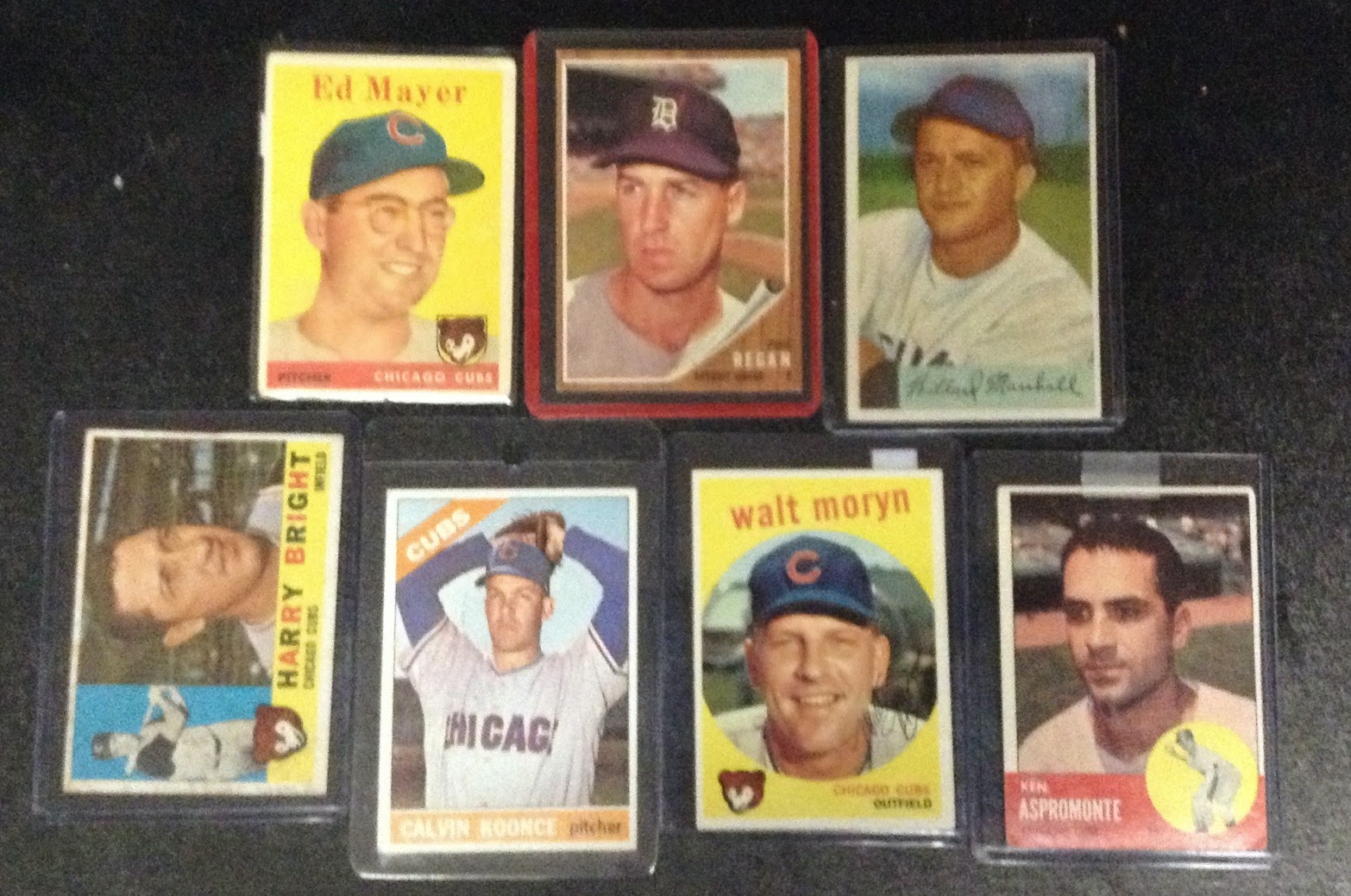
But, I'm trying to clear out some space before I move next month and so the time has come to jettison some of these spares.  I have a few copies of these cards do to my hoarding personality, so I feel pretty comfortable sending them to other homes.  Anyone want to trade?


If you're interested, send me an e-mail and I'll provide some higher quality pictures.  Please see my "Who I Need" and ""Most Wanted" pages on the top of the page and we can arrange a safe exchange. 

I made that sound like a hostage situation; I promise I'm not holding these guys against their wills.

Monday, March 17, 2014

Old as Moses Monday: Bob Addy

*I bet you can figure out the concept here;  it shines the spotlight on the Cubs in my collection that time forgot a long time ago.  We're talking pre-WWI here!*

This piece of cardboard comes from Tristar's Obak series, 2011 edition.  It honors ball players of yesteryear  and important moments/achievements in baseball history.  While this card features a terrible Photoshop crop-job (can someone really lean on the sunset?), there aren't exactly a ton of pictures of our subject:  Bob Addy...


Bob "The Magnet" Addy was the original "scrappy" or "gritty" ball player, or at least darn close to it.  He got his uniform dirty, played honestly (an important trait in those rough'n'tumble, gambling-influenced days) and threw himself all over the diamond.  Mark DeRosa would be proud.

Plus, his uniform may have even been the first to get dirty as he is credited as the first to introduce the slide in organized baseball, an event that this card commemorates.

Yes, he's that old. In fact, we don't know for sure how old the man was; his birth date has been lost to history.

Bob Addy's playing career predates the formation of the National League.  The Canadian started off playing amateur ball in Rochelle, IL in the mid-1860's.  When future-Cub Al Spalding and his Rockford Forest Citys came to town in 1866, Addy “startled the players of the Forest Citys by a diving slide for second base. None of us had ever witnessed the play before, though it may have been in vogue. Certainly we were quite nonplussed.”  Sidenote, "nonplussed" will be my new word-of-the-day tomorrow


Though he may not have been the very first, he certainly was the first to popularize the slide.

He was also the original "Shoeless" baseball player.  While Joe Jackson may be famous for ditching his cleats  in the bush leagues, it was Addy that originally tried out this strategy due to his recurring foot injuries, many moons before Jackson was around.


Addy bounced around pro-clubs and positions on the diamond until the formation of the NL in 1876, where he joined Spalding, the man he impressed years ago, with the Chicago White Stockings, aka the Cubs.  As a Cub, he was already nearing 40 and limited to mostly the outfield. He hit a modest .282, the weak spot in the batting order as every other regular hit over .304.  He was eventually benched in favor of Oscar Bielaski.

However, his wit was much stronger than his bat.  When a July exhibition game to raise funds for an orphanage was rained out, the Chicago Tribune wrote that the orphans were unlucky.  When asked to comment, Addy stated "it was to have been expected that they would be unlucky, for if they hadn’t been unlucky they wouldn’t have been orphans at all.”

Despite his benching, he still came up clutch for the Chicagoans in their eventual Championship run. When the Boston Red Stockings came to town near the very end of the season, Addy made five wonderful catches to save runs in an eventual win.  He then played the hero in the clinching game against the Hartford Dark Blues, with 2 more outstanding catches in the ninth inning to preserve a 7-6 win and the NL Pennant.

What I wouldn't give to write that in the present tense!


However, he was fed up with Chicago and bitter than he had been benched mid-season.  He left the club after 1876 and moonlighted with the Cincinnati Reds in 1877 as a player-manager, but Addy's career was over after that.

After his career, he tried (unsuccessfully) to jump-start a professional baseball league.  The twist?  It was to be played on ice!  Can you imagine Starlin Castro trying to get off a throw to first while on ice skates?  A funny thought, but you might actually see that if Chicago doesn't warm up pretty darn soon. Zing!

Opening Day at Wrigley Field 2014

All in all, Addy is a forgotten hero in Cubs history as the club may very well have lost that inaugural NL Pennant without his heroics.   He was also a pretty interesting character who would have been loved as a scrappy, hustling player that we fans seem to attach ourselves to. 

Sunday, March 16, 2014

Short Stay Sunday: Paul Schramka

Welcome to the 2nd edition of the weekly feature "Short Stay Sunday."  Please make your way to your seats as the feature presentation is about to begin.

Today's profile will be on one Paul Schramka.  His short stay on the northside was really short; it lasted all of three days, April 14th-16th in 1953.  As a bright-eyed, 25 year old prospect, you really think he would've been around longer.


Athletics ran in the Schramka family blood, as his brother Gene captained the basketball team for Marquette University from 1951-1952.  Basketball, too, was a love of Paul and he excelled at both sports as a high schooler in Milwaukee.

But, it was his skills on the diamond that caught the attention of a Cubs scout, who signed him to a minor league deal out of high school. Paul had other ideas though.  Namely, playing hoops at the University of Notre Dame and he was granted his release in order to pursue that dream before actually appearing in a game.

It was not to be though, having failed to impress the Notre Dame basketball coach during tryouts, Paul transferred out after just one semester.  He landed at the University of San Francisco in 1946, where he was to receive a scholarship for basketball and baseball.  But, he soon dropped basketball to focus exclusively on baseball as his playing time on the court diminished.

The tiny school (1,800 enrolled) didn't even have athletic fields and didn't belong to an athletic conference.  However, it offered him the opportunity to play and he made the most of it, regularly batting over .330.  He even became good friends with future NFL commissioner Pete Rozelle. That opportunity lead him right back to where he started, the Chicago Cubs.

He re-signed with the club in 1948, who out-bid 13 other teams for his services.  However, just 5 days after signing, while running up some steps on his way to church, he tripped and fell.  He injured his right shoulder enough to require surgery.  Ahhhh, Cubs prospects just never change do they?

Then, after regaining his health and playing in A-ball, Paul was drafted into the Army.  Instead of going to Korea, he was luckily shipped off to Germany.  But, it seemed as if he would never make it to the bigs.

A few bumps in the road wouldn't stop Paul though and he impressed upon his return stateside in 1952 during spring training. He got the call to open the season as the 7th (!!!) outfielder.  He only saw action as a pinch runner and substitute left fielder, never getting a plate appearance in 2 games.

He was sent right back down and never re-emerged.  After eventually being demoted back down to single-A, he was released 1953.  At age 85, he is back living in Milwaukee after a long career as an undertaker and playing baseball in industrial leagues.

But the real significance of Paul's career was his jersey number:  14.  He was the last person to wear the number before "Mr. Cub" Ernie Banks came along.  It was Paul's telegraph to Ernie shortly after the latter was first called up that makes for one of the funniest moments in Cubs history.  It read, "I left all the base hits in the jersey for you."


The card I have to honor Mr. Schramka's short stay is from baseball card merchant Larry Fritsch's fascinating "One Year Wonder" set.  Another particularly useful collection of cards as this set spotlight's ball players who's stays were so short, that they never had a major league card.  As an added bonus, it's even autographed!

There you have it folks, the story of Paul Schramka.  I hope you enjoyed this week's edition of Short Stay Sunday.  Please kindly make your way to the exit and we hope to see you back next week to learn about another, more recent, local boy.