Wednesday, March 25, 2015

Stroke the Furry Wall

Because that's what you do when life slips you a Jeffrey.

Quick - name that flick!

The Jeffrey that life (or rather Ebay) slipped me yesterday afternoon was of the Beliveau variety.


A Cubs relief-prospect who was on the shuttle between Des Moines and Chicago throughout 2012, thus keeping him from finding his niche (4.58 ERA in 17.2 frames) and burning up his options prematurely. This lead to his unecessary DFA that offseason.

That development proved to be unfortunate, as Jeffrey emerged as a strong component of the Tampa Bay bullpen last season, posting a 2.63 ERA in 30 games.

But we snapped Joe Maddon up from under their noses and the bullpen has actually been one of the strongest and most well-stocked aspects of this team lately - so, we win!


He's ours Tampa!


This mugshot of a baseball card comes from Jeffrey's minor league days, 2011 to be specific. You'll notice that the 18th rd. draft choice from 2008 is listed as a member of the High-A Daytona Cubs, but the uniform he is sporting clearly does not match up. He's actually wearing a Tennessee Smokies uni, AA affiliate of the Cubs.

I find this somewhat goofy, seeing as he never tossed another pitch in Daytona after his call up to the Volunteer State mid-way through 2011. That said, I can see why Daytona would have wanted to document his time spent there in their team-issued set of cards - 0.52 ERA in 17 innings with 2 saves. His performance continued right on up to AA, were he posted a 1.89 ERA in 57 innings. You can see why he became a prospect, despite his draft status.


You win some, you lose some

Courtesy of Dilip Vishwanat/Getty Images North America


So, even though it wasn't for Chicago, it's nice to see that Jeff may have finally solidified his spot in the Major Leagues. What's not nice is my record keeping.

You see, I thought I still needed a Jeffrey card to place into my Cubs All-Time Roster Collection. So, when I saw this card listed for about $1 with shipping included on Ebay, I pounced, seeing as minor league singles are generally tough to come by at a decent price.

Well, it turns out that I was wrong. In fact, not only did I have a card representing Beliveau in my CATRC, I had one that was graciously bestowed upon me by P-Town Tom of Waiting 'til Next Year fame.


This one even looks more like a baseball card than a mugshot. Doh!

C'iest la vie. There much, much, much bigger problems in the world that I could be having to deal with right now. So, I'll just add this to my greater Cubs card collection and smile.

Unlike Jeffrey - he looks like he's been too busy stroking furry walls to smile.


Tuesday, March 24, 2015

Congratulations - It's Tripletts!

Don't worry, I haven't become a parent.  Lord knows I can barely take care of myself and a cat at this point in my life.  Plus, children seem to have a natural distaste for me anyway.

Rather, the "Tripletts" alluded to in the title of this post are actually a reference that works two-fold.  First, I recently acquired a new to my collection, set of three oddball cards.  Second, one of the players featured in said set is one Coaker Triplett.

See?  It's all coming together now!


Yes, it's a Cardinals set.  No, this Cubs fan hasn't lost his mind - two of the subjects were also Cubs during their careers.  In fact, Coaker is actually another name I can now scratch off of the want list for my CATRC!

Yesterday, spotlighted a set of cards by one of the undisputed kings of pre-junk wax era oddballs, Larry Fritsch.  Today, that spotlights swivels over to another even more powerful force:  TCMA.

The no-frills set honors the Cards of 1942-46.  Why that particular span, you ask?  Well, they managed to make it to the World Series in 4 out of the 5 years, winning 3!  That's quite the run, isn't it?  Even this Cubs fan has to (begrudgingly) show respect.

Mr. Triplett was a spare outfielder from 1941-42 and 9 games of '43 for St. Louis and he did a pretty good job of that, batting .266 over across 149 games.  However, with names like Slaughter and Musial populating the outfield, he never got a lot of playing time or an appearance in the World Series.  


 It's hard to get reps when these guys are ahead of you on the depth chart!


He was traded to the Phillies in 1943 and hung around the league for another two seasons in the same sort of role.

But, more importantly, before all that he was part of another World Series bound team:  the 1938 Cubs.

He made the Opening Day roster as a starter during his lone year in Chicago and got off to a torrid start with 9 hits in his first 14 at-bats.  However, he soon cooled off and lost his starting role by May.  Before May was even half way through, he lost his roster spot entirely.

He went back to the minors and at some point was acquired by the Cardinals, though BBref doesn't know when.  It wasn't until the Cardinals run of dominance that he resurfaced in the Majors.


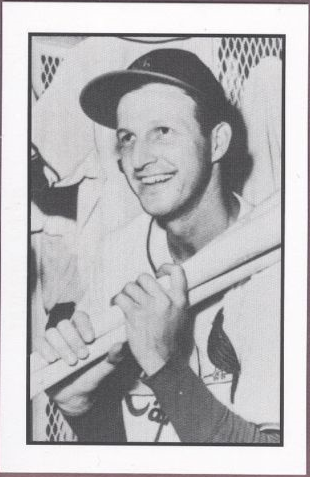
Now, obviously the card on the left in a '72 Topps and not a TCMA piece; it was Harry's prior representation in my CATRC binder.  Now, since this TCMA set provided a card depicting Harry's playing days, it has been replaced.

Nothing against that card, mind you - I love '72 acid dream-like design.  I just prefer to have players represented in my collection with player cards.  Blah, blah, OCD.

"Harry the Hat" was another reason that Triplett never saw much action.  The 2x All Star roamed the outfield for all of the Cardinals' World Series appearances in that span, except for 1944 when he was serving in the military.

Since it was the franchise's modus operandi of the day, the Cubs brought the veteran into their fold in 1949, after the years of playing and serving our country had rendered him a shell of his former self.  They traded another aging slugger, Swish Nicholson, for 42 games of his services.

It worked out alright though, before the year was up, the Cubs were able to flip "The Hat's"
.264 BA to Cincy for 2/3 of their starting outfield for almost the next decade:  Frankie Baumholtz and Hank "The Mayor of Wrigley Field" Sauer.

Theo Epstein would be proud.


The third card in this set is up for grabs since Terry Moore never had anything to do with the Cubs organization.  Is there a Cardinals collector who would like to claim this oddity?

This career Cardinal was another key component in the outfield for that juggernaut team.  The 4x All Star might have been destined for Cooperstown if not for his service in the Armed Forces.

Nothing against the man, I just don't have a use for this card in my collection and I would hate to see it gather dust as a result of my disinterest.

Speaking of disinterest, it's probably about time that I wrap this post up.

All in all, though the design is rather basic on these cards, I'm quite ok with it.  For one, the limits on printing technology at the time for a company like TCMA would have kept them from doing anything fancy.

For two, I feel as though retrospective sets featuring golden-era ball players should be minimalist in nature.  Flashy colors, chrome finishes and random geometric patterns wouldn't really go with the mood of the set.  Basic designs are more in-line with the times of the subjects.

But, that's just me and I've been wrong about a lot of things in my life.

Hopefully not about becoming a parent any time soon. Yikes!


Monday, March 23, 2015

You're All Winners to Me

Don't worry, this blog hasn't devolved into an annoying after-school special where every person is a unique little snowflake and there isn't anything negative thing in the world that can't be fixed with happiness and teamwork.

It's done plenty of devolving, but I haven't dropped to that point yet.

No, this post is about a set of cards that was published a few times over in the late 70's/early 80's that has proven to be extremely helpful towards my Cubs All-Time Roster Collection:  the late Larry Fritsch's "One-Year Winners."

They are fairly difficult to come across in brick and mortar stores, as is the case with most of such releases.  Therefore, I was ecstatic when I found a whole stack of them in my LCS not so long ago:


First put out in 1977, a set exemplified by the two cards you see above, a new set came out every 2 or 3 years through 1983.  Fritsch, who along with TCMA, was one of the undisputed kings of oddball cards in the pre-junk wax era.

His goal with this set was to shine the spotlight on players who only played in the bigs for a single season and were thus likely never to experience the joy of seeing their mug on a baseball card.

Without his noble cause, it would have been damn near impossible to cross Brinkopf and Thorpe off of my list.  For instance, Leon only got into 9 games way back in 1952 and the shortstop batted just .182 in 26 ABs.  Bowman wasn't rushing to get him in their set - no one was - as far as I can tell, this is the only baseball card that was ever produced with his likeness.  The Cubs were okay without him though; the next year, some fellow named Banks came up and did pretty well at short for the next few years.

Not to be confused with the player of the same name who made a three-year cameo in the majors a few years earlier, Thorpe's only big league action came in 1955 and lasted for a whopping 3 innings across 2 games.

It got ugly from there.  Bob was driven from the game by a sore arm and elbow surgery by the end of 1959.  Less than a year after his retirement from baseball, Thorpe was working as an apprentice electrician on power lines in his native city of San Diego, when he was accidentally electrocuted at the age of 24.

Just finding a picture of Bob in a MLB uniform had to be challenge, let alone a baseball card.


The next edition of Fritsch's "One-Year Winners" came out in 1979 and Mr. Eaddy here was the only example of which I was able to add to my collection.

In researching Don for this post, I know find that he almost could have been spotlighted along with Tim Stoddard, Kenny Lofton & co. in my post on Saturday about players who both starred on the hardwood in March Madness and played for the Cubs.

The versatile athlete was a three-sport star for the Michigan Wolverines - halfback in football, guard in basketball and third baseman in baseball.

His hoop skills were legitimate, having been selected as an All-Big Ten Conference player. Unfortunately, the Wolverines did not make the NCAA tournament during his college days.

Having ultimately decided to pursue his baseball career, he signed with the Cubs in 1955.  His reasoning for signing with Chicago?  "I thought I would have a better chance to reach the major leagues sooner with them, because they are not loaded with material."  Harsh, true, but harsh.

Unfortunately for him, he was soon drafted into the Air Force in 1956 and had to put his MLB dreams on hold until 1959.

When he finally ascended to the Majors that year, Eaddy was able to make it into 15 games.  The catch being that they were all as a pinch-runner except for a single at-bat, in which, he struck out.

Thus ended what could have a promising career.


Now, we fast-forward to 1983 to examine the third and final set.  As you can see, the design drew it's inspiration from the very set that this year's Heritage is aping:  1966 Topps.

Elder was in fact White's given name but it also proved fitting in that he was 28 years old by the time he reached the top rung in 1962.  It was easy to get lost in the shuffle with the Cubs and their ludicrous College of Coaches experiment that was going on at the time.  However, the middle infielder did not help his cause by batting .151 in 64 PA's.

His career in the minors was much more successful and 12x longer as well.

Lary actually managed to sneak onto an MLB roster in two separate year, but those two years were VERY separate.

The pitcher got into a single game during the 1955 season and turned in a quality start - going 6 innings with 2 ER.  Despite that, Al wouldn't get the call again until 1962, when he saw action in 15 games, mostly out of the bullpen.  The fact that he posted a 7.15 ERA in the span assured that he wouldn't get a third year in the bigs.

All told, having signed with the Cubs in 1951 and retiring from baseball in 1964, Lary spent 14 years in the organization and only played in 16 MLB games - talk about gutting it out!


Don Prince was really more of a frog - and that was really more-so for his exploits after baseball.

After all, he really didn't have time to do anything significant in the majors.  His career lasted but a single inning in 1962.  He walked a Met and hit the second man up before eventually settling down and retiring the side.

But many years later, in 1996, Prince was arrested by two undercover policemen in South Carolina.  The crime?  Murder for hire!  Turns out that sometime after he quit baseball, he decided that being a hitman was his true calling.  He got 17 years in the big-house, which means he was only just released a couple of years ago.  Watch your backs, folks!

Gregory is a far less interesting case.  the hurler made the big time in 1964 and managed to stick around for 11 games out of the bullpen.  He posted an ERA of 3.50 in 18 innings without factoring in a decision.  Not too bad, right?

The Cubs must have liked his bat too.  He was used as a pinch-hitter 13 times, but he only managed one hit.  He even played some outfield in the minors that year, likely as a means of extending his career and usefulness to the franchise.  Sadly, it wasn't enough and this Brooks Kieschnick prototype was out of baseball by 1965.

Perhaps Prince was the one who killed his career?


The last card that I added to my collection was that of George Gerberman.

In September of 1962, George was a promising young prospect in his second year, just drafted out of the Braves organization.  He was lucky enough to get that ever-elusive call to the show and was thrust into the spotlight.

He didn't do too badly either.  In his lone appearance, a start against the lowly Mets, George went 5.1 innings and only allowed three hits with one ER.  He was a little wild though, allowing five walks before being relieved by Freddie Burdette.

Even so, that was to be his only chance to shine on a Major League diamond.  Gerberman kept on trying though; pitching in the minors through the 1968 season with varying levels of success.


As you can plainly see, this set has already proven fruitful for my CATRC and that's just the tip of the iceberg.  There are several other players who have popped up in the various editions of this set that would cross off targets on my want-list who would otherwise be impossible.

So, thank you Larry Fritsch for your contributions to the baseball card world.  It is sets like your "One-Year Winners" and the like that break up the monotony of the Topps-dominated world.

Diverse subjects make for more interesting sets, in my opinion.  I'd rather find a card of Don Eaddy or Elder White than a millionth one of Ryne Sandberg any day.

That said, I still love my Sandbergs - I'm kind of a hypocrite too.

I know I said that this post wouldn't devolve into an after-school show where I gab on about how everyone is unique and special, but Fritsch and his cards were definitely so.


Good luck getting that out of your head; I've been trying for 20 years!


Sunday, March 22, 2015

Sunday, (No) Fun Day

The man that I'm about to profile would certainly not approve of the "Sunday, Funday" drinking phenomon amongst today's youths.  In fact, he would not approve of drinking alcohol on any day of the week.

Who is this humbug, you ask?  Well, he shares his last name with this day of the week:


That's right, the famous evangelist, orator and prohibition-pusher was a Major League Baseball player in his youth.  He was a pretty decent one too.

The unique card you see above was made to honor Sunday by one Dave Stewart; no, not the current Arizona GM.  This Stewart was a disabled Vietnam Veteran who, in the 80's and early 90's, created a series of unique baseball card of obscure subjects like Sunday, Kurt Russell and even Abe Lincoln in their baseball-playing days.  He'd give these cards out in exchange for donations, presumptively to pay for living expenses and the cost of printing these professionally done, glossy cards.

Unfortunately, no one knows what became of Mr. Stewart.  All that remains are his fascinating, odd ball creations.
 

Nope, wrong Dave Stewart


As for the subject of his entry into my collection, we know exactly what became of him.

The Iowa native was born into poverty and even spent some years in an orphan's home before his blazing speed afforded him an opportunity with Cap Anson's Chicago White Stockings in 1883.

Used as an extra outfielder for most of his career, he stole 246 bases (that we know of - records weren't kept before 1886) over the course of his 8 year career, including a whopping 84 in 1890.  It's a good thing he was so fast, because his bat was mediocre at best with a career .248 mark.

But, it was the wild and crazy lives of his teammates which eventually pushed him away from baseball and into the church, especially the exploits of King Kelly, who's spot in the outfield Billy would take when King caught.


 A couple of original Goodwin Sundays that I definitely do no own.


The Stockings played hard and drank harder and were known to basically live on Rush Street.  It was during one of these drunken escapades in 1886 or 87 when Billy and the boys were stopped by a gospel preaching team.  Inspired, Sunday soon adopted Christianity and denounced drinking, swearing & gambling.

It was soon thereafter that Billy was sold to the Pittsburgh Alleghenies (who's uniform he is sporting in the card you see above) in 1890.  Was it a result of his new-found sobriety and faith? That answer has been lost to time.

After a few successful seasons in Pittsburgh and one in Philadelphia, Sunday decided that his time devoted to baseball would be better spent devoted to God and he walked away from the game at the age of 27.


From that point forward, he became one of the most fiery and dramatic orators of his time, holding evangelical revivals all across the country, drawing audiences of thousands.  In particular, he held great power in Chicago - maybe a result of his time with Anson's NL ballclub?

One of his favorite causes was prohibition and he is often credited as being one of the main reasons that the infamous 18th amendment was  ratified in 1919.

We all know how that turned out, but it wasn't for lack of effort on Sunday's part.

Through all of this, Billy never lost his love for the American Pastime.  He often umpired minor league ball games in towns that he held revivals in, attended MLB contests whenever he could, including a game of the 1935 World Series just two months before he died and made appearances in old-timers games.

Which, despite how wonderful the Stewart oddball above is, it's a card that depicts Sunday at one of these old-fogey contests that represents his Cubs tenure in my CATRC:


The reason that this 2013 Panini Golden Age card (inspired by the DeLong Gum Co. set) supplanted the Stewart is because it officially lists him as a member of the Cubs - well, Chicago anyway.  A cubs card always trumps a Pirates card!

Also, let's take a moment to appreciate Panini.  Though they may lack an official license and their logo-less cards sometimes turn out awkward and weird, they sure do put forth some effort.

After all, do you really think Topps would bother to include subjects like Sunday in their sets?  No, they'd much rather play it safe and easy with several new Banks, Sandbergs, Williams, etc. every year.  This would require too much research and to actually go out on a limb for once.

That frustration aside, I felt that Sunday would be the perfect day to show off my two-card deep Sunday player collection - the fact that he played well more than a hundred years ago really limits the cardboard options for him. 

We'll close things out with a song - a song that name checks our subject and his effort to end drinking. It was the first time I ever heard his name, long before I realized he was a baseball player.

Ladies and gentlemen, here's Ol' Blue Eyes himself and his little ode to Chicago - the town that Billy Sunday could not shut down:


Saturday, March 21, 2015

It's Madness, I Tell You!

So, the sports world is currently being consumed with Madness, March Madness that is.  The NCAA Division I Men's Basketball Tournament is all anyone seems to want to talk about.

I've never been one to get into college sports, so this excitement is lost on me.  Maybe it's because I don't feel any loyalty for schools which I never went to and my alma mater competes in the NAIA.

But, that doesn't mean there isn't any aspect of the tournament and it's history that intrigues me.  I heard a snippet about this topic on the radio the other day and it drew me in quickly.

There have been only two players in history who have competed in the Final Four and also a World Series.  Plus, they just so happen to have played for the Cubs (not in the World Series though *sigh*)


Kenny Lofton was both a well-traveled MLB speedster AND a backup point guard on the University of Arizona Wildcats.

In fact, for his first two years in college, his primary sport was basketball - he didn't go out for baseball until his junior season.

In 1988, he backed up Craig McMillan and future Bulls star Steve Kerr as the Wildcats made it to the Final Four, before being bounced by Oklahoma in the semi-finals, 86-78.

So close - almost as painfully close as being the center fielder for a Cubs team that was 5 outs from the World Series...

*Happy thoughts, happy thoughts!*

But, who is this other man who was lucky enough to play in both national spotlights?


Ah, a member of another Cubs team that came painfully close to ending the most infamous streak in sports.

But, no matter, though he didn't make it to the World Series with the Cubs in 1984, he got his ring the year before with the World Champ Orioles.

Not only that, he was the starting point guard for the North Carolina State Wolfpack squad that went 30-1 on their way to winning the national title and breaking UCLA's seven-year run on top.

Thus, Tim Stoddard is the only man in sports history to both win a NCAA Division I basketball championship AND a World Series ring.

What a bad-ass athlete!


Now, both of these men are local boys and hail from East Chicago, IN.  So, to tie it all together with a nice big bow, both Tim Stoddard and Kenny Lofton attended and played basketball for East Chicago Washington High School.

There must be something in the water out there!  I mean, besides all the pollutants from the oil refineries and such.

While no other multi-sport star has been able to reach the championship level of both arenas, there have been several others who have competed in both March Madness and then later made it to the MLB.

By my count, two of them played for the Cubbies as well:


At Loyola Marymount, Terrell Lowery made it to the Elite 8 in 1990 as a guard.  As a Cub, he hit .241 in 33 games from 1997-98.  After brief stops with the Rays and Giants, he washed out of baseball by 2000.  I would say that his basketball experience was probably much more memorable.

More memorable both because of his team's success and because he was the person who fed the allyoop to Hank Gathers moments before his tragic death on the court that same year in the regular season WCC tournament.

I didn't say it had to be memorable for entirely good reasons, now did I?


Finally, we have Steve Hamilton.  He was both the forward for the Morehead State University Eagles when they competed in the 1956 & 57 NCAA tournaments and a long-time member of the Yankees pitching staff before wrapping up his career with the Cubs in 1972.

He later came back to Morehead after his baseball career ended to become their baseball coach and, later, their Athletic Director from 1987-97.

However, the picture that you see of Hamilton does not depict him in an Eagles uniform (I could not find that); no, it shows him in Lakers yellow!  You see, Hamilton was the second person to play in both professional basketball and in the MLB.

The first? ANOTHER Cub - The Rifleman himself, Mr. Chuck Connors, who played for the Boston Celtics in the old National Basketball League.


Baseball, Basketball, acting... was there anything this man couldn't do?


From 1958 to 1960, Hamilton was a power forward/center for the then Minneapolis Lakers.  Over 2 seasons he averaged 4.5 points per game, 3.4 rebounds per game, and 0.5 assists per game before he decided to pursue his baseball aspirations.

Seeing as he played for the team that lost to the Boston Celtics during the 1959 NBA Finals and he pitched for the Yankees in their 1963-64 World Series losses, Steve is (as far as I can tell) the only man to appear in the championships of both professional leagues, albeit in losing efforts.


 Eat your heart out MJ!
(I wish I hadn't lost this card - image courtesy of tradingcarddb.com)


So, though I might not give much of a damn who wins which school comes is crowned the NCAA champions this March, but that doesn't mean I can't find something interesting about the tournament.

Seeing as it takes a truly special athlete to reach the top levels of any sport, it's not all that surprising that there is some crossover at lower levels.  After all, there are several others who have competed in both the MLB and the NCAA tourney; however, they weren't Cubs so I don't care nearly as much!

That said, here's hoping that the end of March comes quickly and that baseball will soon reign supreme in sports conversation.

I can't take much more talk about Kentucky...


Friday, March 20, 2015

Gotta Get Down on Friday


TGIF!  I'm almost as elated as Alfonso here that the end of the work week has finally arrived.

Today will be just a quick post, as my schedule is really crowded and I'm saving my well-thought out post ideas for the next couple of days, when I'll have much more time to do them justice.

In the meantime, since his emotions nearly match mine, I figured this was as good of a time as any to show off this fantastic Topps Stars piece from 2008.  I have plenty of Sori cards in my collection, but when I saw this sitting in a discount box, there was no way I was leaving it there.

First of all, I don't think I've ever seen such pure elation on any baseball card.  This shot would have been perfect for the old Emotion brand put out by Fleer in the mid-90's.

Second, it comes from one of my favorite moments in Cubs history - or at least from my era:


Ah - 2007 - one in a long line of "next years" for us Cubs fans.  However, it was as I jumped up and down in my living room after this glorious walk-off that I thought that this squad really could come roaring back from 8 games back that May.

And they did.  In fact, they had many come from behind victories such as this, as I recall.  They called them the Cardiac Cubs.

It felt like destiny.  We all know how that eventually turned out; but, nevertheless, it was a great moment in a great season.

Also, let's take a second and appreciate Sori's vertical!  If this whole baseball thing hadn't worked out for him, maybe he would have had a future in hoops.  Speaking of which, that's a good hint as to what tomorrow's post will be about...


Who is this and what do they have to do with tomorrow's post?


All in all, I had to add this wonderfully shiny piece of pure ecstasy to my CATRC binder to represent Al.  I was happy to do so - maybe not as happy as he was at the time though.

I'll close things off with the song from which this post gets it's title.

WAIT! Don't worry, I'll be merciful and not post the original - we all know how terrible that is.  However, this version is very much exemplary of the joy of Friday:


Thursday, March 19, 2015

What's This? What's This?

You just never know what you're going to find at your LCS.

Especially at mine, anyway.  I find something new for my collection pretty much every time I step in the door - no matter how often.  They amaze me.

But, sometimes, they mystify and confuse me.  In a good way.

A few weeks ago, I was browsing through one of their glass cases of vintage cards and I saw all the usual suspects.   Stars of the 50's and 60's on Topps cardboard were staring back at me, but they held no interest to me.  It was a stack of cards with this oddity on top that caught my attention:


Hey, we're talking pre-war vintage gold here!  Vance Page was a Cub from 1938-41.  He was a mediocre pitcher, but he logged some time in the 1938 World Series and how many people can say they pitched for the Cubs in the World Series?

Well, none.  They've all since died, but you get my point.  That includes Page, who unfortunately died at the far too young age of 35 when he fell off of a barn in 1951.

But, back to the card - what the heck is it??

Odd size (though that's pretty usual for the time), penciled in names, random seam in the middle, no identifying information whatsoever... I was stumped.

There was no more help to be found on the back:


But it sure looks like a trimmed playing card to me.  However, the front did not have the texture of a playing card; it felt like a normal square of cardboard.

The shop's purveyor really had no clue either.  He bought a collection en masse from a local yocal and found said stack of mystery cards nestled inside.  But, he did offer them to me for a buck a piece; anything that old for that cheap and I'm sold!

I did have a sneaking suspicion as to the origin of these cards, but more on that later.

Besides Page, I was able to find a couple more old-time Cubs that I needed for my Cubs All-Time Roster Collection:


That's Ival Goodman on the left and Al, not Paul, Epperly on the right.  Goodman appears to be pictured in a Cincinnati Reds uniform and the person behind the penciled in text seems to have confused Al with teammate Paul Erickson, both mounds-men.

Goodman was an All-Star twice over in Cincy during the late 1930's, but was running out of steam by the time the Cubs bought his contract in 1941.  His bat was still potent  (.298 BA in Chicago) but he couldn't stay on the field ( just 142 games over 2 seasons).

Epperly got a brief trial with the Cubs in 1938, getting into just 9 games before being sent down.  Unfortunately for him, Al wasn't to see his name on a big league roster again until he took the mound for 5 games with the 1950 Brooklyn Dodgers.  Talk about perseverance!

Since Epperly only had one season with the Cubs, I think we know what year these cards date from!

It was the notch that's predominantly present on the front of Goodman's card that really cemented my theory as to the story behind these cards; that said, it was the back of the same card that absolutely confirmed my theory for me:


It looks like a chopped up entry form for some long-forgotten contest put on by the Reds.  So, what does this mean?

It means that these are super-vintage custom cards!

Some kid in the late 30's wanted more baseball cards, so he grabbed an old program/scorecard/advertisement (I'm not sure exactly what publication they came from) with pictures of ballplayers, cut them up and glued them to whatever scrap paper he could find - including playing cards and old ballots.

I guess Goudey wasn't "Goudey-nuff" for him! Nyuck, Nyuck, Nyuck.


A time-period appropriate reference!


They might not technically be authentic baseball cards, but that just makes them all the more fascinating to me.  As a result of their home-spun creation, there's so much more character and child-like wonder behind these customs.

Thus, they will still be entered into my CATRC set until further notice.  An authentic release would supplant them from that binder, but not my collection.  They are far too unique and special for me to simply get rid of them just because they were created by a kid in his basement rather than a chewing gum company.

Like I said, you just never really know what you're going to find in your LCS.  Topps flagship? Definitely.  Flashy auto/relic cards? Sure thing.  Pre-WWII vintage customs?  Apparently it can happen.