Friday, June 12, 2020

Old Frog and Even Older Players


One of the hot button issues in sports today involves the Confederate flag.  NASCAR, a traditionally southern sport, has tried to drag their organization into the 21st century by officially banning the rebel flag from all of their race tracks and events.  Without getting too far into the weeds, I just want to applaud the organization for finally acting on the matter, even though it's a decision that's been decades in the making.  Flying the flag of a hostile foreign power that stood for human bondage is not being proud of your heritage, it's anti-american.

Anyway, here we are in the third decade of the new millennium and yet we're still fighting a war that  ended when Betty White's GRANDPARENTS were young.  

With that in mind, it's time I make a sudden pivot to some lighter, but somewhat related content.  This flag controversy might date back to the shadow of the Civil War and just a few days ago, I acquired some cards which also were inspired by the same time period and they are far less controversial.


The very first "Cubs" squad in 1870.


The Chicago Cubs were founded as the Chicago Base Ball Club just five years after the bullets stopped flying, in 1870.  That's right, in case you didn't know, the Cubs can trace their roots back several years before the National League was even a thing, back to when professional baseball was still a new concept.

After a year of amateur play, the Chicagoans became one of the founding members of the first true Major League - the National Association - 1871.  Unfortunately for them, the White Stockings (as they came to be called for reasons you might guess) were only just barely able to finish one season because their ballpark, records, and uniforms were completely destroyed by the Great Chicago Fire.  Afterwards, the team went on hiatus for two years while they, along with the rest of the Windy City tended to their wounds.  Of course, they were back in time for the 1874 campaign and, after another league hop and some name changes, still play today at the corner of Clark & Addison.

This is a gross over-simplification of their evolution, but you get the gist.

As longtime readers of Wrigley Roster Jenga know, it is my goal to collect at least one card of every player to ever suit up for the Cubs franchise.  This includes everyone from every era, including those guys who were actually White Stockings and not technically Cubbies.  Pre-war cards are tough as is, but trying to track down realistically obtainable pasteboards for men who's playing careers predated the founding of the National League has proven to be quite the chore.  I had long since resigned myself to the fact that I'd probably never be able to complete my collection and this era of Chicago baseball has remained completely unrepresented in my Cubs All-Time Roster Collection tome.

Until recently, that is.  A couple of weeks ago, a hero "hopped" into my life:


While randomly perusing Ebay late one night, I was haphazardly plugging the names of long-forgotten ballplayers of yore into the search bar.  It was during this process that I stumbled across a listing that almost made question my sanity.


A whole set of cards based around the old National Association?  Major League Baseball rarely even acknowledges that their history extends before the National League and, thus, it's rarely acknowledged by anyone but hardcore baseball history nerds.  Yet, here's an entire set of cards dedicated to the original MLB circuit?  You could say my interest was piqued, but that'd be putting it quite lightly.

While skimming through the details and featured images, I quickly deduced that the cards centered around the inaugural 1871 NA season and each founding club was represented by nine spots on the checklist.  The Fort Wayne Kekiongas were there, the Troy Haymakers were accounted for, the Cleveland Forest Citys were present, and - most importantly - my beloved Chicago White Stockings were no exception!


The only fact that tempered my excitement was that the complete set cost $120 and I didn't exactly have that much fun money lying around for baseball cards.  Furthermore, I had no idea what the story was on these oddballs nor was I at all familiar with the seller, who went by the name of Old Frog.  However, this listing had dug deep into my brain and was not going to let me go.  With that literally in mind, I fired off a quick message to this fellow, asking some questions about his product and sheepishly inquiring if he might be interested in selling team lots in addition to the full collation.

Luckily for me, the vendor was, in fact, feeling "froggy."

Mr. Old Frog explained to me that all of these cards are individually drawn, cut, distressed, and collated by hand to create a faux-vintage look.  Also, he was generously willing to offer me a team set for the Chicagos, going so far as to create a separate, private listing for little ol' me.  For fifteen bucks, the whole set of Stockings was mine, an extremely fair price, especially considering how much work goes into these ACEO's and how much card art sells for on the 'Bay.  I mean, just look how much a single Helmar card sells for these days.

Needless to say, I "hopped" on that deal.  In fact, I could have kissed that old frog.

Just a few days later, my eagerly anticipated gap-fillers arrived in the mail and they most certainly did not disappoint.  Let's take a look at the "Cubs" of 1871, shall we?


First up, we have the battery.  George Zettlein started all 28 games that season (which I think is a schedule that MLB would love to bring back this summer) and pitched all but 10.1 innings.  Different times, right?  Along the way, "the Charmer" earned 18 of the clubs 19 wins and posted a 2.73 ERA, which was tops in the circuit. George earned that moniker from his deceptive changes in speed and his ever-present smile. However, Zettlein is also noted for having given up the first home run and grand slam in NA - and thusly - MLB history.

Meanwhile, the man Zettlein was pitching to was Charlie Hodes, who contributed a .277 batting average.  Beyond that, I don't have much information on Mr. Hodes.


Into the infield now, we have Michael "Bub McAtee at first base and Jimmy Wood at second.

Bub batted .274 for the Stockings after joining the club from Troy.  McAtee had been playing with the Troy Haymakers for several years, but jumped to Chicago for '71.  Meanwhile, Wood holds a special significance to the franchise beyond starting at the keystone.  You see, Jimmy was the literal, very first Chicago Cub.  It was Wood who was tasked with putting together a "nine" to represent the city of Chicago, charged by a business man by the name of Tom Foley late in 1869.  Wood also served as the team's maiden manager.

Additionally, Wood lead the 1871 White Stockings in more ways than one.  Besides being the skipper, he was the key cog on offense, leading the way with a .378 batting average, one of only two men to cross the .300 threshold.


Hugh Duffy, the shortstop, was a controversial figure in the sporting world.  Duffy's name was infamous for having previously been banned from organized baseball following a gambling scandal in 1865.  However, he was welcomed back in 1870 with the Stockings and was still with them the next year.  Ultimately, it would officially be his first and last true professional season.

Ed Pinkham was both the club's first baseman and it's emergency pitcher.  Pinkham took the pitcher's box (no mound yet) when Zettlein was pounded for ten runs in just two frames by the Boston Red Stockings in a June contest.  Pinkham pitched the rest of the way and, though he allowed four runs of his own, ultimately earned the win as the Chicagoans stormed back to win 16-14.  He also swatted three doubles and scored four runs.  You've heard of the night the backup catcher got the win, but I bet this is the first you've heard of the day the third baseman got the win!

Pinkham's pitching heroics weren't completely out of the blue though, as he spent 1870 as Chicago's ace hurler before moving to third.  Baseball sure was different back then.  He was also a Civil War veteran, having served with 47th New York Volunteer Infantry.


As for the outfield, we only have two of the three regulars.  I'm not sure why Tom Foley - who is not the same business man that funded the team - didn't make the cut.  But, let's focus on who is actually here.  Joe Simmons was the weak link in the starting lineup, batting an anemic .217 was Treacey was second only to wood with his .339 mark.


Lastly, we have Marshall "Mart" King, who played as the team's roving utility player.  Injuries seemed to be a problem for King, as he missed more than a month of the season with a broken finger and, while subbing for Hodes at catcher in a game against the Red Stockings, suffered a “peculiarly painful and enervating injury.”  Curiously, whatever that injury was has been lost to time.

Missing from this set are the aforementioned Tom Foley and Mike Brannock.  The latter is not nearly as notable, having only appeared in three games as an emergency replacement for Ed Pinkham, who did not make the final road trip of the season.

And there you have it - the 1871 Chicago White Stockings, as illustrated by Old Frog.  Overall, while some portraits are better than others, overall the artwork is solid and feels very authentic to the era.  The artificial distressing also helps in creating an aura of antiquity about these decidedly modern cards.  My only complaint is that the cardstock is rather thin, but that's only if I'm feeling nitpicky.  All in all, I am quite content with my purchase.

As for the real '71 Stockings, they very nearly won the first National Association pennant.  Of course, the Great Chicago Fire decimated their home city just as the season began to wound down.  However, the team didn't let that tragedy stop them - they doggedly played the rest of the schedule on the road and in borrowed uniforms (the club literally lost everything in the blaze).  In the end, the Stockings lost to the Philadelphia Athletics in the very last game of the year which gave the pennant to the City of Brotherly Love.  The Chicago franchise was then temporarily disbanded (for what should be obvious reasons) after the campaign.


When the team reformed in 1874, Jimmy Wood once again lead the charge.  However, he was strictly a bench manager at this point, as he had a leg amputated due to terrible infection just prior to the season.  Also returning were Zettlein and Treacey, but the rest of the roster was made up of completely fresh faces.  Funnily enough, Pinkham was apparently the inspiration for Dwight Schrute, as he retired to a beat farm.  But, by the time the National League was formed in 1876, none of the original Stockings remained on the roster and were thus kicked to the dustbin of history by MLB.

Thanks to Old Frog, though, there are actually some baseball cards floating around out there that honor this era of baseball history.  Without him, the National Association would remain completely unrepresented in my CATRC binder.  For that, this guy is the exact opposite of a toad, in my book.

Further evidence of just how good of a frog this prince is comes from all of the extras he threw in with my team set.  That's right, not only did he make a special order of his hand drawn art at a rather modest price, he also included a bunch of bonus material for my enjoyment.


In our conversation, I mentioned that Clipper Flynn was one of my favorite pre-NL players.  When I first caught this player's name while skimming a dusty old tome as a young adult, I was struck by his name - it just flows so well and seems so apropos of an 19th century baseballist.  Flynn plied his trade with Troy in 1871 and therefore appears as a Haymaker in the Frog's NA set.  That being said, the first baseman was also an original Cub, as he was on their amateur roster in 1870, prior to the formation of the NA.

Thus, I nearly croaked when Old Frog mentioned that he would graciously include a Clipper card in my package, along with the White Stockings.  This amphibian is absolutely out of his lillipad!

Also, I should probably let ya'll see the back of these ACEO oddballs, as - unlike many of his peers - Frog does not ignore the reverse.  We get an illustration of our hero, very much in the vain of a trade card from the 1800's, along with the 1871 stat line for the player depicted.  As you can see, Clipper knocked out hits at an impressive "clip!"

And as if all this wasn't enough...


While I have been obsessing over Old Frog's National Association product, he reminded me that's not the only set that he has created.  Clearly a student of ancient baseball history, this polliwog uses his talents to shine a light upon another oft-forgotten Major League circuit:  the American Association.


The AA was the first league to rise and mount a sustained challenge against the Senior Circuit's reign.  In fact, from 1886-1890, the first proto-World Series were played between the champions of the two leagues, two of which involved the Chicago White Stockings after their transfer from the NA.  But, these first postseason championships are not included in the modern World Series' lineage.  Why not? The Stanley Cup doesn't pick favorites when it comes to which leagues contested the title.

Frog's set focuses on the 1882 season, which was the first season for the upstart league.  Charlie Householder here played for the original Baltimore Orioles and looked equally at home on diamond as he did at a Dick Dastardly look-a-like contest.  No Cubs connections here, sadly.  The design of this card and the action shot remind me very much of the legendary Goodwin tobacco cards of the same era.

Perusing the checklist, I see a bunch of painfully obscure guys who both played in the AA in 1882 and spent time with the Chicago Base Ball Club.  I might just have to snag a few packs of this product and see if I can pull a Ned Cuthbert, Charlie Waitt, or John Peters.  At only five bucks a pop, these packs are priced in-line with and are much more intriguing to me than a lot of the stuff Topps and Panini stock the shelves with.
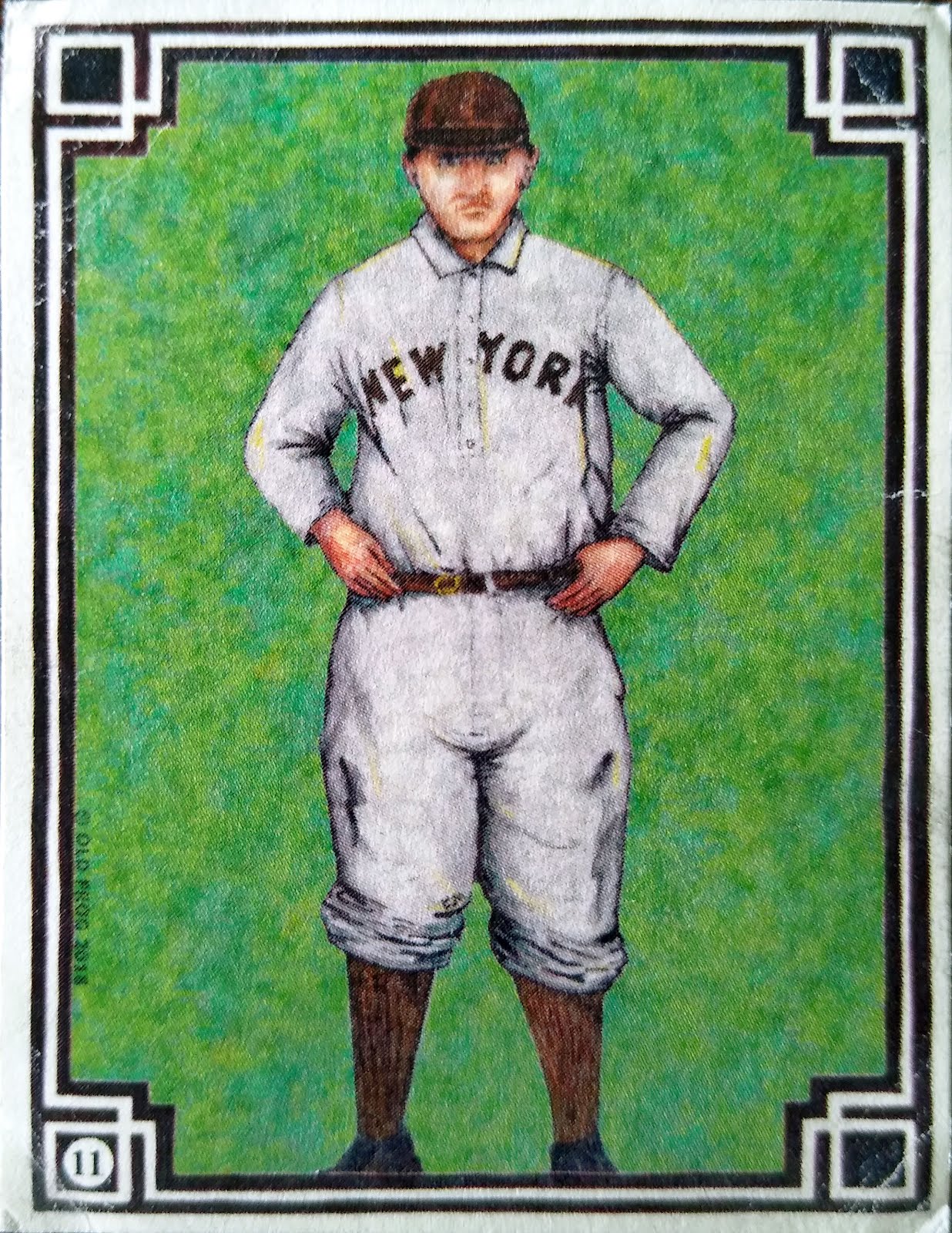


Old Frog also has a 16-card set dedicated to Hall of Fame manager, John McGraw, which comes in a signed and numbered tin box and a 42-card checklist dedicated to the Giants of Early Black Baseball which focuses on African American heroes from before the Negro Leagues were even formalized. 

While I am extremely familiar with the career of  "Little Napoleon," Williams Clarence Mathews is a name that I have never heard of.  Apparently, Mathews lead the Harvard baseball team in batting average for three straight years (1903-05) and, upon graduation, joined a minor league club in Burlington, becoming the only black player in the white professional ranks.  There were even rumors that he'd break the unofficial color barrier in 1905 and join the struggling Boston Beaneaters as their starting second baseman, more than forty year before Jackie Robinson successfully did so.  However, this obviously never occurred.

Mathews joined the Bar Association in 1908 and went on to enjoy an immensely successful career in politics.  He eventually became one of the first African-American Assistant District Attorneys in the country and worked on the Calvin Coolidge campaign.  In the end, William rose all the way up to the U.S. Assistant Attorney General before he passed away in 1928.

As successful as he was in the world of politics, it's a damn shame he didn't get that rumored shot with the Bostonians.  I just barely skimmed his career, but I highly encourage you to do some research on this early trailblazer - his story is for more interesting that I can do justice in a brief blog summary.  I learned more from this freebie than I did from the rest of the entire purchase!


Lastly, to add an exclamation point to his package, Old Frog also tossed in some simulated ephemera from the mid-to-late 1800's, including a mock ticket stub, an advertisement for some sort of miracle elixir, and an advertisement for a locomotive assembly plant.  As much as I love baseball, I too am an avid fan of railroading history, so that was a fortuitous throw-in!

With that, we've finally covered all the goodies found in Old Frog's mailing.  All in all, thanks to his artwork, I've added ten names to my CATRC binder that I truly never thought I would be able to obtain, plus a handful of other fun bonus items - thank you, Old Frog!  I hope to do business with you again soon; after all, there are still several players in the rest of your National Association set who eventually spent time in Chicago, plus those American Association players I mentioned earlier in the post. 

If you would also like to sample the Frog's work, you can find his Ebay store right here.  His work is certainly at least worth perusing!

In the meantime, screw the Confederate flag.  If were going to continue reliving and re-litigating the Civil War and Reconstruction Era a century and a half later, let's focus on our national pastime instead of a flag that stands for a hostile foreign power, human bondage, and racial hatred.

Just sayin'.


Wednesday, June 10, 2020

A Long Time Coming


The card you see is not real.

While it might look, feel, smell, and taste like a true, blue (and pink) 1976 Topps single, it is nothing but a construct.  This pasteboard is nothing but a digital image, a .jpeg file that is posing as an authentic, means of bubblegum conveyance.  Wayne Tyrone, briefly a Cubs outfielder, does not appear on the checklist and, in fact, never shows up on a baseball card whatsoever.  I created this impostor to fill a gap in hobby history that Topps so irresponsibly created 40+ years ago.

Until recently, that is.

Although, while not an MLB-approved bit of memorabilia, this trading card has come to exist in the same physical realm that we currently occupy.  By that, I mean that I printed it out on cheap cardstock and printed with my workplace's HP Laserjet photo printer.  Shhhhhh.... that's our little secret.  Even better still, this Wayne Tyrone card can now be considered a true collectible, rather than a cheaply made ACEO wannabe.  You might be asking yourself, "how can this be, Mr. Burbs?"  You see, after this card was spat out onto the tray, I stuffed it in an envelope, mailed it to the far-off land of Texas, and waited patiently for it to boomerang back to me with a signature.

Yesterday, was the day that "Lassie" came home.


And, as you can see, I delivered my card was delivered back to me with love.

The whole TTM process is common here on the blogosphere, so I feel safe in assuming I needn't explain the procedure.  Suffice it to say, if you are new to the process, one obtains the address at which a celebrity can be reached, sends an object that the sender wishes to have signed through the mail (along with a return envelope and paid postage), and then eagerly anticipates said celebrities return.  Some famous folks charge for this privilege, others don't, and still others have more hoops inquiring minds must jump through before a signature will be provided.  All in all, it's a fairly common hobby, especially among our lot.

This isn't my first rodeo either and I'm not just saying that because this return comes from Texas.  While I'm not a chronic TTM chaser, I have sent a dozen or so over the years with varying degrees of success.  Seeing as my collecting goal is to obtain at least one card of every man to have suited up for the Chicago Cubs and, like Wayne Tyrone, not every such athlete has had the privilege of appearing on a wallet-sized rectangle.

With this in mind, I've had to try any means necessary to plug these otherwise un-fillable gaps in my Cubs All-Time Roster Collection.  For more recent ballplayers, I've used the TTM process to create cards and obtain such players' John Hancock.  For some reason, a "stamp of approval" makes the customs feel like true collectibles rather than some fantasy piece.  Over the years, I've had luck with reaching and hearing back from several obscure Cubs, including Tony Balsamo, Footer Johnson, John PyechaGene Krug and now, Mr. Tyrone.


Of course, for each of these four (now five) successes there's been dozens of failures.  In fact, I was just discussing one of these missteps on Wrigley Roster Jenga last week, when I went ranting about how someone had pilfered one of my custom creations.  Not only did my TTM request to Bob Raudman not make it back to me, but a dastardly devil had taken the .jpeg that I'd shared on this blog and used it to hawk cheap prints on Ebay.

In that same post, I indirectly alluded to yet another TTM failure.  As a matter of fact, in another post just days earlier, I maligned the fact that this request went to a player that I was surprised had never appeared on so much as a regional or minor league oddball, considering his active career brushed up against a baseball card explosion.  One that I had sent out long ago and never heard back from.  One that I had given up hope on many moons ago, causing me to stop entertaining the dream of filling the player's slot in my CATRC tome.

That player?  Why, it was Wayne Tyrone!


I waited patiently for this one to come back to me alright, so long that I don't even really remember when I sent it out.  A quick scan of my blog archive seems to indicated that this custom hit the post office some time in late 2017.  So, all in all, it's taken nearly three years for this bird to come home to roost!

Did Wayne see my belly-aching online and get tired of the whining.  I suppose it's possible, I did include a link to my blog in my letter.  Awkward...

Anyway, way back when, I was searching various databases for former Cubs who were still living and didn't feature much of a cardboard footprint.  I found a listing for Tyrone on a website called ContactAnyCelebrity.com and figured it was worth a shot.  Lo and behold, I sank that shot; however, the ball bounced around the rim for a few years.  Better late than never though, right?


Perhaps we should take a moment to actually examine the career of the man that I so rudely bothered by mail.

Wayne Tyrone played professionally for nine years, from 1972-81, up and down the ladder from Quebec to Monterrey.  Before signing his first contract, Tyrone also starred for the University of Texas Pan American, which got him drafted by the Cubs in the 20th round of the 1972 draft.  Similarly, his older brother Jim also spent him amateur days at UTPA and was selected by the Northsiders just a year prior, though the elder brother went to Chicago in the fifth round.

All told, Wayne Tyrone manage to climb from the 20th round to the Majors in about four years, getting that call in the summer of 1976.  Tyrone then spent the rest of the season on the Cubs bench, filling in both the outfield, third base, and first base.  From July through September, Wayne batted .228/.262/.298 across 62 PA's in 30 games - obviously, not the strongest slash line.  Accordingly, the Cubs let him go after the National League's centennial campaign, where he would then go from the North Side to north of the border, inking a minor league contract with Montreal.  After a few more years in the Expos and then the Orioles chain, the now-journeyman wrapped up his pro career with a pair of seasons in the Mexican League, hanging up his spikes after the 1981 campaign.

In the end, Tyrone's 30 game cuppacoffee in 1976 ended up being the only Major League action on his ledger.


Wayne's older brother, Jim, was also Cub, spending three years with the team in the 70's


Interestingly, despite the fact that their time in the Cubs organization overlapped and both ultimately spent time on the Big League roster, neither player was on the 25-man at the same time.  Jim was a Cub intermittently from 1972-75; however, the year that his kid brother made the club just so happened to be a year which he spent the entire schedule in AAA.  While the brothers worked together in Wichita with the Aeros, Jim was left behind after Wayne made his debut.  Also, both Tyrone brothers were out of the Cubs org by the middle of 1977.

Fun factoid, the Tyrone's are one of 11 sets of brothers who both suited up in Cubbie Blue pinstripes.  You might remember the Patterson's, the Reuschel's, or even the Hairston brothers, but don't forget the Tyrone's!


Further fun fact - my custom card has also been sourced for Wayne Tyrone's Google search.


Since calling it quits as an active player, Wayne Tyrone has returned to his Texas roots.  It appears as though he's spent a lot of time coaching youth baseball.  It's always nice to see an old pro give back to the game - heck, lord knows MLB isn't actually vested in growing the sport, so it's critically important to see yesterday's stars do the heavy lifting.

Furthermore, in doing research for this post, I think I came across the reason why my card took so long to get signed, at least partially.  Unfortunately, it looks like Mr. Tyrone was suffering from some serious health problems, as of the early portion of 2020.  While trying to dig up some info on his post-playing career, I came across a Go Fund Me that had been set up to pay his medical bills.  Thankfully, the crowd-sourcing was immensely successful and collected more than double it's stated goal.  Hopefully, Wayne is doing better a few months later.  I don't mean to get up on my soapbox, but isn't it disgusting that in this "first world nation" we have to turn to the kindness of strangers on the internet to raise money for medical care?

I hope your on the up-and-up, Mr. Tyrone!

Wayne (standing, right) with his 9U champion Dallas Tigers ballclub.  Image courtesy of Dallas Tigers Baseball.


Has anyone else reading this had any experience with TTM requests?  Am I the only one who whips up their own customs to fulfill such inquiries?  If so, what's the longest that you've waited on a return envelope?  Can anyone beat me nearly three-year holding period?  Please feel free to share your stories in the comment section below; I'd love to hear from you!

Before I go, I should also remind all you readers that my Digital Dash contest is still open.  A couple of bloggers have taken me up on my offer, but I'd love to see a few more.  My wife and I are hosting a charity 5k run/1k walk to raise money for St. Coletta's of Illinois, a nonprofit that does a lot of critical work with adults who have special needs.  It's only ten dollars to enter the run or walk and everyone who signs up will be entered into a drawing for a prize package which will include an authentic 1936 Goudey Wide Pen Premium.  The race is open until Sunday, so all you have to is complete your distance by then and submit your time.  I know there are some runners out there on the blogosphere - let this virtual event fill the Covid-shaped gap on your fitness calendar.

Finally, just in case you are reading this, Wayne Tyrone, thank you for generously answering my letter and signing my fantasy card without asking anything in return.  I appreciate it more than you will ever know - I never thought I'd be able to fill this nagging gap in my collection.  I hope you're doing better and feeling stronger every day!

In the meantime, I'm left to wonder, do I have any other TTM requests floating around in limbo?  I guess I'll just have to wait and see.


Saturday, June 6, 2020

Digital Race for Physical Cardboard - a Contest


With the state of the world being what it is, much of our lives have had to go on pause.  COVID-19 has cancelled vacations, graduations, birthday parties, sporting events.  Of course, it's impossible for society to completely halt.  When possible, in order to prevent transmission, we've had to work from home, order groceries and supplies, and socialize through the internet.  Zoom has facilitated conference calls and workplace collaboration, retailers have pivoted to online ordering and curbside pickup, and graduation commencements have been simulated through YouTube broadcasts.  To the latter point, I've personally created two of them thanks to the Adobe Creative Suite.  Hell, even most of the pro sports leagues have taken to the web to fill the vacuum.  iRacing and an MLB The Show tournament were actively being discussed on ESPN and even broadcast on live television, though auto racing has since come back (with empty bleachers, of course).

In short, during the age of Corona, a lot of our everyday lives has gone digital since our reality is not an XBox game with a pause button.  In this scenario, does that make the Corona virus the mom beckoning us to the dinner table?  Anyway, I digress...


Like all sports, running has had to pivot, as well.  Of course, the Olympics have been put on hold and all of the major track meets and road races across the world have been postponed.  In fact, the Boston Athletic Association has truly embraced the upset apple cart by uploading the 124th annual Boston Marathon to the internet.  Registered runners will complete their 26.2 miles on their own time (with GPS tracking) and submit their times to officials, which will later be compiled to generate the official race results.  Will participants get the same thrill as they would staggering up Heartbreak Hill on a hazy, fall morning?  No, but it's something - something to distract from the troubles of the world and create a semblance of normalcy.

With that in mind, the charity for which my wife works, St. Coletta's of Illinois, has had to make a similar adjustment.  All of their in-person fundraisers have had to be cancelled since the outbreak hit pandemic status.  As a non-profit, you can imagine what this has done to their funding and their work with adults who have developmental disabilities.  One of the events that had to be struck from the calendar was a charity 1K walk, which was expected to be one of the pillars of their summer fundraising schedule.

However, not all hope was lost.  Instead of outright cancelling the event, my wife had the ingenious idea of following the Boston Marathon's example and using the internet to our advantage.  Now, St. Coletta's is hosting the Digital Dash 5K Run and 1K Walk, an entirely virtual road race.


Now, why am I telling you all about this?  Like I said, this event is being hosted by St. Coletta's of Illinois and - more specifically - my wife.  Of course, I want to see her succeed and I will do anything I can to lift her up as high as humanly possible.  Furthermore, seeing as she married a crazy runner dude, she brought me onto the project as the official Race Director, so I have an even more vested interest in this event's success.  The Digital Dash will be the first time I get to don the Race Director hat and, again, I'm going to promote this race as loudly as I can using every avenue available to me.

I know that I am not the only card collector who also dabbles in running and/or fitness.  With that, if you are like me and have been looking for ways to replace the races you had planned this spring and summer, I humbly ask that you consider the Digital Dash.  Race information and registration can be found right here.  For your troubles, you can have a soft, cotton t-shirt (that I designed, btw) mailed your way to commemorate your participation. There's also a bib available for download to truly complete the simulation.  Furthermore, there are medals up for grabs for the top finishing men and women, as well as participatory awards for all who submit a time.  All in all, we've tried to make this as much like the real deal as possible.


The biggest difference here between the Digital Dash your more traditional charity 5k is that, instead of the race taking place at one place, date and time, participants can complete their chosen distance whenever and however they'd like.  Do it on a treadmill, jog it on a trail, push a stroller or walk your dog - however you'd like to exercise.  Just make sure that the result has been submitted by next Sunday evening, so that we can compile the official results in a timely manner.

Most importantly, I'm not just taking to the blogosphere for selfish reason.  The money raised from this event will go completely towards St. Coletta's of Illinois and their work with adults with disabilities.  If you are not familiar, you can read all about the nonprofit's goals and what they do for the community right here.  I've seen first hand what great work they do and they need all the help they can thanks to the Corona Virus crisis.

If you do decide to jump on-board, please let me know in the comment section down below.  Everyone that does so and who's registration I can confirm will be entered into a drawing for a special prize package, headlined by a super-vintage, Type I 1936 Goudey Wide Pen Premium, featuring Ethan Allen.  Plus, many other goodies will be tossed in with it, in order to sweeten the pot.  I will randomize and draw once the event concludes, a week from tomorrow.


If you've read this far, thank you for tolerating this non-card content. I hope you decide to take the plunge and join me for the Digital Dash!  Run or walk a virtual race for charity and maybe get some physical, vintage baseball cards to go along with your t-shirt, souvenir bib, and award!

If you have any further questions about the event, please feel free to ask here and I will do my best to answer them.

And don't worry, you don't have to suffer through another Zoom call.  Even though this is a virtual event, we know you've surely had enough of those, at this point.


Thursday, June 4, 2020

Anybody Want to Trade?

I made an oopsy.

As you know, my collecting goal is to obtain one card of every man to ever suit up in Cubbie Blue.  Seeing as the franchise history extends back into the Ulysses S. Grant administration, that leads to a large swathe of my Cubs All-Time Roster needs being much more obscure than your average Topps or Panini pasteboard.  More importantly, at least to my wallet, this means that many of my wants are expensive antiques that I can't justify dropping beaucoup bucks on without some careful financial planning.

In the midst of a total household remodel, I've been selling a lot of old furniture and knick-knacks on Facebook Marketplace.  This stuff would have been simply dropped off at Goodwill, under normal circumstances; however, with the local thrift shops not accepting donations (or even being open) during this pandemic, I figured I'd try to get the junk piling up by our front door out of the way via capitalism.  Thanks to a Covid-captive audience, that mass of lamps, desks, end tables, etc. was quickly transformed into some rainy day cash.

The wife and I treated ourselves to some date nights through the drive-thru, birthday celebrations, and some new, more aesthetically pleasing wall decorations.  Although, at the end of our clearance sale, there was still some leftover fun money for splurge of a card purchase.  As I usually do when I find myself with bonus bucks burning a hole in my pocket, I opted to cross a pre-war need off of my cardboard shopping list:


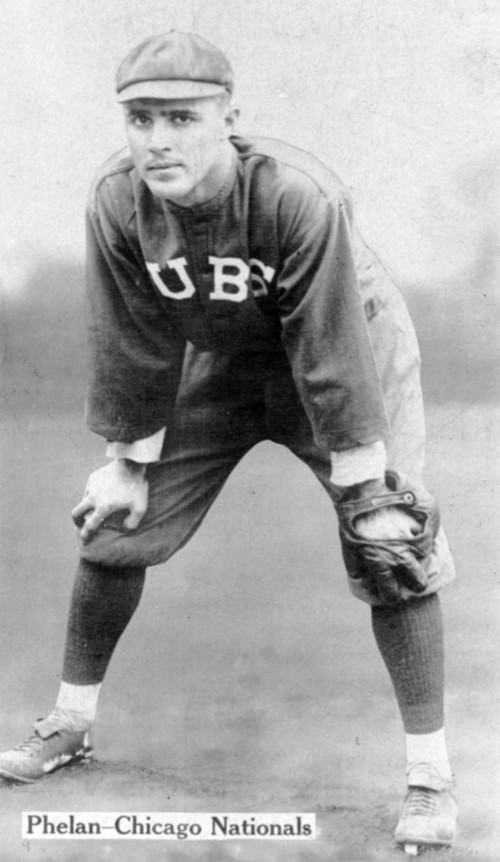
Of course, pretty much anyone who knows anything about cards is familiar with the most popular tobacco releases from the first decade-plus of the 20th century - the T206 Honus Wagner has made sure of that.  One "Flying Dutchman" contemporary set that doesn't get nearly as much attention as those brightly colored portraits is the 1912 Imperial Tobacco (C46) release, as seen above.  Not only do they lack color, but the brown, wood grain border of these Canadian cards combined with the dark black & white photography create a rather dreary and bleak-looking product.  Plus, the checklist is absolutely chock full of minor leaguers, focusing on players active in the International League at that time.  Thus, they don't seem to generate nearly the same level of interest as the much more celebrated T206's, T205's, Hassan Triple Folders, etc.

One thing that they do have going for them, compared to their brethren of the era, is a backside dedicated to player bios, rather than advertising space:


This is especially helpful considering the large amount of obscure bush-leaguers which populate the checklist.  The bio truly shines a light on some people that time has forgotten.

Speaking of forgetting, I probably shouldn't have forgotten to double-check my research before pulling the trigger on this purchase.

When I saw this "Phelan" card pop up in my saved Ebay searches, I got a bit excited.  First of all, it was only fifteen bucks, a price point I rarely see tobacco cards offered at unless they are literally missing chunks of cardboard or held together with century-old tape.  Furthermore, it showed up under my saved search for "Art Phelan," a third baseman who played with the Cubs from 1913-15 and who I knew appeared on some tobacco issues back in his day.  When I read that notification, I got caught up in the thrill and quickly jumped, purchasing the pasteboard with nary a second thought.  This listing popping up, in my price range, just as I found myself with some extra funds seemed more kismet than coincidence.

This is where I made my oopsy.


Art Phelan, appearing on one of those contemporary cards, as a Cub


Not even ten minutes later, a creeping doubt began to seep into the back of my brain.  You might notice that both the nameplate on the front of the card and the write up on the reverse only mention the ballplayer's last name, "Phelan."  There's no mention of the first name anywhere on the card.  Although the listing clearly stated "Art Phelan" in it's title and description, the dark thoughts reminded me how easy it would be to misidentify a minor leaguer from before "the Great War" had even taken place.  Although I hoped that I was just being a pessimist, or maybe even feeling a twinge of buyer's remorse since I rarely splurge with double digits on a single card, dread quickly overwhelmed my initial euphoria.


Sadly, a Google search proved Luke Skywalker correct. 

While Art Phelan was a former Cub with a five-year Major League career John Phelan - better known as Jimmy - shared no such qualifications.  Though he was a ten-year professional, this Phelan never played in the Majors, let alone with the Chicago National League Ballclub.  His career .241 batting average probably had a lot to do with his lack of ascension, especially considering the era in which he played.

Anyway, cue the sad trombone - I was tricked by a Phelan *womp, womp*


 Art - not Jimmy - Phelan on his T207 (left) and Fatima (right) cards.


The fault is completely mine, I should have been more careful about my purchase.  After all, even though the listing was incorrect, I highly doubt the seller was being spurious - there's not exactly a demanding market for the other Phelan, so why intentionally misrepresent.  As a result, I've been quite bummed about my impulsive mix-up, especially considering how rarely I treat myself to one of these comparatively high-dollar acquisitions for my CATRC binder.

On the bright side, tobacco cards always seem to generate interest, even on the low end.  With that in mind, is there anyone out there on the blogosphere who wants to trade for this antique oddity?  Maybe you just so happen to have the correct Phelan on his T207 or Fatima release (off condition, of course).  In the likely event that you do not and are still interested in obtaining this woodgrain, Imperial beauty, I'm interested in any pre-war era Cubs card that features a player still needed for my CATRC.  Please see the "Cubs" tab found at the top of this page for my collection record and who has yet to be obtained for my most hallowed tome.  If I don't have someone from that era, I'll take them in whatever uniform you have to offer - beggars can't be choosers, after all.

Have you ever allowed your excitement to get the better of you when it comes to a hobby purchase?  Did you ever pull the trigger on a card of the wrong player?  Perhaps, in the heat of the moment, you got tricked with a reprint versus the real deal?  Still, you might have accidentally clicked "purchase' before reading the full description of an item and gotten something completely different than you thought you were.  Personally, I've done all three and have screwed up in countless other ways.  Please feel free to vent with me in the comment section below.

In the meantime, I've learned a lesson and next time I decide to treat myself, I won't let my exuberance overwhelm my sense of reason.  Oopsies happen, but this one was particularly frustrating.

Darn tricky Phelans...


Sunday, May 31, 2020

You Know What They Say About Imitation...

Short post today because the world is burning and I live too close to an epicenter to relax.  I need to do something to shift my focus and save my mental health, so why not blog about a problem so minor that Major League Baseball is looking to contract it?

They say imitation is the most sincere form of flattery.  With that old adage in mind, I guess I should be blushing right now:


That right there is a listing for an "ACEO Art Card," listings which often pop up in my saved Ebay searches for obscure Cubs players of the past.  For those who may not know, ACEO is shorthand for "Art Cards Editions and Originals" - basically, a blanket term for custom cards.  Much like "Broder" and it's relationship with counterfeit and unlicensed cards, ACEO has become a part of hobby lingo.

Now, I have absolutely no problem with people whipping up their own custom trading cards; after all, I create my own and share them online for the whole world to see.  In fact, I'd say that seeing other hobbyists creativity on the blogosphere and wherever else on the internet is the most fascinating part about collecting in the 21st century.  Also, while technically frowned upon due to copyright infringement and intellectual property when it comes to source photographs, mimicked designs, and intellectual property, I don't take issue with people selling their own creations either.  All in all, as long as your not marketing your custom creations as the genuine article or purposely aping Topps, Panini, Upper Deck, etc. with deceptive intent, I'd probably be more than happy to lay down a few bucks for a well-made ACEO custom.

Thus, on it's face, I shouldn't have a problem with this listing - the seller has made it abundantly clear that this card is not from the Topps printing presses.  However, the sticking point here is that I know this particular vendor didn't create this card.  And how I can be so sure that they didn't whip this up in Photoshop or InDesign?  Well.... uh...


...that's because I'm the wannabe artist.

I created this fantasy 1966 Topps pasteboard to fill in a gap in my Cubs All-Time Roster Collection.  You see Bob Raudman appeared in 16 games for the North Siders from 1966-67.  With this cuppacoffee being his only MLB action, "Shorty" never appeared on a bubblegum card, be it in a Cubs uniform or any other colored laundry.  However, I was able to dig up a potential TTM address for the former player, so I whipped up a custom to mail off in hopes of creating a piece of memorabilia worthy of my CATRC tome, to fill an otherwise un-fillable slot.

As you can tell by the image above, my mailing attempt was unsuccessful; however, it appears as though someone saw my work, even if it wasn't my intended target.  Unless I have a split personality who happens to only sell baseball cards on Ebay (and how boring that would be), I don't think this guy is selling his own work.

I'm not going to name the seller, but I will say that he has a prodigious presence on the ol' auction site.  I'll also add that he has the same, unusually combative description for every item that he lists:

"####FREE COMBINED SHIPPING BUY 1 OR 100 FOR THE SAME PRICE, INCLUDES CANADA TOO ##### THIS IS A NOVELTY CARD THAT IS CUSTOM MADE. IT HAS NO VALUE, IT IS FOR COLLECTING ONLY. IF YOU DO NOT KNOW WHAT A CUSTOM CARD IS, PLEASE BUY FROM SOMEONE ELSE. THESE CARDS ARE THE SAME SIZE AS A NORMAL CARD BUT NOT AS THICK. IF YOU WANT A THICK CARD THEN BUY FROM SOMEONE ELSE. IF YOUR GOING TO DISPLAY YOUR CARD IN A TOPLOADER, WHY DOES IT MATTER HOW THICK IT IS. IT WILL LOOK GREAT. CARDS ARE MADE ON 140LB CARD STOCK"
It's always in all caps too - that's not me editorializing.  Seems level-headed and rational.

Once again, I have no personal problems or vendetta against people selling their creations, even if it is technically against some rules.  However, this person is apparently taking images that he or she finds online, printing them out on photo paper, and selling them as their own.  THAT does rub me the wrong way.


I have to wonder just how many of these ACEO cards that they are selling are also pilfered from other corners of the internet.  Any of the above selections look familiar to anyone?

I should also note that there is a little bit of egg on this vendor's face.  As I detailed in my original post on the TTM failure, I made some critical errors on this card.  For one, Raudman's 16 games in a Cubs uniform came in the outfield, not on the mound.  In fact, I can find no record of Raudman having ever taken the mound in a professional setting.  Furthermore, the photo that I culled from the internet is actually of former Cubs catcher, Randy Bobb, not Bob Raudman. I got the wrong Bob. I have no idea what I was thinking when I created this comedy of errors.

It's quite doubtful that this person actually cares about the accuracy of the ACEO's that he's hawking, but it does make me feel a touch better that this particular piece is such a screw-up.


Bob Raudman, courtesy of the Duluth News Tribune.

Anyway, I realize that I have no legal claim to my Raudman "card' and that it was created from an image and design that I hold no intellectual property over.  Not to mention the fact that I openly shared it on the internet without so much as a watermark to stop such practices.  This situation just rubs me the wrong way and I felt compelled to rant about it just a little bit.  What better place to rant than on my baseball card blog, after all?  With everything that's going on right now, it feels good to complain about such an insignificant "problem" for a little bit.

Also, if you're in the market for true ACEO's, I recommend you stay away from listings that look like this and steer towards guys like Gary Cieradkowski and Gypsy Oak, among others.  There are plenty of talented artists out there, with a passion for baseball, who create some truly binder - nay - frame-worthy custom baseball cards that are much more worthy of your attention.

In fact, I'll have another post coming up that's dedicated to another creator whose work I recently discovered.  As a bit of a preview, I'll say that this card-tist's work covers an era of baseball that is all to often ignored by card companies and fans alike.  Keep an eye out for that Wrigley Roster Jenga post in the next few days.

In the meantime, stay safe out there.  Remember what is being protested and to mentally separate the protesters from the opportunistic agitators.  The system is rigged, brutal, and needs to be shocked - people live in daily fear, based on the color of their skin, fear that they might be killed while jogging, while entering their own home, for wearing "suspicious" clothing" and a further infuriatingly long list of other reasons. 

Hopefully, we emerge on the other side of this turmoil in a better place as a society. 

Sunday, May 24, 2020

I'm Going to Wichita


Remember way back in the early aughts, when garage rock was king?  I can't blame you if you don't - the genre's reign was blink-and-you missed it brief.  Back when bands like Franz Ferdinand, the Strokes, Jet, and the Hives were the choice of music taste-makers.   Back then, a throwaway line in a gibberish song based around Jack White's inability to say Salvation Army could make Wichita, Kansas seem like the most badass, rock and roll hive this side of New York.  Those were the days

Of course, the way the world is today, being able to travel anywhere, Wichita included, seems like an exotic adventure.

Anyway, a good 25 years before White boasted of travelling to the middle of nowhere, Cubs' minor leaguers also spent a lot of time there, as the Wichita Aeros were their AAA affiliate throughout most of the 1970's.  Thus, as a rabid Cubs collector and lover of minor league memorabilia, it should come as no surprise that the above 1973 J.B. Kelly Bank Wichita Aeros team set above piqued my interest when it showed up in my saved searches on Ebay earlier this month.

While the collation in incomplete - the nine above are missing 12 brethren - I was okay with that seeming black mark.  These over-sized cards (about the same dimensions as the 4x6 photographic prints you used to pick up from Walgreens) don't pop up very often.  The coyness is probably due to the fact that vintage MiLB cards are rare in and of themselves and the checklist contains a novelty card of Hall of Famer, Tony LaRussa (yup, he spent some time in the Cubs system).  That being said, I'm not chasing the future Cardinals manager; rather, I have long been chasing after a different card found in the set and it happened to be part of the lot:


I know, Pete LaCock is cool and all, but it was Jose Ortiz who captured my attention.  You might be asking yourself, why is that?  Who the heck is this guy?

You see, if you're familiar with Wrigley Roster Jenga, you know that my main collecting focus for nearly two decades now has been my Cubs All-Time Roster Collection (CATRC) - one card of every single player to suit up in Cubbie Blue pinstripes.  Ever.  Seeing as the franchise stretches back into the Reconstruction Era, you might expect that the early days of the team's sprawling history would present the most obstructions to my lofty collecting goals and you would be right.  That is, mostly right.

The first half of the 20th century and earlier contain, by far, the most gaps in my CATRC binder for reasons that should be obvious.  Thus, these black holes in my collection are not all that frustrating, I know obtaining tobacco cards of roster fodder from 100 years ago isn't a quick process.  However, the gaps aren't limited to those long bygone days of jazz, flappers, and Model T's.  In fact, the most frustrating missing pieces in my most treasured tome are from a much more modern era, when bubblegum card collecting was one of the most popular childhood hobbies and Topps was doing a pretty good job of documenting our nation's pastime on cardboard.

Until recently, with just two exceptions, I had at least one card of every single Wrigley inhabitant since 1970, making those two MIA's all the more annoying.  Now, thanks to this Aeros lot, it's just one.


Sidenote - if anyone know of a Wayne Tyrone card, please let me know.  As far as I can tell, the 1976 Cub has never appeared on a pasteboard product.  Or perhaps you know of a TTM address where I can send this custom creation?  Either way, any help would be greatly appreciated!

Like Wayne Tyrone, Jose Ortiz has never appeared on a single traditional baseball card.  Unlike Tyrone, he did at least showed up on a small handful of oddballs when he was still plying his trade.  According to the Trading Card Database, there's a 1971 Picture Pack set that was sold at Wrigley Field which includes him, though those oddities are closer to photo prints than baseball cards.  Also, there was spot for Ortiz in the 1972 Puerto Rican Winter League sticker set, but that release obviously has no connection to the Cubs.  Thus, I settled for chasing the '73 Aero card, seeing as it's the best of both worlds.

Even though Topps did a decent job of documenting baseball, as the only game in town, a few of the more obscure players did slip through the cracks.  It's not really a surprise that Jose Ortiz and his brief, three-year career was one of those unfortunate men.  Please allow me to properly shine the spotlight on the forgotten Cubs outfielder, in honor of my latest acquisition.


Jose Ortiz's other two cardboard options, courtesy of the Trading Card Database


In the winter of 1969, on the heels of one of the most infamous implosions in sports history, the Cubs were left licking their wounds.  Centerfield had been a primary weakness for the team which ever-so-politely yielded to the Miracle Mets, with scrubs such as Don Young, Jim Qualls, Adolfo Phillips, and an afro-less rookie by the name of Oscar Gamble cycling through the position without making much of an impression.  Obviously, the club was looking for answers as to why they wilted during the heat of the pennant race and centerfield was targeted as a prime area for improvement.

Of course, with the benefit of hindsight, we now know that the remedy to their outfield woes was already on the roster.  The aforementioned Gamble would go on to star in the Majors throughout the next decade and a half; unfortunately, the most famous follicles in the game would be found under an assortment of non-Cubbie Blue caps during this time.


Looking for a shakeup, on November 30th, the talented newbie was swapped to the Phillies for Johnny Callison, who by then was decidedly on the other side of the proverbial hill.  Much bellyaching is heard in the Northside bars of Chicago about an assortment of egregious trades - Brock, Madlock, Maddux (although he technically left in free agency) - but the quick punt on Gamble is rarely heard during these bootleg therapy sessions.  However, we're not here to talk about Oscar and we've already devoted far too many lines to his tale.  Instead, let's shift our focus to the another outfield-related transaction made exactly one-year later.

With Callison having proved to be to old and injury prone to handle center, the Cubs found themselves leaning on a Rule 5 pick (Cleo James) to pick up the slack. This sad trombone left the team having to upgrade the position after a near postseason miss for the second year in a row.  Luckily, they had veteran, mid-season acquisition, Joe Pepitone, still in the fold; but, the club still lacked a long-term solution.  Thus, the Cubs sheepishly turned to their South Side neighbors for assistance.  In what was just the third trade between the ballclubs during their then nearly 70 year-long rivalry, the Cubs acquired a promising young centerfielder by the name of - you guessed it - Jose Ortiz.


All told, the summation of this transaction can be found listed in Webster's Dictionary under "obscure;" but, at the time, Ortiz was seen as a legitimate prospect.  The Puerto Rican stole a whopping 79 bases in the minor leagues in 1967 and rose to the Majors for the first time just as the Cubs were dropping down the standings in September of '69.  Ortiz was largely a singles hitter, as his 1969-70 slash of .314/.375/.381 suggested; however, those stats were accrued in just 25 at-bats.  Perhaps with a little more seasoning on the farm, the speedy youngster's bat would develop enough to allow the Cubs to fill that gap in the center of the diamond.

Come 1971, the future quickly became now.  Nearing the end of his MLB road, injuries forced Ernie Banks to start the '71 campaign on the disabled list and brought Pepitone in from center to cover first base duties.  Suddenly, Ortiz no longer had time to figure things out in the minors - rather, he was #1 on the depth chart, #20 on the roster, #8 on the scorecard and starting on Opening Day at Wrigley Field.

Sadly, it was all downhill from there - 1971 was to be his last season in the Majors.


Jose spent the month of April as the starter in centerfield, but was kicked back to the bench in favor of fellow prospect, Brock Davis, come May.  Ortiz maintained a spot as a regular pinch-hitter and extra outfield glove that month; however, playing time became sparce by June and he was back in the bushes by July.  All told, Jose posted a slash line of .295/.347/.398 seemingly stunted as a slappy, singles hitter and the team felt they could do better.

Alas, centerfield continued to be a problem for the Cubs throughout the rest of the 20th century and well into the next one.  Much was made of the team ineptitude at the hot corner before Aramis Ramirez came along, but sustained success in center has been every bit as rare.

While Jose was done in the Bigs before 1971 was out, he hung on the Cubs chain as a minor league journeyman through '76.  At first, he played with the Cubs' AAA affiliates in Tacoma and Wichita (as my baseball card attests) but was then further demoted to AA Midland before he was granted release.  After one more go-round in the Mexican League in '77, Ortiz finally hung up his spikes without clawing back up to the top.

And that's the story of Jose Ortiz.  He was an Aero longer than he was a Cub, so I guess the card I ended up with is quite appropriate.

While Jose represented my chase card - one of my most desired and longest sought after, at that - he was not the only intriguing pasteboard in the stack.  In fact, among the oddballs, there was a card of a guy who never appeared on another card, before or after, and also saw time with the Major League club:


Like Ortiz, Compton's time in Major League Baseball was already over with by the time he posed for this photograph, he just didn't know it.  The hurler pitched in a single game during the 1972 season and that was the end of his MLB tenure.  Clint drew mopup duty in an eventual 11-1 loss to Philadelphia on October 3rd, the second to last day of the season.  Two innings pitched, two earned runs allowed, and that's all she wrote.

The 3rd round of the 1968 MLB June amateur draft played one more season in Wichita and then abruptly retired at the age of 22.

Were he to have played today, the high draft choice would have had a million Bowman cards on his ledger before he even took the mound on that fateful October afternoon.  As it stands, being a one-game wonder in an era where baseball cards were still all about actual Major Leaguers, Mr. Compton never made it onto a Topps piece.  In fact, according to my sources, this Aeros single is the only card that Compton ever appeared on.  Thus, I should also need this one for my Cubs All-Time Roster Collection?  It's not like there's another option, right?  Well...


As it turns out, I already have Compton in my binder, as a Cub even.  How is that possible?

You may or may not be familiar with the Rookies App.  This iPhone program allows users to create custom baseball cards from pre-built templates, just add photos and text to the front and back and *bam* you have a brand new, unique to you baseball card.  Then, you have the option to order a bonafide wax pack filled with your creations, printed on quality cardstock all professional-like and everything.  You honestly wouldn't be able to tell the difference between a Rookies App card and your average Topps or Panini product unless you scientifically studied them.


The first pack I ordered through the Rookies App back in 2014


Also, unlike Topps' card creator, this one doesn't block you from using photos with MLB trademarks.  So, I created a few pasteboards of guys who didn't have any previously or only had realistically unattainable pieces to their name.  At the time, I though Compton fit that profile.  It appears as though I was quite wrong and now I am at a crossroads.

On one hand, cards which feature players in a Cubs uniform always receive priority in my collection and, though you can't truly tell from the photo I originally selected, Clint is in his Cubbie duds.  However, the Wichita Aeros card feels more like a "real" card, i.e. not a bootleg creation I whipped up to fill a gap that actually doesn't exist.  So, I don't know what to do.

Which card would you chose to represent Clint if you had a CATRC?  Please help me to decide!


All inner turmoil aside, the rest of the cards won from this Ebay lot feature a bunch of eventual or former Cubs already found in my CATRC, including the aforementioned LaCock:


These will slide nicely into my "Nothing Major" collection, made up of minor league cards of Major League Cubs.

Lastly, there was also a former MLB moundsman in Floyd Weaver.


Weaver spent time in the Bigs with the Indians, White Sox, and Brewers by never made the trip from Wichita to the North Side of Chicago.  Interestingly enough, Weaver made only one appearance with the '73 Aeros, which marked the end of his pro career.  Anyway, this card will be inserted into my "Coulda Been a Cub" binder, made up of players who were under contract with the Lovable Losers but never suited up with the MLB club, for one reason or another.

Do you have any favorite off the beaten path type-minor league cards like these '73 J.P. Kelly Bank Wichita Aeros in your collection?  If so, what makes them worthy of your collection?  Is it because they're just so obscure and/or peculiar?  Do they show a favorite player in a "before they were famous" bush league uniform?  Or, perhaps they depict a PC player who doesn't have much in the way of a cardboard footprint, like Mr. Jose Ortiz?  I highly encourage you to share your stories in the comment section below.

At any rate, the highlight of this purchase - far and away - was finally being able to cross Jose Ortiz off of my "needs" list.  Once I figure out a way to get a custom TTM out to Wayne Tyrone, I will have a card of every single player to suit up for the Cubs since 1970 and I can shift my entire focus on vintage and super-vintage targets.

And the best part was that I didn't even have to go all the way to Wichita to get that bad boy - I made Wichita come to me.  I didn't have to worry about Seven Nation Armies holdin' me back - take that, Jack White!