Wednesday, February 20, 2019

Putting the Car in Cards


Most years, my wife and I celebrate Valentines Day by attending the Chicago Auto Show.  We've been making our way downtown for this event almost every February since 2014 and it's certainly become an annual tradition for us, at this point.  Sure, it's not the "stereotypical" romantic, sappy setup and we're not hardcore "gearheads," but a few hours of wandering around McCormick Place while surrounded by the latest in automobile technology, pipe dream cars, delicious snack foods, and tons of free swag makes for a fun way to spend an afternoon.  Plus, it's the only way I can ever feasibly hope to sit behind the wheel of a Challenger or a Corvette and not get arrested for grand theft auto.

Not to mention, this annual experience can be quite productive, in the long run - our reliable and versatile, blue KIA Soul (named Clark), was the direct result of this tradition, as the first time we ever examined one of these toasters was at this show.

But, getting back to the free swag... that honestly might be our favorite part of the whole convention.  I mean, our reusable grocery totes are reliably replenished by this yearly event, courtesy of Toyota, Ford, etc..  Plus, free pens from this event fill my cup at work and at my home office.  But, it goes beyond pragmatism with the gratis giveaways, as our free totes are often also stuffed with funny stress balls (which my wife collects), stickers, decks of playing cards, posters, and the like.  Sure, it all serves as free corporate advertising, but at least it's FUN, free corporate advertising.


 The Sauber Formula One team brought a show car to represent their constructor, Alfa Romeo


Now, in years past, there's been unexpected cardboard connections, as well, leading to surprise blogging material.  Commemorative personal trading cards, hero cards of professional race car drivers, athlete autographing appearances are common at the Chicago auto show; but, these are all sideshow items, extra perks/premiums meant to draw you over to a particular branded booth.  After all, the actual stars of the show are truly the automobiles themselves, right?


With that in mind, there's also the slightly less fun swag - you know, the pamphlets, booklets, fliers, etc. that lay out the details of each brand's new models and why they're so much better than the competition.  Honestly, this information is much more important than a KIA-branded stress ball in the shape of a basketball.  But, that being said, these items almost immediately move from kiosk to waste paper basket, as passers by give a glance and move on to the next shiny object.
 
This year, Chevrolet finally noticed this pattern and changed up their giveaways accordingly.  When it came to the question of amusing but irrelevant or informative but dull, the bowtie boys went off the beaten path and asked themselves a very important question, "¿Por que no los dos?"


via GIPHY


Now let's think for a minute - what is a good way to get people to hang onto to something?  Make it fun and collectible, right?    Taking that a step further, what is an effective method of conveying information in a physcial format that plainly displays the content, while simultaneously creating something the "average Joe" would find appealing to the eye and feel compelled to hang onto.

That line of thought, ladies and gentlemen, is how we ended up with Chevy trading cards:


Printed on legitimate cardstock and not flimsy, glossy flier paper, Chevrolet stocked the counter of their booth with the above trading cards, which paid tribute to their famous pickup trucks of the past and the latest edition of the Silverado.  They're oversized and, while I don't have a ruler nearby, I would estimate them to be about the size of you average baseball "police set" of the late 80's/early 90's.  Unlike those vintage oddballs, you can tell a lot of thought went into this clean and crisp design, which features artful touches like artificial aging and simulated texture.  In fact, I think it would look pretty decent as the model for a Panini-branded NASCAR set.  

Obviously, their marketing gimmick worked on me, as I "picked up" the full set of three pickups as soon as I saw them, even though I harbored no interest in Chevrolet or trucks before walking through the display.  They got me good.


Of course, they wouldn't be true trading cards without proper backs and, as you can see above, Chevy did not disappoint.   While trucks do not have batting averages, on-base percentages, or runs batted in, they do have plenty of associated statistics of their own.  Channeling their inner Topps, the bowtie marketing department made sure to whip up a stat-line and "player" bio to complete the effect and, y'know, brag about how great their automobile is.  That is the ultimate goal, after all.

Chevy goes the extra mile though; they don't just want you to know how sleek and strong their 2019 Silverado is, they want to remind you of how great their trucks have always been too.


This promotion features a pair of pickups from the brand's illustrious past - the 1988 K1500 Sportside (above) and the 1978 K10 Fleetside.  It does appear as though that Chevy named their set "Truck Legends," so it stands to reason that they would need to throw in a few retro players.  After all, it's a move straight out of the baseball card market - Topps has a hard time releasing any products without at least some vintage player representation these days.  Nostalgia is a powerful drug.

Like I said, I am far from a gearhead and definitely not a truck nut.  Furthermore, I grew up in a Ford household and I currently drive a PT Cruiser, which is indicative of my taste in cars.  Thus, in the end, these cards hold no long term interest for me, though I must applaud Chevy for their efforts.  These bad boys would make for fine oddball additions to the collections of anyone who enjoys automobile-themed cardboard.  Perhaps these are angled straight down the lane of Cardboard History's, Billy Kingsley?

Do car cards really rev your engine? Do you have a special affinity for Chevy trucks?  Have you ever been to the Chicago auto show? Would you too have felt compelled to pick up these oddball trading cards were you to encounter them like I did?  Please feel free to weigh-in through the comment section below!

In the meantime, it's time for me to log off.  I've got some branded tote bags to sort through before grocery shopping day!


Tuesday, February 19, 2019

What's In a Name?

Throughout the years, I've been bestowed with many a nickname that failed to stick.  For a while, I was referred to as "Road Rage" as I was aggressively difficult to pass up during a track or cross country meet.  That tag lasted for maybe a year of high school though before people forgot.  Then, I became "T-Burby" thanks to a quickly cobbled together Halloween costume that slightly resembled a pimp.  Then, for a short time at work, I was christened "BLT" for reasons that are entirely too convoluted and silly to get into here... and, no, it had nothing to do with sandwiches.

Eventually, "Burbs" - a shortened version of my last name - took hold and has stuck with me for about a decade now.  As such, I even use it in my Blogger profile, much like a certain baseball card I recently acquired.  In 1974, TCMA released a set of baseball cards with a unifying theme.  Like most of their products, this set was black & white, lacked frills, and featured nostalgic players of the previous generation.  Of course, what made this set unique was the fact that the checklist was fille exclusively with the most colorfully nicknamed ballplayers of the 1930's & 1940's.  

Now, we aren't talking about boring monikers like "A-Rod" or "D-Lee" - those lack character and are way overdone.  We're talking about, back in the day, when nicknames were colorful and truly painted a picture, like Sad Sam, Mule, Dizzy, Hot Potato, Heave-O, and Rapid Robert, among the 27 total included in the product.  Although players today are rarely graced with such interesting aliases, this is an idea that might make a nice subset or insert in Flagship... *cough, Topps, cough*

For Christmas (yes, I'm still working on quite a backlog of acquisitions thanks to the blogging blah's), my father generously me with a stash of oddball baseball cards which filled some long empty gaps in my Cubs All-Time Roster Collection.  One of those oddities just so happened to be a single from this set of sobriquets:


Forrest Pressnell was a knuckleball hurler who plied his trade for the Brooklyn Dodgers and the Chicago Cubs for five seasons in the Major Leagues.  Operating as a swing-man for both clubs from 1938 through 1942, "Tot's" minor league career was much longer, as he was forced to bide his time for eight years in the bushes before finally getting a shot in the limelight.  He was 31 years of age when he first debuted for "Dem Bums" - far from being a "tot" in the world of professional athletics.  However, his nickname was not an ironic moniker like one might infer; Pressnell was deemed "Tot" by the local of his hometown of Findlay, OH because the "tot" would always pal around town with his older brothers.

Of course, there was more to Pressnell than his nickname.

After that tot grew up, he would journey through the minor leagues, making stops in the Browns', Tigers', and Indians' chains before finally inking his first Major League contract with the Dodgers in 1938.  Most of his time as a prospect was spent on the roster of the American Association's Milwaukee Brewers, 1933-38, a team which would (coincidentally) later become a Cubs affiliate.  More interestingly, I would be remiss if I didn't mention the fact that Tot's time with the other St. Louis franchise came with the provokingly named Longview Cannibals. 

Now THAT is a colorful nickname!


Pressnell proved himself a useful asset for the Dodgers - he posted a 26-26 record with a 3.76 ERA in 417 innings spent bouncing back and forth between the starting rotation and the bullpen.  Essentially, he was the Mike Montgomery of his day -  an extremely valuable, yet criminally under-appreciated member of the pitching staff.

On that note, "Tot's" time spent in the borough is overshadowed by went on around him at the time.  For instance, during his rookie season, Tot pitched four innings in relief opposite of Cincinatti's Johnny Vander Meer... who just so happened to be in the process of twirling his yet-unmatched second consecutive no-hitter.  Pressnell wasn't around for that historic conclusion though, as he left the mound on a stretcher after a liner off the bat of future Cub, Ival Goodman, took out his knee.  For the record, despite this scary scene, Tot did not even miss his next start. 


 The super-vintage custom that reps Ival in my CATRC


Additionally, Pressnell was around for the circus surrounding Babe Ruth's tenure as a coach with the Dodgers in 1938.  At the end of the doomed experiment, the Babe presented some of his equipment to his favorite teammates as a thank you.  As part of this show, Ruth's fielding mitt went to "Tot," who kept the glove as one of his most treasured possessions for the duration of his life and gleefully jumped on any opportunity to show it off to fans.  I mean, wouldn't you?

In the midst of a youthful rebuild in Brooklyn, Pressnell was sold to the Cardinals in November of 1940.  Suddenly, a game of hot potato ensued, as the Cards then sent him to the Reds before a month had passed.  The Reds, in turn, swapped him to the Cubs for an undisclosed amount of money.  From November to February, the poor man had literally no idea where he would be come spring time.  Thankfully, the merry-go-round finally halted in Chicago.


"Tot's" promotional headshot from either 1941 or '42.


As a Cub, Pressnell pitched well during his first season in the Windy City, 1941, with a 5-3 record and a 3.09 earned run average in 29 games - 28 of those appearances coming out of the bullpen. In fact, John Thorn and Pete Palmer, editors of Total Baseball, later came to the conclusion that Tot was the most effective reliever in the National League that year.  However, that performance was wasted on a club that finished in sixth place.  Then the wheels fell off in 1942 and his ERA ballooned into the fives, leading to his permanent benching by September.  After being told he'd be sent to the PCL for 1943, Tot chose to retire rather than return to the bushes again.

After his professional career came to a close, Pressnell returned to his native Findlay with his wife, raised his family, and worked for what would become Marathon Oil.  He still loved the game though, as he occasionally dusted off his knuckler for a semi-pro game here and there.  "Tot" Pressnell passed away in 2001, at the age of 94.  At the time, he was one of the ten oldest former major league players.

And that is the story of  Forrest "Tot" Pressnell - an underrated, knuckleball pioneer for Dem Bums and the Lovable Losers who had a knack for showing up in the periphery of history and who's nickname had nothing to do with potatoes.


It sure would be nice if Topps were to explore this topic for a future insert set, even if there aren't nearly as many endearing nicknames as there were in the early days of baseball.  I guess they were pretty close with their commemorative Player's Weekend Now sets of the past two seasons, but those print-to-demand specials are certainly out of this penny-pincher's price range.  

What do you think about this idea?  Would it make a good theme for a set today?  Was it silly even back then?  What cool or unfortunate nicknames have you been saddled with over the years?  Feel free to share in the comments section below!

In the meantime, it's time for "Burbs" to log off.  Welcome to the CATRC, "Tot!"


Friday, February 15, 2019

Error 404 - Player Not Found

Yesterday morning, the Cubs added yet another, low cost/high reward contract onto the ledger to bolster their relief corps.  Xavier Cedeno, a lefty who has been in the league since 2011, was brought in on a non-guaranteed, Major League deal worth $900K.  Initial reports indicated that the bullpen piece would be on a minor league contract with an invitation to spring training; however, today we learned that X will be occupying a 40-man roster spot but can be cut for only a portion of his salary this spring.  He represents another acquisition in Theo's plan to throw as many cheap arms at the bullpen problem as possible and see who's left standing at the end of the Cactus League schedule.


In 2018, Cedeno spent time with two rivals to the North Siders - the White Sox and the Brewers.  All told, he was pretty much lights out when on the mound, posting a sterling 2.43 ERA in 33.1 IP and averaging 9.2 K's per nine innings.  As a reliever, he was worth 0.9 WAR for the season.  Not to mention, throughout his career, he's been murder on same-handed opponents, limiting southpaws to a egregious .218/.285/.298 batting line.  If the Cubs can get that kind of production out of Cedeno, his contract will be an absolute steal.

Considering the team's need for an experienced lefty after the departure of Justin Wilson and this MLB deal, it can be reasonably expected that Cedeno will likely head north with the Big League club... provided he can prove his health.  After all, the 32-year old lost nearly all of the 2017 campaign to dreaded forearm issues.  Rather than undergoing the knife and losing a season-plus to Tommy John Surgery, the newest Cub treated his foreboding injury with rest and platelet-rich plasma injections.  Thus, a clean bill of health, like his contract, is not a guarantee.

Anyway, all things considered, the odds are pretty good that a healthy X would head to Chicago with the Cubs come April.  Thus, it would be reasonable for me to look into a acquiring an Xavier Cedeno card for my Cubs All-Time Roster Collection - like a good Boy Scout, I try to always be prepared.  Let's see what's on the market for the team's new reliever:


Hmm... that's peculiar...

According to baseball reference, Xavier Cedeno has seen action in every single Major League season since 2011 and made more than 40 appearances in four of those campaigns.  Despite that fairly long and experienced resume, Cedeno has not shown up in a single checklist from Topps, whatsoever.  There's no Bowman appearances either, seeing as he was a 31st round draft selection in 2004 and never was a blue chip name.  Hell, Xavier doesn't even cameo in the packs of Panini or Leaf or In The Game or Razor or whatever other second and third tier challenger to Topps you can think of. 

Should Xavier Cedeno eventually make an official appearance in Cubbie Blue, the only options I will have for enshrining him in my CATRC will be his MiLB team-issued singles, which - like many such products - are fairly scarce and often over-priced.


Heck, I could only find one minor league card for X on the Trading Card Database and there aren't any singles up for grabs on Ebay at the moment.  In fact, this was the only card that even turned up in a Google Images search.  Obviously, this is not an ideal cardboard situation.

Despite the fact that Cedeno is on the cusp of his ninth season in the Majors, he has exactly zero MLB trading cards.  Nada, zlich, none.  How unfortunate is that and how does that happen?   I guess that's what happens when you're living in a monopoly and all of the focus in the industry is on the latest shiny new prospects.  I guess we're lucky that almost of the starters on Big League clubs get cards today, let alone bench players and relievers.  That said, you'd think that after nearly a decade, Cedeno would have snuck through at some point.

Have any of my fellow collectors run into this issue during their cardboard quests?  Have you ever encountered a surprising amount of difficulty finding cards of Major League veterans?  Is this even an uncommon issue?  Please feel free to share your thoughts and experiences in the comment section below!

In the meantime, I suppose I'll just wait and see what happens with Xavier Cedeno before I make the commitment to hunt down one of his pasteboards.  After all, patience is a virtue, right?


Sunday, February 3, 2019

Big In Japan


Just like so many one-hit wonders who disappeared after one chart-topper in the United States, the latest Cubs signing made it big in Japan.  Tony Barnette - like Scatman John, Mr. Big, The Ventures, and Anvil before him - didn't have much success in his professional career stateside, so he turned to "Land of the Rising Sun" to stay in the game.  However, the pitcher turned out to be more like a Cheap Trick, as he was able to parlay that unexpected success in Japan into a lucrative career upon returning to his homeland.

Barnette was selected in the tenth round of the 2006 draft by the Diamondbacks and was able to reach as high as AAA before stalling out.  After posting an egregious 5.79 ERA in 29 Pacific Coast League starts that season, he was released by the Snakes and - like so many a tweener before him - the Nippon Professional Baseball League made him an offer he couldn't refuse (in that, they offered him enough money to live comfortably on, unlike MiLB).  Thus, Tony spent the next six years patrolling the mound at Meiji Jengu Stadium for the Yakult Swallows and doing quite well for himself.

After one further stinker of a season in the starting rotation, Yakult switched Barnette to the bullpen, a role in which he absolutely flourished.  Becoming one of the premier closers in the league, he saved 97 games there after ascending to that role and pitched to a 1.29 ERA in his final season. Suddenly, American scouts were paying attention to the righty once again.  Ultimately, the Texas Rangers decided to import Tony back into the USA and onto their Major League roster.


 Here's a couple of Barnette BBM's from his time in Japan, courtesy of Japanese Baseball Cards (love this blog!)


Since his return, across three seasons in the Lone Star State bullpen, Barnette has been mostly effective as a non-closing, middle reliever:  11-4 with a 3.50 ERA, 3.56 FIP in 144 IP.  He throws strikes too - 132 to 43 K/BB ratio during his MLB career - something that the Cubs bullpen has struggled with in years previous.  Thus, seeing as the club has been in need of rebuilding bullpen depth due to the losses of Jesse Chavez and Justin Wilson in free agency and Brandon Morrow to injury, one can see why the Cubs pounced on this Japanese import.

However, injuries issues have hindered his time on the mound.  For instance, Tony's 2018 season came to an abrupt halt in June after his shoulder began to bark and finger problems limited his effectiveness in a dismal 2017 campaign.  Combine those concerns with the fact that the pitcher is already 35 years old and it comes as no surprise as to why the budget-conscious Cubs were able to secure his services for a bargain - $750K salary for the 2019 season and, should things go well, a club option valued at $3MM for 2020.

So, Barnette represents a great "low risk, high reward" gamble.  If he performs poorly, he could easily be jettisoned with minimal financial blow.  If he looks like he did in 2016 and 2018 (pre-injury) his contract could represent an absolute steal.


This has largely been the big market, large budgeted franchise's strategy for building bullpens since Theo Epstein came to town, aside from the Morrow signing and Aroldis Chapman trade.  Relievers are fickle, oftentimes having wild swings from lights-out to doormat on a year to year basis.  With that in mind, it's not particularly surprising that Theo and Co. have stayed out of the Craig Kimbrel  and David Robertson markets and instead restocked their bullpen with a bevy of lower-tier candidates.  Brad Brach and Barnette represent the MLB signings, while George Kontos, Rowan Wick, Junichi Tazawa, Rob Schaill, Mike Zagurski, and others with Big League experience have been invited to Spring Training.  It's pretty much the current front office's MO when it comes to building a pen.

However, the Cubs budget has been (seemingly artificially) strained this offseason, with Daniel Descalso, Brach, and Barnette serving as the only notable additions.  After a monnumental collapse of the offense in 2018 and years of a rumored run at Bryce Harper in free agency that have been walked back by money concerns, the Chicago faithful have been up in arms this winter.  It seems as though Tony is aware of this situation, and even took to Twitter to apologize for not being Bryce:


Looks like this guy has a healthy sense of humor; I like him already!  He's also got a really cool first name too.


I'm happy to add Tony Barnette to my Cubs All-Time Roster Collection and, lucky for me, I just so happen to have a copy of his 2016 Topps Rookie Card.  I found this bad boy stashed in the Texas section of my trade box; guess I don't do too much dealing with Rangers fans.  

If the Cardinals can have Mile Mikolas, maybe we too can catch lightning in a bottle with our own Japanese success story.  Welcome to Chicago and to the CATRC, Tony Barnette.  Here's hoping your career continues on a trajectory similar to Cheap Trick and your time in the Windy City doesn't end up more like Spinal Tap!


Thursday, January 31, 2019

Once Bitten, Twice Shy

Last winter, the Cubs signed Drew Smyly to a two-year, Major League contract.  The lefty starter was coming off a lost year due to Tommy John Surgery; although, by all accounts, his rehabilitation was right on schedule and maybe even progressing faster than expected.  In fact, it seemed quite likely that he would be able to make it back to the Big Leagues by late summer.  If not, his contract included a second year; so, even if 2018 was a setback and spent entirely on the disabled list, he would be a sure bet to back by the next spring.  Thus, I had no reason to doubt that Symly - being a lefty hurler with a significant amount of past success and still on the right side of 30 - would not eventually become an official Cub.

With those factors in mind and some Smyly singles dug up from my trade box, I made what I was thought was a safe decision to add Drew to my Cubs All-Time Roster Collection.  Now, I have the UltraPro pockets organized in alphabetical order and the letter "S" is the most common surname in that binder.  Thus, whenever I add a new card, I have to slide each card over to the next slot, one by one.  It's a labor of love, but it is still sort of tedious work.  That said, it's a small price to pay to add a new card to my favorite collection.

In retrospect, that was an impatient, "oopsy doodle" on my part.


Ultimately, while Drew Smyly was in the mix for a September call-up, as a LOOGY reliever, it was decided that he was not quite ready yet.  Then, instead of revving up for a Cubs debut in 2019, the would-be reinforcement for the Chicago starting rotation was swapped to the Texas Rangers in November as part of a transaction designed to help bankroll the team option exercised over Cole Hamels.  Now, Hamels vs. Smyly is an easy decision to make; that said, I was a little disappointed that I would have to remove the latter from my CATRC three-ringer.

Instead of my marquee binder, the zero-year Cubs printed of Smyly in 2018 Topps products will be filtered into my "Coulda Been a Cub" collation.  First world problem?  Absolutely.  Nevertheless, it was annoying having to re-sort my collection.

Fast forward to the Winter Meetings, that were held about a month after Drew was shipped down south, it was deja vu all over again:


While rumors were flying about meetings with Bryce Harper and Manny Machado, the Cubs stayed under the radar and inked Kendall Graveman to a two-year contract.  Graveman is a sub-30, starting pitcher with a track record of past success and is coming off of a year lost to Tommy John Surgery... stop me if you've heard this tale before.

Of course, the former Blue Jay and Athletic is a righty moundsman; but, otherwise, the similarities are striking.  Is this duplication all that strange?  Simply put, no - this is the kind of "buy low" forward-thinking depth move that all clubs seek out.  Plus, pitchers are fickle and pretty much always needed across the Major League landscape.  Thus, this move is completely understandable, especially when you consider that the aforementioned Hamels is due to become a free agent in 2020 and Jose Quintana will be entering a team option year.

However, in the words of 80's one-hit wonders, Great White, I'm "once bitten, twice shy."  Do I add Graveman to my CATRC?  Do I wait until he actually suits up and takes the mound at Wrigley Field?  Decisions, decisions...


I was able to kick this can down the road a little bit after the acquisition was made, seeing as I was unable to uncover a Graveman card in my trade stacks, in either my Jays or A's sections.  Although, that didn't stop me from looking for a potential inclusion.  Thus, when I came across his 2015 Topps rookie card on Ebay for chump change, I couldn't help but pull the trigger on the lucky find.  After all, while it's not the same shade, Jays blue blends a lot better into my pages than A's green and yellow.  Now, I'll have something ready to go if and when his rehab concludes and his return to the Bigs is officially made.

In the end, I've decided to hold off on immediately tossing Graveman into my CATRC book.  After Smyly left me frowny, I couldn't justify going through the procedure until it was a sure thing.  The Cubs signing of Kendall was made with an eye to the future, I guess it's appropriate that I bought his card with the same idea in mind.

If you were in my shoes, how would you handle this situation?  Would you throw caution to the wind for the sake of instant gratification and insert Kendall?  After all, lightning doesn't usually strike twice.  Or, would you play the long game, wait, and risk losing the card in the interim?  Organization isn't exactly my strongest quality.  Please feel free to weigh in on the matter in the comment section below.

At any rate, good luck in Texas, Drew Smyly, and hopefully we see you on North Side of Chicago sooner rather than later, Kendall Graveman!


Wednesday, January 30, 2019

Jack Wallin and His Diamond Greats

You know it's cold outside when the US Postal Service cancels mail deliveries.  Rain, sleet, and snow can't stop these unsung heroes of communication; but, temperatures and wind chills bottoming out in the negative fifties is enough to freeze anybody in their tracks. 

Speaking of mail, I don't too much TTM collecting.  All in all, it seems like an awful lot of work - deciding what subjects to pursue, acquiring appropriate and worthwhile material to sign, hunting down addresses and locations with a fervor approaching that of stalker... or at least, that of a crazy ex.  That's not even to mention the fact that success in these endeavors can be frustratingly fleeting at times and, with postage pricing only continuing to rise in 2019, I am simply far to frugal to open my wallet to such pursuits.


Of course, I don't point this out to disparage the TTM collecting community -  far from it.  In fact, I greatly admire the work, passion, and dedication required to obtain autographs through the mail.  However, it's just generally not the way I prefer to collect... not my cup of tea, you might say.  That said, I have dabbled in the "signature by way of mailbox" hobby on a few separate occasions, seeking to add Sharpie marks to custom cards that I've created for forgotten baseball players from the days of yore who were never properly honored by one of the old bubblegum card companies.  For several past North Siders, this was the only way for me to add them to my Cubs All-Time Roster binder.

On that note, I am certainly not the only person to have gone that route to fill out their collection.  Far from it.  Since the dawn of the hobby, intrepid enthusiasts have whipped up their own creations in order to acquire the John Hancocks of their favorite diamond heroes   One such man was so passionate and successful in this cause, that he was able to parlay his hobby into a career most of us fans can ever approach in our wildest dreams.

Jack Wallin was fascinated by the history of America's pastime.  As a collector and dealer  in the 60's and 70's, he was seeking the signatures of baseballers from the previous generation.  However, seeing as Topps didn't even begin to dabble in the market until around 1948 and there was no industry standard during the 30's and 40's, there weren't a lot of cardboard options from that era for TTM pursuers like Wallin to stuff into envelopes.  Luckily for us, Wallin did not let this stop him from fulfilling his quests; he was made of stronger cardstock.. Instead of wallowing in his frustration, in 1979, Jack simply created his own, far-reaching set of baseball cards dedicated to the sports golden era.  That's ingenuity at it's finest!

Of course, being the late-70's, printing technologies were far more limited than what we have today, especially for amateurs.  It's not like Wallin could simply conjure up Adobe Creative Suite and work some Photoshop or Illustrator magic.  Thus, his creations, which he titled Diamond Greats, were far more basic than those being pumped out by Topps - however, they were at least on the same level as oddball purveyors such as TCMA.


Intended to be standard-sized, the cutting on these custom works was, as you might expect, imperfect.  This resulted in some under and over-sized dimensions.  Additionally, the slips of cardboard featured a no fills design with a simple black and white photograph on a white or cream cardstock.  The backs were entirely blank, so the player statistics included on the bottom of the front and, along with the player name and team designation, contained within a thin, black border box.

I imagine, the backs were left blank in order to provide a clean surface for players to jot their name.  If not, the basic and colorless design on the front made for an apt place to sign, as well.

While the design was simple and not particularly bold, Jack's ambition was just the opposite.  All told, his 1979 Diamond Greats release was made up of four series of 100 cards each, with each series focusing on historic players from a specific group of four teams, all of which were still alive at the time.  Remember, the driving purpose behind this whole set was filling in the Pre-War gap, so no expansion teams appear in Wallin's magnum opus.  After coming off of the presses, Wallin was left with 2,000 sets to distribute to TTM lovers across the United States.

I'm not sure how this cardboard visionary shared this set with other collectors, as I cannot find any primary sources which shed any light on this matter and I was negative eleven at the time.  Perhaps someone who was around and actively collecting at that time can fill me in?  Was it advertised in the hobby periodicals of the time, in the mold of TCMA?  Wallin was a dealer, after all.  All I know is that one did not find Diamond Greats packs on store shelves.

However Jack sold his pet project, it must have garnered a fair amount of attention.  After all, it appeared to have caught the attention of big-time trading card producer, Donruss, who hired Wallin as a photographer upon busting the Topps monopoly just a a year later.  From what I can tell, Jack was the man behind the lens of Donruss products throughout the 80's and 90's.  I have to believe his work with the Grand Slam set had to put Wallin on Donruss' radar - that has to look pretty good on the ol' resume to a baseball card challenger!

Anyway, Wallin's personal endeavor still stands as a popular oddball set, owing to it's varied player selection.  Personally, without his work, filling in the crevices of my CATRC would be even more impossible than it already is.  While I already had one of these bad boys in my favorite binder - the Voiselle you see above - this past Christmas, I was lucky enough to be gifted with a few more gap-fillers by my father.


Johnny Moore made his Big League debut with the Cubbies in 1928, sticking around long enough to see action in the 1932 World Series, although he went 0-for-7 while Ruth was busy calling his shot.  He was traded to the Reds that winter.  

Most interesting to me though, was his second stint with the Cubs, which came in 1945... a full eight years after his last MLB plate appearance.  The player shortage brought on by World War II was no joke.  the Cubs would again win the pennant that season (their last for a few years); however, Moore would not appear in that Fall Classic as his seven game stint that September began one day too late for postseason eligibility.  Would the 43-year old outfielder have turned the tide for the Cubs against the Tigers?  Doubtful, but you never know. 


Cliff is best remembered for no-hitting the Boston Braves in 1951 and some well-publicized labor issues in the early 50's while with the Pirates.  Before all of that, Chambers began his career as a back-of-the-rotation starting pitcher with the Chicago National League Ballclub in 1948.  Auditioning as a swingman, the hurler appeared in 29 games (12 starts) and posted a record of 2-9 with a 4.43 ERA.  The Cubs of the late 40's were, simply put, absolutely embarrassing.

He was traded that December with Clyde McCullough to Pittsburgh for Frankie Gustine and Cal McLish and would hang around the National League through the 1953 season.


Clarence, aka "Footsie," Blair was an infielder who plied his trade exclusively with Chicago from 1929 through 1931.  He spent one year as a starter up the middle (1930), but mostly served as a utility infielder during his three-year Major League run.  Unfortunately, he didn't get much playing time as his competition for the second base job just so happened to be Hall of Famer, Rogers Hornsby.  To make matters even worse for Footsie, Rajah just so happened to be the manager, as well.  The only reason he ascended to the starter's role in 1930 was because Hornsby broke his ankle that May.

Thus, it wasn't long before poor Blair faded back into baseball obscurity.  While he earned the his moniker for his noted speed, that simply wasn't enough to lift him over the greatest right-handed batter of all-time.

After examining the three subjects of my Diamond Greats Christmas haul, it should come as no surprise to anyone that they did not leave much of a cardboard footprint.  After all, the scarce issues that were hitting the market during their playing days weren't going to bother with the bottoms of the rosters.  In fact, while he does appear in some team-issued photo packs, this product marks the only traditional baseball card appearance for Blair.  Without Jack Wallin, adding these guys to my CATRC would be a much taller task and he allowed be to do so in with Cubs uniforms no less.

Furthermore, this stream has not run completely dry with these additions - there are still a handful of Diamond Great Cubs left for me to chase down.  Vern Olsen highlights my wants, along with potential "Cubgrades" for forgotten favorites like "Dim Dom" Dallesandro, Hank Wyse, and Hy Vandenburg.  Thank goodness Jack Wallin took it upon himself to fill in some of the gaps left in the Pre-War era!

Now, I might not dabble much into the world of TTM'ing, but, as a custom card enthusiast, the career path of Jack Wallin is quite inspirational.  After researching this post, I know that tonight I will have dreams of using my Photoshop creations to launch a career in the trading card industry to keep me warm at night.  That's a good thing too, since apparently Chicago is officially the coldest location on the planet earth right now, even rivaling temperatures usually found on friggin' Mars.  I'll need all I can get to warm my cockles - a heated blanket only goes so far.

A tip of the cap to you, Mr. Wallin!


Tuesday, January 29, 2019

The Team That Time Forgot

1938.  The world was teetering on the edge of another Great War and America was still mired in the Great Depression.  Escapism was welcomed... almost needed.  Thankfully, there was plenty going on in the world of entertainment.

This was the year that the funny papers introduced us to some guy in tights who leaped tall buildings in a single bound.  A cartoon rabbit first popped out of his hidey hole to torment animated hunters for the next seven decades.  Orson Welles accidentally pulled the greatest prank in the history of the world with a little radio drama he called "War of the Worlds."  In sports, Seabiscuit defeated War Admiral by four lengths in their famous match race at Pimlico and Joe Louis knocked out Max Schmeling in the first round of their rematch at Yankee Stadium.  As you can see, it was a big year for the art of distraction.

Speaking of Yankee Stadium, boxing wasn't the only professional sport hosting a championship within it's confines.  That year's fall classic featured the formidable New York Yankees (because it was the 30's, of course it did) and their challengers from the Midwest, the Chicago Cubs.  This too was a rematch - a grudge series that served as a follow up the "Called Shot"-lead beatdown served up by the Bronx Bombers on the pre-goat, clobberin' Cubs, six years previous - and involved the two most highly populated metropolitan areas in the United States.  It was truly a clash of the titans.

Or... at least, it should have been.  Again, just like they had in their domineering four-game sweep of 1932, the Yanks brushed the Cubbies under the rug without nary a peep from their toothless challengers.  Of course, that's just how it was for those who went up against Joe DiMaggio and the New Yorkers back then.

For loyal Cubs rooters, it was surely a stinging loss, but not a defeating blow.  After all, the club was a consistent threat for the NL pennant and had made a World Series appearance every three years since 1929.  It was only a matter of time before the North Siders finally broke through and donned the ultimate crown, right?

Well, we know how that story ended, 78 loooooong years later.

Anyway, those Cubs of 1938 have long been forgotten.  That fact is simply criminal, as that season featured the most furious comeback in the history of the Chicago franchise and maybe one of the greatest in all of baseball history.  On July 20th, with the Cubs mired six games back of the Pittsburgh Pirates, the front office shook things up and promoted catcher Gabby Hartnett to player-manager.  From there, Hartnett and mid-season acquisition, Dizzy Dean, lead the charge up the standings, closing to within a game and a half of the Burghers when they came to town with just one week left in the season.

History was made as the Cubs delivered a devastating three-game sweep of the would-be champs, punctuated by Hartnett's now legendary "Homer in the Gloamin'."  In the second game of the set, with darkness descending on the light-less Friendly Confines, the score was knotted at five runs all going into the ninth inning. It was getting to the point that the umpires could hardly see incoming pitches, so they ruled that the ninth inning would be the last to be played. According to the rules of the time, that meant the entire game would have to be replayed the following day if the score remained tied. With two outs and a dreadful 0-2 count, Hartnett surprisingly launched a Mace Brown pitch deep into the night and shadowy Wrigley Field instantly became, as the kids say today, lit.

From that point on, the North Siders never relinquished the peak.  Anyway, you might be wondering, why am I randomly rambling on about the 1938 Cubs today?  I thought that I should get my readers more acquainted with this forgotten Chicago squad, since my Cubs All-Time Roster Collection recently got a whole lot more familiar:


As a Christmas gift (I've been sitting on these a while) I received a healthy selection of singles from TCMA's 1976 release centered around the Cubbies who won in the gloamin'.  The kings of oddball cards were churning out several team-centric and retro sets likes this at the time and it's a good thing they did, seeing as these exceptionally specific, no frill sets created the only attainable (or only cards, period) of guys that I've long needed for my CATRC binder.

Of course, I already had the big names repped in the tome - i.e., Hartnett, Dean, Billy Herman, Stan Hack, etc.  These Hall of Famers and stars have a much larger cardboard footprint than the third-string catcher, Bob Garbark, or a bench-jockey like Red Corriden  For the record, Garbark appeared in parts of three season with the Cubs (1937-39) - never tallying more than 24 appearances.  Also, while Corriden was only a coach by 1938, he served as utility infielder for the club from 1913-15 - a relative dead period for baseball cards.


While both Garbark and Corriden were entirely new additions to my CATRC, these two gentleman you see above were technically already accounted for in said three-ring book.  However, these two cards serve as significant upgrades to what was already there.

Three has been the general theme with this particular batch of baseballers and Bobby Mattick is no exception.  He too spent a total of three seasons with the Chicago National League Ballclub, making his MLB debut in 1938 and sticking around the Second City until 1940.  After two years further with the Reds, Bobby would eventually pop up in the Big Leagues again nearly forty years later, as a skipper for the Blue Jays from 1980-81.  His 1981 Donruss single from that latter tenure had previously occupied Mattick's slot.  Obviously, I'm always going to take the opportunity to "Cubgrade" my cards!

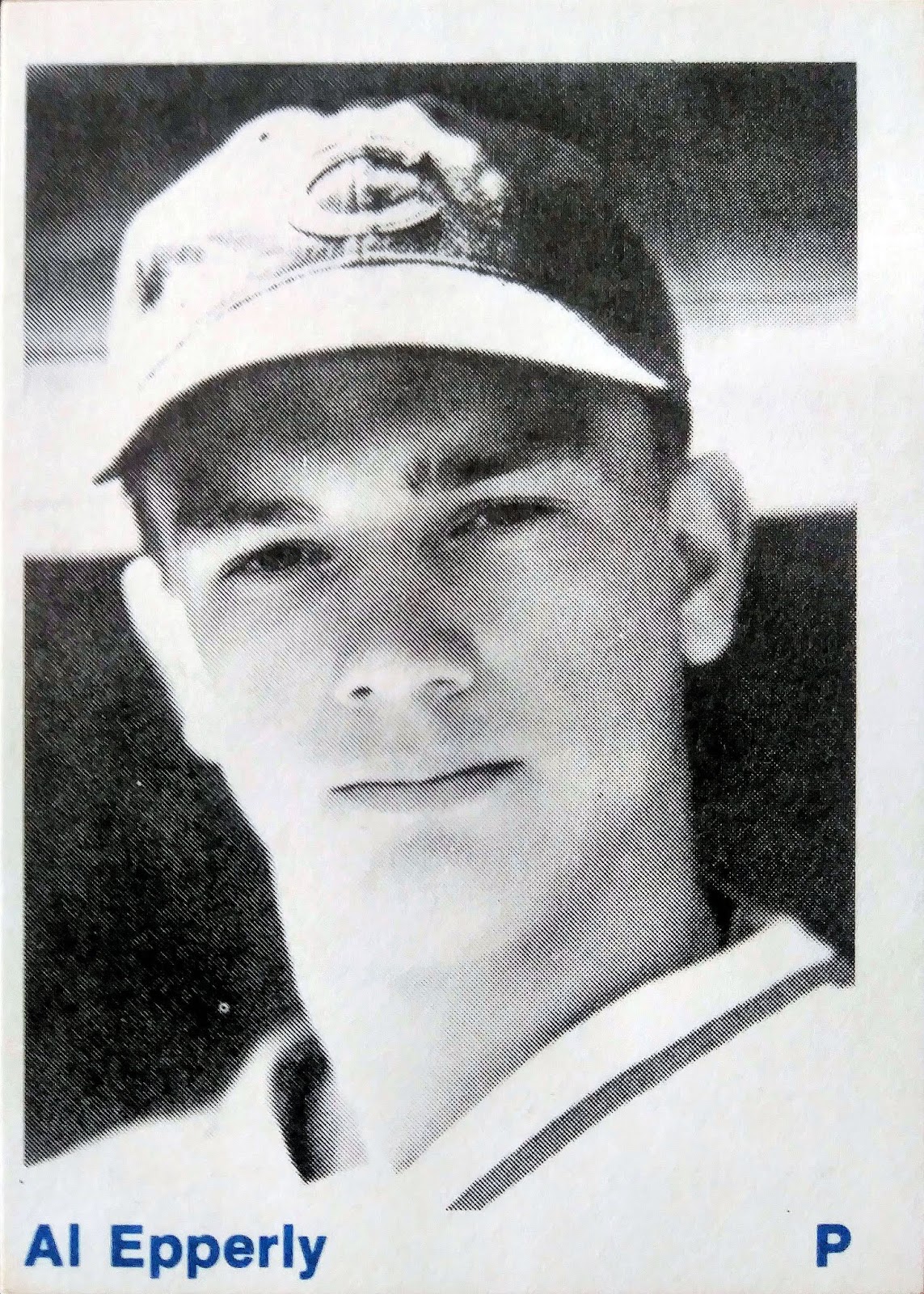
Meanwhile, Epperly breaks our chain of threes as his Cubs career expanded no further than 1938.  In fact, he would not appear again in a Major League game until another brief cameo with Brooklyn in 1950.  As such, this TCMA oddball is one of a scant few official issues available for the coffee sipper.  Unofficially, Al had already been nestled in my UltraPro pages with a super vintage custom card that an intrepid youngster had whipped up back in the day - however, as cool as that antique is, I prefer my cards to be truly authentic, when possible.  Plus, the lad had confused Epperly with fellow Cubs hurler, Paul Derringer.  Of course, a couple of those unique pieces still reside in other pockets of my collection.

These were all of the TCMA 1938's to show up under my Christmas tree; that said, they weren't the only Cubs from that historic season to appear in that particular stack:


The Conlon Collection continues to be an invaluable source for my extremely niche collection.  TCMA and other oddball brands have contributed mightily to my collecting cause - however, the flow of Conlons into my binder has been a steady stream since the day I began my endeavor.  Every time I think I've acquired all I need from the four-year running brand of the early 90's, I find another unexpected need hiding within it's checklist.  This time, it was Joe Marty who was hiding in plain sight.

Marty was yet another three-year member of the Cubs during the late 30's, with his stint lasting from 1937-39 as an extra outfielder.  Notably, Joe was the first Cubs player to homer in a night game, which he did on July 1, 1938 while playing in Cincinnati. Also, he drove in 5 runs in a single game during that 1938 World Series (they, of course, still lost).  Furthermore, Marty had been minor league teammates with a rather notable member of his World Series opponent: he and Joe DiMaggio had played together with 1934-35 San Francisco Seals of the old Pacific Coast League.  Post-Cubs, Marty had another three-year stint, this time with the Phillies.

On that note, this Marty marked another "Cubgrade" addition, as I had previously acquired a modern reprint of his 1941 Play Ball issue in Philadelphia garb.  Easy call there!

With that, I was able to add two entirely new names from the 1938 squad to my Cubs All-Time Roster Collection, as well as three "Cubgrades" to go along with them.  That's not a bad haul and  it served as a great opportunity to remind myself of how awesome that '38 team was down the stretch, even if they were ultimately swept out of the World Series by the Yankee juggernauts.

Of course, the teams of 2016, 1908, 1984, and 1945 will forever be remembered better or far more widely discussed, we Cub fans should never forget about the "Homer in the Gloamin'" and the Cubs' furious late-summer charge to usurp the Pirates back in 1938.

It was a magical year for Chicago baseball and a significant one for the country as a whole.